A Japanese car can look affordable until its manufacture year changes the eligibility question, valuation and final landed cost. If you’re researching car import to Uganda in 2026, check the manufacture date and total landed cost before the auction price. A 2014 city hatchback and a 2019 hybrid should not be judged by the purchase price alone.
This guide applies Uganda’s 2026 import rules to four real Japanese-market examples: the Toyota Aqua, Toyota Sienta, Suzuki Ignis and Toyota Vitz. It focuses on buyer fit, condition evidence and age margin, rather than pretending that one generic clearing figure fits every vehicle.
Policy checked on 25 August 2026: current official guidance continues to use the 15-year manufacture-date framework. The proposed 13-year amendment was withdrawn on 21 April 2026. Check the current position and levy treatment with URA before payment or shipment.
Quick Answer
- Uganda’s first eligibility check is the vehicle’s date of manufacture, not simply its registration year.
- For ordinary passenger vehicles, current guidance says importation is prohibited at 15 years or more from manufacture; statutory exceptions apply to certain commercial, agricultural, special-purpose and heavy vehicles (URA, Ask the Commissioner General 27, 2026).
- For most Kampala commuters, the 2019 Aqua is the simplest fit; families should start with the seven-seat Sienta.
- A 2019 Toyota Aqua or 2018 Toyota Sienta gives more age margin than a 2014 Toyota Vitz.
- Compare the vehicle-specific landed estimate before choosing by purchase price.
Uganda’s 15-year import rule in 2026
For ordinary passenger vehicles, Uganda prohibits importation when the vehicle is 15 years old or more from its manufacture date. Separate statutory exceptions apply to certain commercial, agricultural, special-purpose and heavy vehicles. The 2018 amendment uses manufacture date, while July 2026 URA guidance repeats the passenger-vehicle position (Traffic and Road Safety Act amendment, 2018; URA, Ask the Commissioner General 27, 2026).
That means the year of first registration is not enough. Check the manufacture date shown on the auction sheet, Japanese export certificate, invoice and customs paperwork. A vehicle registered later than its manufacture date can appear newer than it is.
The withdrawn 2026 bill caused understandable confusion. Parliament’s official tracker records that the proposal sought a 13-year limit. It was withdrawn on 21 April 2026 and did not become law (Parliament Bill Tracker, Traffic and Road Safety Amendment Bill 2026, 2026).
A 2019 vehicle therefore offers much more planning margin than a 2014 example. The exact manufacture month still matters near the boundary, so treat this timeline as a screening guide, not a legal calculator.
Read the Uganda vehicle import rules for the current eligibility, inspection and customs requirements before arranging shipment.
| Manufacture year |
Position in a 2026 decision |
Buyer interpretation |
| 2019 |
Newer age margin |
Lower age-related uncertainty |
| 2018 |
Newer to mid-age |
Check the exact date and estimate |
| 2016 |
Mid-age |
Check valuation and levy treatment carefully |
| 2014 |
Older but potentially eligible |
Allow for higher timing and cost exposure |
| Near the boundary |
Exact date becomes decisive |
Obtain confirmation before shipment |
How does the environmental levy affect vehicle choice?
In 2026, URA’s used-vehicle guidance links environmental-levy treatment to vehicle age and class, while customs value includes cost, insurance and freight for sea, road and rail imports (URA, Import & Export FAQs, 2026). URA’s used-vehicle database is a valuation reference, but published values are indicative and do not replace the formal customs-valuation rules or the price paid or payable where applicable.
A passenger hatchback and a seven-seat hybrid people-mover can therefore produce different cost outcomes. Body style alone does not establish the customs class. For the linked 2018 Sienta estimate, ask URA whether it is classified as a passenger vehicle or another category before relying on the environmental-levy line.
The relevant details include classification, age, customs value and current official treatment. Those details matter more than assuming that every hybrid or every seven-seat vehicle follows the same calculation.
URA says its Used Motor Vehicle Valuation Database supports used-vehicle valuation. Its current Motor Vehicle Value Guide is marked “As at 01st August 2026” (URA, Motor Vehicle Value Guide, 2026).
The practical lesson is simple: a newer, smaller car may be easier to budget than an older car with a lower purchase price. Check the URA Import & Export FAQs and the individual vehicle page’s Estimated landed cost panel before paying.
| Age position in 2026 |
Buyer implication |
| Newer example |
More eligibility margin and less age-related uncertainty |
| Mid-age example |
Check official valuation and levy treatment |
| Near the age boundary |
Higher timing and documentation risk |
| Beyond the boundary |
Not suitable for ordinary passenger-import planning |
Which listed Japanese cars are sensible choices for 2026?
As at 25 August 2026, these four Japanese-market examples show why buyers should compare age, body style, condition evidence and use case together. The clearest fit is the Aqua for Kampala commuting, the Sienta for family seating, the Ignis for compact urban driving and the Vitz for a lower-budget city role.
| Vehicle example |
Year |
Fuel |
Engine |
Seats |
Odometer |
Grade |
Best suited to |
| Toyota Aqua |
2019 |
Hybrid |
1,496cc |
5 |
77,000 km |
4 |
Kampala commuter |
| Toyota Sienta |
2018 |
Hybrid |
1,496cc |
7 |
116,000 km |
3.5 |
Growing family |
| Suzuki Ignis |
2016 |
Hybrid |
1,242cc |
5 |
51,754 km |
3.5 |
Compact urban buyer |
| Toyota Vitz |
2014 |
Petrol |
1,329cc |
5 |
26,000 km |
3.5 |
Budget city buyer |
A grade 3.5 or 4 is an auction inspection assessment, not a guarantee of mechanical condition. Read the official auction sheet alongside the second inspection report, then review underbody comments, repairs, tyres, odometer and hybrid-system evidence.
The stock information below is a dated snapshot. Refresh the vehicle data before publication or payment, because model codes, condition notes and listed vehicles can change.
Toyota Aqua, a strong fit for Kampala commuting
Toyota Aqua vehicles make sense for a buyer who spends much of the week in Kampala traffic. The 2019 Toyota Aqua Hybrid example records 77,000 km and auction grade 4 on its vehicle page, 2026. Its compact hatchback body should also be easier to park than a larger family vehicle.
The listing records a 1,496cc hybrid engine, NHP10 model code, CVT, front-wheel drive and five seats. The inspection describes a clean underbody, good tyres and no reported interior damage.
That hatchback layout is useful in traffic and tight parking areas, but it limits luggage space compared with the Sienta. It’s less suitable if you regularly carry bulky loads, need seven seats, want a higher-riding body or travel on rough roads. Review the hybrid-system evidence before committing.
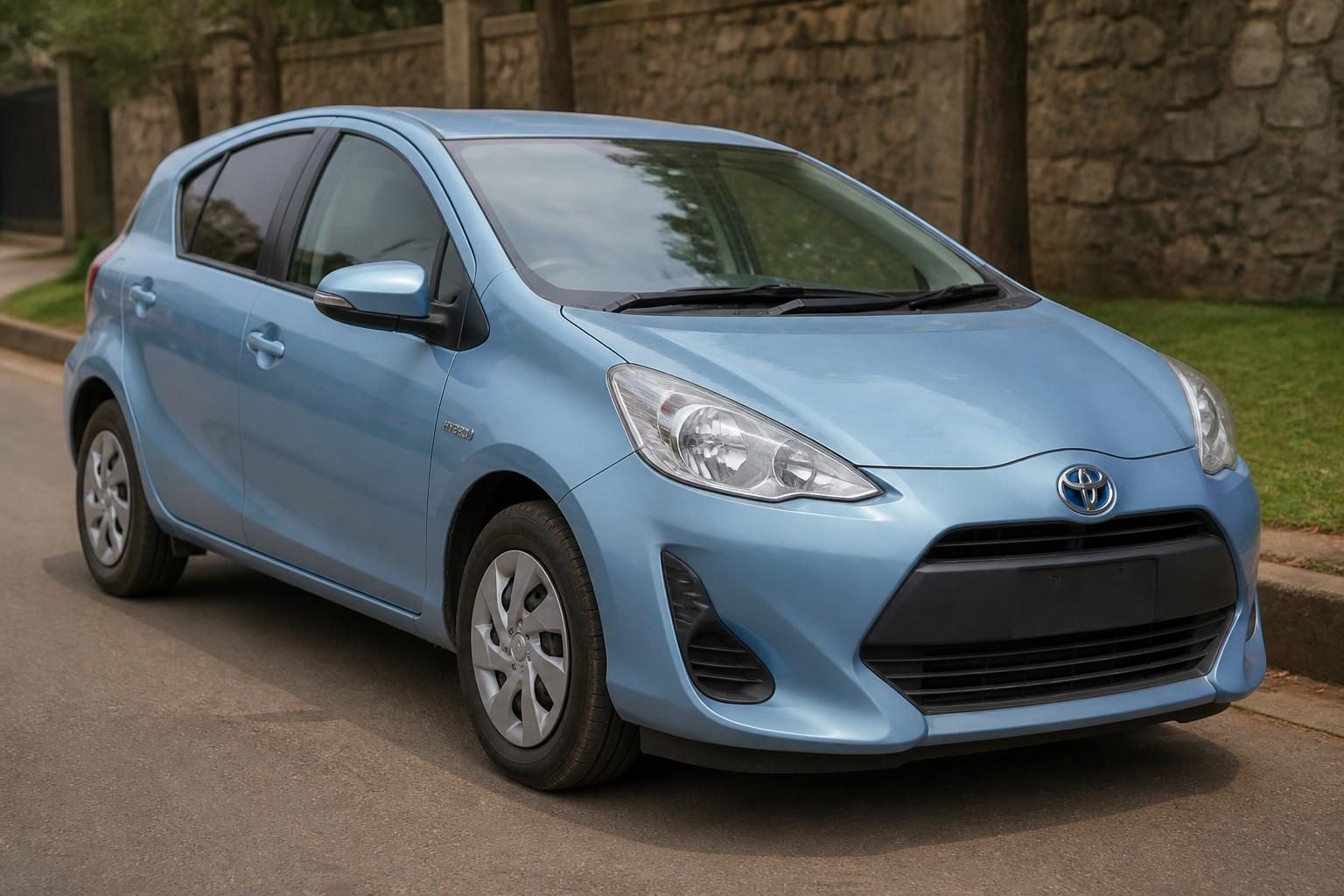 2019 Toyota Aqua
Toyota Sienta, the practical family option
Toyota Sienta family cars suit buyers who need seven seats without moving into a large SUV. The 2018 Toyota Sienta Hybrid example records 116,000 km and auction grade 3.5, 2026. Its newer manufacture year also gives more age margin than the 2014 Vitz.
This example uses the NHP170G model code, a 1,496cc hybrid engine, electric CVT, front-wheel drive and seven seats. The inspection records a clean underbody and good tyres, with minor marks on the front bumper and near a door handle.
Seven seats improve family flexibility, but they don’t mean full luggage space when every seat is occupied. Confirm the exact seating layout, customs classification and valuation before payment. The linked Sienta estimate shows an environmental-levy line, but this article does not treat that amount as confirmed. Ask URA to confirm whether the vehicle is classified as a passenger vehicle or another category.
 2018 Toyota Sienta
Suzuki Ignis, a compact alternative
Suzuki Ignis compact cars are worth considering when a small footprint matters more than maximum cabin space. The 2016 Suzuki Ignis Hybrid example records 51,754 km and auction grade 3.5, 2026. It sits between the newer Aqua and older Vitz in this age comparison.
The recorded specification is a 1,242cc hybrid engine, FF21S model code, CVT, front-wheel drive and five seats. The vehicle page records its body type as SUV, although its compact shape remains closer to a small urban hatchback in practical use.
Its small dimensions should help in crowded urban streets and restricted parking spaces. The trade-off is less rear-seat and cargo room than the Sienta. The inspection notes a clean underbody, 8mm tyre tread and light rear-panel paint wear. Confirm the exact variant before relying on equipment or economy claims.
Toyota Vitz, affordable but closer to the age boundary
Toyota Vitz city cars remain a practical option for a first-time buyer who mainly drives in town. The 2014 Toyota Vitz Petrol example records 26,000 km and auction grade 3.5, 2026. Its low recorded kilometres are useful, but they do not remove the age and eligibility checks.
This Vitz uses the NSP130 model code, a 1,329cc petrol engine, CVT, front-wheel drive and five seats. The inspection records a clean underbody, with minor front-bumper and roof marks.
A low odometer reading cannot offset the Vitz’s older position under the 15-year rule. It may suit a lower UGX budget bracket, but the complete vehicle-specific estimate matters more than the auction price. Check the manufacture date, valuation, reports and registration costs together.
For another hybrid comparison, see Toyota Prius hybrid options. Buyers wanting a petrol hatchback can also compare Nissan Note hatchbacks.
As an inference, the cheapest auction purchase is not always the cheapest import. A newer compact hybrid could make better financial sense than an older petrol car once age exposure, valuation, fuel use and future maintenance are considered. Compare the vehicle-specific figures and your own assumptions rather than treating this as a guaranteed outcome.
Car clearing costs in Uganda
In 2026, URA defines customs valuation as the process of determining an imported good’s value for taxation. Its guidance says marine imports include cost, insurance and freight to the place of importation (URA, Import & Export FAQs, 2026). Clearing costs therefore extend beyond an agent’s service fee.
Plan for these layers:
- Vehicle purchase price.
- Shipping and insurance to Mombasa or Dar es Salaam.
- Customs valuation and government charges.
- Environmental-levy treatment where applicable.
- Authorised clearing-agent work.
- Port and bonded-warehouse charges.
- Road transport from the port to Uganda.
- Inspection, registration and number plates.
URA may use its official used-vehicle database as a valuation reference. Its published values are indicative and do not automatically replace the formal customs-valuation rules or the price paid or payable.
Customs declarations are normally handled through a duly licensed clearing agent. The Uganda Trade Portal motor vehicle procedure is a starting point for the formal process.
Ask URA or your licensed clearing agent to confirm the required documents for an individual house bill. These may include the importer’s TIN, commercial invoice, house bill of lading and packing list. Ask for a dated, itemised estimate instead of relying on a generic clearing figure.
 Importer reviews paperwork and calculator beside a model vehicle.
How should you choose a car before paying?
In 2026, the safest buying sequence is eligibility first, condition second and landed cost third. Four stock examples show the difference clearly: the Aqua and Sienta are newer, the Ignis is mid-age, and the Vitz has less policy margin (Toyota Aqua vehicle page, Toyota Vitz vehicle page, 2026).
Use this checklist:
- Check the manufacture date, not only the registration year.
- Check the current 15-year rule before shipment.
- Review the exact model code, variant, fuel type and engine size.
- Read the official auction sheet and second inspection report.
- Check auction grade, odometer, repairs, tyres and underbody comments.
- Review hybrid-system evidence for hybrid vehicles.
- Compare at least two cars in the same UGX million bracket.
- Use the vehicle-specific Estimated landed cost panel.
- Leave room for customs charges, clearance and registration.
A Kampala commuter will probably prefer the Aqua. A growing family should compare the Sienta. The Ignis suits a buyer prioritising compact dimensions. The Vitz can work for a budget buyer, but only when the complete estimate still makes sense.
What support can you expect with a Japanese import?
A managed import should provide vehicle evidence before payment, a clear proforma invoice and documents that follow the car from Japan to East Africa. The total journey can take about 6 to 10 weeks from purchase confirmation to delivery in Uganda, including clearance and handover.
The route is Japan to Mombasa or Dar es Salaam, followed by road transport to Uganda. The buyer remains responsible for customs taxes, port clearance, inland transport and registration unless the final invoice states otherwise.
An auction sheet can show a well-presented older Japanese vehicle, but it is evidence from one inspection rather than a guarantee of condition. Age still changes the eligibility margin, valuation risk and time available to correct a documentation problem before shipment.
In this four-car snapshot, manufacture years span 2014 to 2019, while auction grades range from 3.5 to 4. That spread shows why mileage alone cannot decide the purchase.
Read how the buying process works for the vehicle selection, payment, inspection and shipping steps. Check the shipping schedule for sailing information covering Mombasa and Dar es Salaam.
The final service option is Carbarn Uganda. It owns its listed Japanese vehicles and provides the official auction sheet and an in-house inspection report before payment. Vehicle-specific inspection and certification details are provided for the relevant vehicle and shipment.
The service includes a dashboard with invoices, inspection reports, bill of lading and shipment tracking. Where stated, the quoted all-inclusive price covers the vehicle, shipping and inspection. Customs taxes, port clearance, inland transport and registration remain separate.
Browse the Japanese vehicle listings and check the Uganda import rules before paying.


