Fuel costs can make a small daily car look attractive, but the vehicle price is only the beginning. Customs valuation, clearance, registration and a tired hybrid battery can change the calculation quickly.
This guide explains the Honda Fit Hybrid in Uganda without relying on one generic kilometre-per-litre claim. You’ll learn how to budget in UGX, read official Honda fuel figures, check a used hybrid before payment and decide whether a compact hatchback suits your roads.
Information checked: 23 June 2026. Stock, shipping schedules, import rules and official charges can change. Confirm the latest vehicle-page estimate before paying.
Quick Answer
- The Honda Fit Hybrid suits urban buyers who want a compact five-seat hatchback and efficient stop-start driving.
- Honda’s 2017–2020 archive lists 37.2 km/L JC08 for the base HYBRID FF, while figures vary by trim; that isn’t a Kampala promise.
- URA’s current guidance prohibits vehicles above 15 years old from the year of manufacture. Check the rule again before shipping.
- The listed vehicle price is separate from customs, clearance and registration.
- A clean auction grade does not prove hybrid battery health.
Honda Fit import process and documentation guide
Is the Honda Fit Hybrid suitable for Uganda?
The Honda Fit Hybrid is a strong urban choice because it combines five seats, a compact body and hybrid assistance. The 2018 vehicle page lists a five-door hatchback with five seats, front-wheel drive and a 1,500 cc engine (2018 Honda Fit vehicle page, 2026). It suits Kampala commuting better than rough-road work.
Its small footprint helps in traffic and tight parking areas. The hatchback body also gives easier access than many small saloons, while the folding rear seat adds useful flexibility for shopping and family errands.
The compromise is ground clearance. If your daily route includes deep potholes, rough estate roads or regular upcountry access tracks, a larger vehicle may make more sense. The Fit also isn’t suitable for seven passengers or bulky business cargo.
A current 23 June 2026 model guide gives the Fit a 5/5 fuel-efficiency score but only 1/5 for rough-road suitability (Honda Fit inventory page, 2026). Those are market guidance indicators, not independent testing, but they capture the main trade-off clearly.
The Honda Fit is therefore a compact urban hatchback, not a general-purpose family or rural vehicle. Its five seats and small turning footprint work well for Kampala traffic, parking and routine errands. The main limits are clearance, cargo space and the need to check the hybrid system carefully. If you regularly carry seven people or use rough roads, choose a larger vehicle instead.
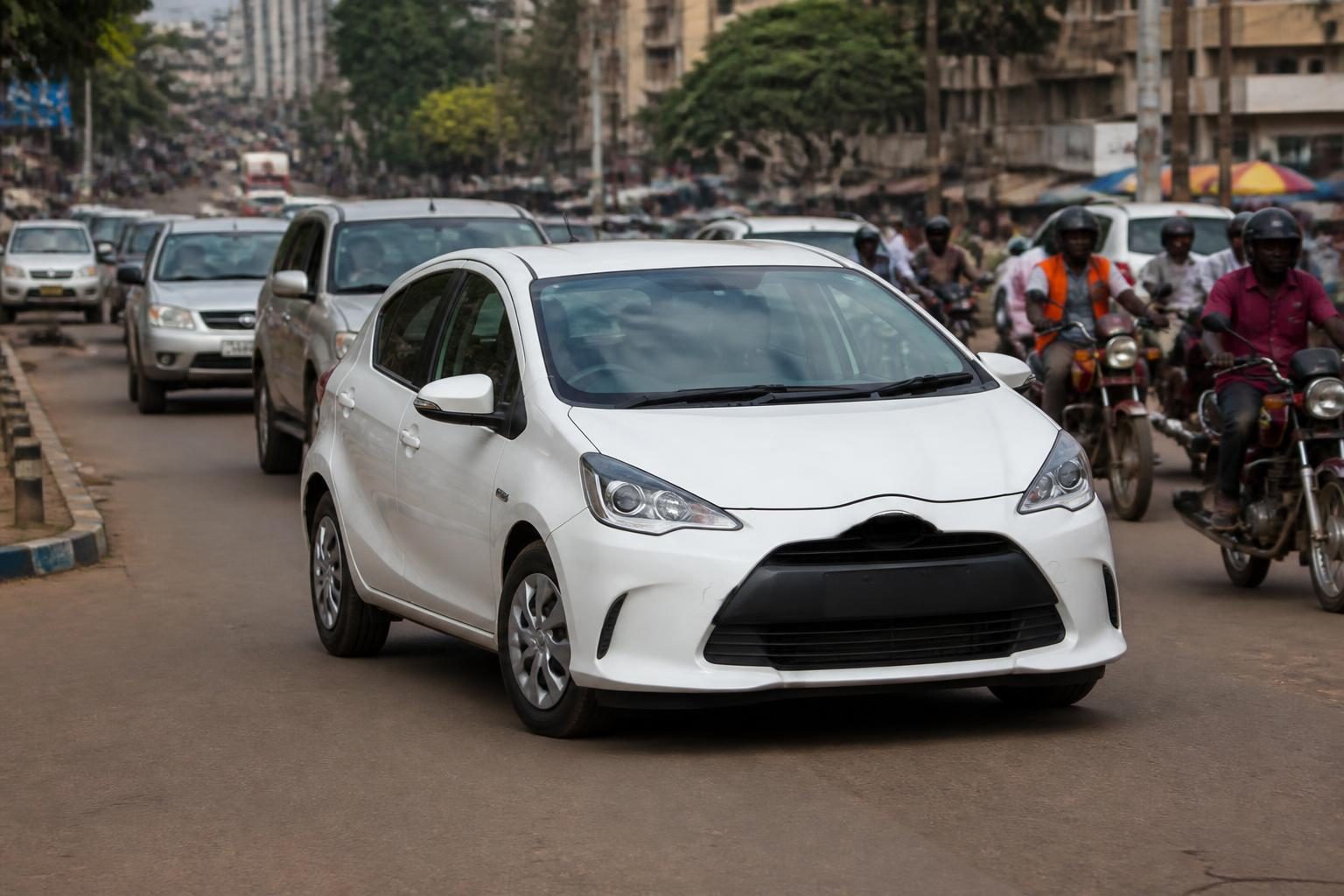 A white compact hatchback moves through busy traffic alongside motorcycle riders.
| Buyer need |
Honda Fit Hybrid position |
| Kampala commuting |
Strong fit |
| Easy parking |
Strong fit |
| Small family use |
Practical |
| Frequent rough-road driving |
Limited fit |
| Seven passengers |
Not suitable |
| Heavy cargo |
Consider a larger vehicle |
For dimensions, equipment and variant differences, compare the Honda Fit specifications before choosing a model code.
How much does it cost to import a Honda Fit Hybrid in Uganda?
A Honda Fit Hybrid should be budgeted in layers, not as one advertised figure. In a 23 June 2026 snapshot, hybrid Fit vehicle prices ranged roughly across the under-20M to 40M-plus vehicle-price brackets, depending on year, mileage, grade and variant (Honda Fit inventory page, 2026). Those are vehicle-price brackets, not final on-road costs.
The selected 2018 GP5 was shown in the UGX 20–30 million vehicle-price range at that snapshot. Its 109,000-kilometre odometer and grade 3.5 also show why buyers must compare condition, age and price together.
Your wider budget can include:
| Cost layer |
What it means |
| Vehicle |
The Japan-sourced Honda Fit itself |
| Shipping |
Transport to Mombasa or Dar es Salaam |
| Inspection |
Pre-shipment inspection and certification |
| Customs charges |
Assessed under Uganda’s customs rules |
| Port clearance |
Charges after arrival at the entry port |
| Inland transport |
Movement from the port to Uganda |
| Registration |
Local registration and related costs |
Landed cost is the estimated total after the vehicle, shipping and applicable import-related charges are considered. The listed price covers the vehicle, shipping and EAA pre-shipment certification. It does not include import duty, VAT, port clearance or registration. Read the estimated landed cost example, then check the estimate on the exact vehicle you’re considering.
That vehicle-specific total remains an estimate, not the final amount payable in Uganda. Confirm whether port clearance, inland transport and other local charges are included. In 2026, the Uganda Revenue Authority’s Import & Export FAQs explain that customs value can include the cost, insurance and freight up to the place of importation (URA Import & Export FAQs, 2026). The seller’s invoice therefore isn’t automatically the final customs value.
A vehicle price in the under-20M to 40M-plus brackets does not describe the full amount needed to put the car on the road. Shipping and EAA certification are included in the listed price, but import duty, VAT, port clearance and registration remain separate. Customs may assess value using cost, insurance and freight to the place of importation, so the vehicle page’s estimate is the practical starting point for budgeting.
The cheaper older Fit may look attractive, but it can leave less room for clearance, registration and unexpected work. A slightly newer car can be the safer budget decision if it gives you more eligibility margin.
What does the 2018 Honda Fit Hybrid GP5 offer?
The 2018 Honda Fit Hybrid GP5 is a five-door, five-seat hatchback with a 1.5-litre hybrid system and front-wheel drive. Its vehicle page records 109,000 km and auction grade 3.5 (2018 Honda Fit vehicle page, 2026). It is a useful reference for an urban Ugandan buyer.
The GP5 uses Honda’s SPORT HYBRID i-DCD system. Honda’s archived Fit catalogue lists a 1.5-litre Atkinson-cycle engine, lithium-ion battery and seven-speed dual-clutch transmission for this generation (Honda Fit fuel and performance archive, 2017).
Honda’s archive lists 110 PS for the engine, 29.5 PS for the motor and 137 PS as the system’s maximum output. These figures describe the Japanese-market system, not a promise about performance from every used example.
For ownership, the important details are practical:
- Five seats suit a commuter or small household.
- Front-wheel drive favours paved urban use.
- A 1,500 cc hybrid system can reduce fuel demand in stop-start traffic.
- At 109,000 km, maintenance history matters as much as the auction grade.
- Grade 3.5 describes overall auction condition, not battery condition.
- The 2018 manufacture year offers more age margin than an older example, subject to the rule in force.
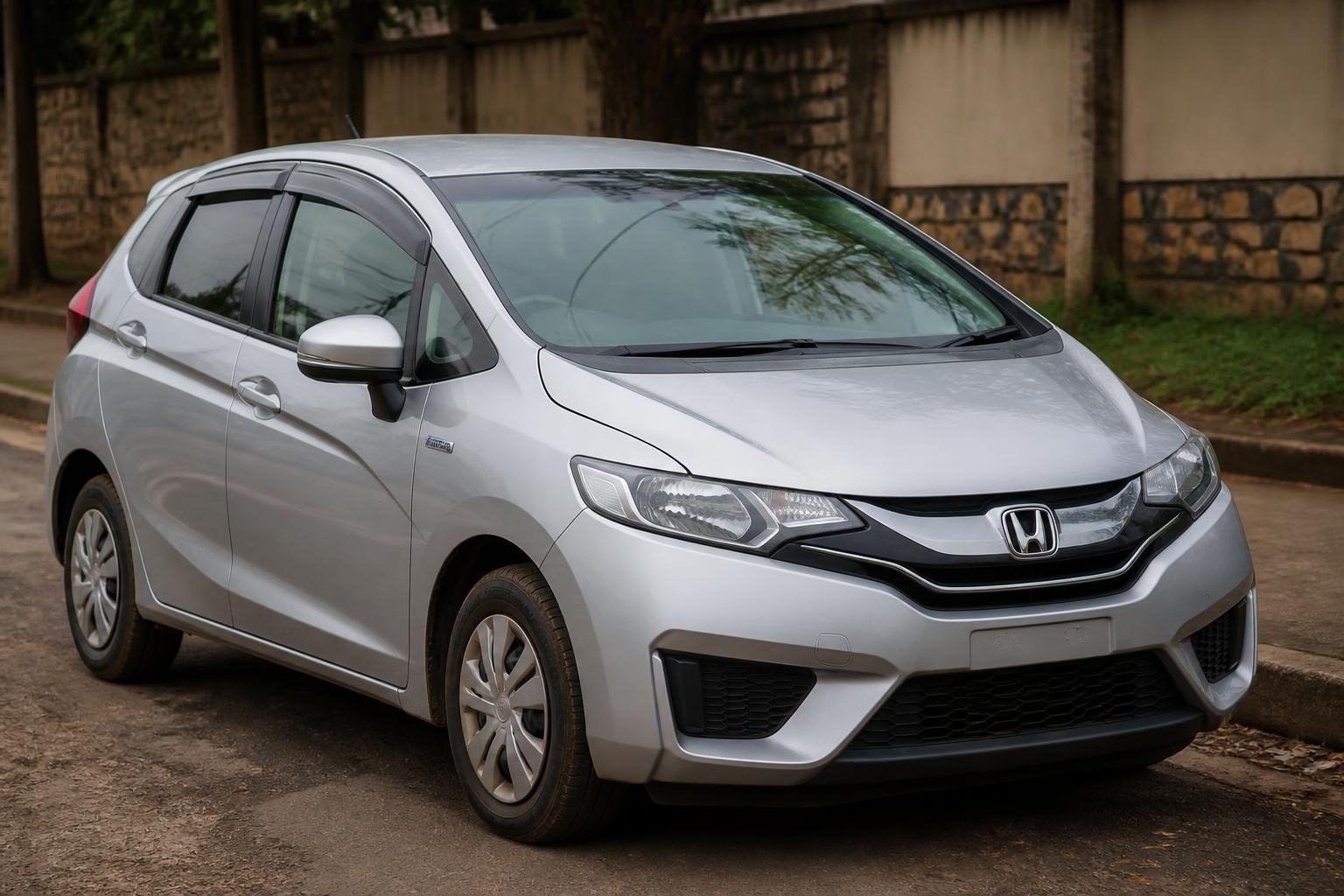 2018 Honda Fit
An auction grade is a Japanese auction condition rating, not a battery-health assessment. Before payment, treat the grade, odometer, hybrid-system evidence, transmission behaviour and inspection comments as separate checks.
What fuel economy and battery checks matter?
Honda Fit Hybrid fuel economy depends on generation, drivetrain, grade and test cycle. Honda’s 2013–2017 archive reports 36.4 km/L JC08 for the base HYBRID FF and 29.0 km/L JC08 for the base HYBRID 4WD (Honda Fit fuel and performance archive, 2017). Those figures do not apply to every Fit Hybrid trim.
The model years and codes in this guide refer to different generations or configurations. The 2013–2017 and 2017–2020 models are earlier Fit Hybrid generations, while GR3 and GR4 identify later e:HEV configurations. Current e:HEV figures should not be treated as the fuel result for a 2018 GP5.
| Fit version |
Test cycle |
Official figure |
| 2013–2017 base Fit HYBRID FF |
JC08 |
36.4 km/L |
| 2013–2017 base Fit HYBRID 4WD |
JC08 |
29.0 km/L |
| 2017–2020 base Fit HYBRID FF |
JC08 |
37.2 km/L |
| 2017–2020 base Fit HYBRID 4WD |
JC08 |
29.4 km/L |
| Current Fit e:HEV BASIC FF |
WLTC |
30.2 km/L |
| Current Fit e:HEV BASIC 4WD |
WLTC |
25.4 km/L |
| Current Fit e:HEV HOME FF |
WLTC |
29.0 km/L |
| Current Fit e:HEV HOME 4WD |
WLTC |
25.3 km/L |
Honda’s current specification sheet reports 30.2 km/L WLTC for the current e:HEV BASIC front-wheel-drive version (Honda Fit official specification sheet, 2026). JC08 and WLTC are different test cycles, so don’t combine them into a single “average”.
JC08 is an older Japanese test method. WLTC is a later global test cycle. Both help compare similar variants, but neither guarantees your result in Kampala.
Stop-start traffic can suit a hybrid because the system can assist at low speeds and reduce idling. Fuel economy can still fall with air-conditioning, low tyre pressure, heavy loads, hills, aggressive acceleration or poor battery condition.
Official fuel figures are comparison tools, not Kampala forecasts. The 2017–2020 base HYBRID FF is listed at 37.2 km/L on the JC08 cycle, while the current e:HEV BASIC FF is listed at 30.2 km/L under WLTC. JC08 and WLTC are different Japanese test cycles, so those figures should not be averaged. Traffic, air-conditioning, tyre pressure, hills, load and battery condition can all reduce actual fuel economy.
Before paying, check:
- Hybrid warning lights and diagnostic comments.
- Battery cooling intake and fan condition.
- Transmission engagement and low-speed hesitation.
- Odometer consistency across documents.
- Accident, flood, corrosion and underbody comments.
- Tyres, suspension and air-conditioning.
- Chassis number across the listing, auction sheet and export documents.
- Whether the vehicle is GP5, GP6, GR3, GR4 or another configuration.
The Honda Fit specification database lists later GR-series e:HEV variants separately. Don’t assume every Honda Fit Hybrid uses the same drivetrain or battery system.
How does the Japan-to-Uganda process work?
The route takes about 6 to 10 weeks from purchase to delivery in Uganda. Vehicles are shipped from Japan to Mombasa or Dar es Salaam, then transported by road to Uganda. Clearance, inland transport and handover affect the final timing, so use this as an estimate rather than a promise.
The usual sequence is:
- Choose the exact Fit variant and confirm its eligibility.
- Review the Japanese auction sheet and in-house inspection report.
- Confirm Mombasa or Dar es Salaam as the destination port.
- Pay against the official proforma invoice.
- Complete the applicable pre-shipment checks, including EAA certification. EAA certification is the pre-shipment certification required for the relevant shipment process. If a separate JEVIC inspection is offered, confirm that it is the current UNBS-approved PVoC inspection for the shipment and that it produces the required CRW.
- Ship the vehicle by RoRo.
- Track documents and vessel movement.
- Arrange customs, port clearance, inland transport and registration.
The shipping schedule shows weekly sailings from Japanese ports and tracking information for customers. Uganda is landlocked, so arrival at Mombasa is followed by road transport into the country.
| It suits you if… |
Consider another vehicle if… |
| You mainly drive in Kampala or another busy town |
You regularly use rough roads |
| You want a compact five-seat hatchback |
You need seven seats |
| Fuel use is a major priority |
You carry bulky cargo |
| You will check the hybrid system carefully |
You want the simplest petrol drivetrain |
| You can budget for customs separately |
Your budget only covers the vehicle price |
The Uganda import rules and regulations page states that vehicles above 15 years old from manufacture are prohibited. URA also warned in 2023 that altering manufacture-year documents to bypass the limit can lead to vehicles being impounded (URA notice on altered manufacture years, 2023).
For this Honda Fit, confirm the genuine manufacture year before payment and check the latest inspection and clearance requirements published by the Uganda National Bureau of Standards (UNBS, 2026). Ask which certificates apply to your shipment before it leaves Japan.
What does the Carbarn import service cover?
The service provides the Japanese auction sheet and in-house inspection report before payment, then arranges the applicable EAA pre-shipment certification. If a separate JEVIC inspection is offered, confirm that it is the current UNBS-approved PVoC inspection for the shipment and that it produces the required Certificate of Road Worthiness.
Vehicles are shipped by RoRo to Mombasa or Dar es Salaam, followed by road transport to Uganda. Customers pay in full against the official proforma invoice. Customs duty, VAT, port clearance and registration remain the customer’s responsibility. Review the Honda Fit options, the how-to-buy process and the vehicle page’s estimated landed-cost panel before making a decision.


