A 2WD van may handle Kampala traffic and paved highways without trouble. The question changes when your route includes wet murram, steep rural access roads or muddy work sites.
That is why buyers consider a Toyota Hiace 4WD. It offers van-sized passenger or cargo space, familiar Toyota mechanicals and extra traction. But four driven wheels do not automatically provide Prado-level clearance or serious safari ability. This guide explains the difference, plus the checks that matter before importing a used Hiace.
Quick Answer
- A Toyota Hiace 4WD suits passenger, cargo and field work on slippery murram roads.
- Toyota describes applicable Japanese variants as full-time 4WD with a 50:50 front-to-rear torque split (Toyota Japan, “Hiace 4WD: Type and Torque Distribution”, 2026).
- Toyota’s cited specification documents full-time 4WD, but does not document low-range gearing for every Hiace variant.
- Vehicles generally cannot be imported for registration at 15 years or older from manufacture, subject to classification and current customs rules.
- Always verify the exact drivetrain, auction sheet, inspection report and estimated landed cost.
Is Toyota Hiace 4WD good for Ugandan roads?
The Toyota Hiace model range includes Japanese-market variants with different body styles and drivetrains. In 2026, Toyota’s Japanese Hiace feature page says applicable 4WD versions use a full-time system with a centre differential and viscous coupling (Toyota Japan, “Hiace Van Features”, 2026). Full-time 4WD is a drivetrain that powers all four wheels during normal driving. It makes a Hiace useful on low-grip Ugandan roads, but it does not turn a long van into a low-range off-road specialist.
Murram is a gravelly or lateritic road surface that can become slippery when wet. The extra traction matters most on wet murram, loose gravel and slippery hills. It can also help when a loaded van reaches a muddy access road, construction site or rural compound. Uganda drives on the left, and Japanese stock is right-hand drive, which suits the normal driving position here.
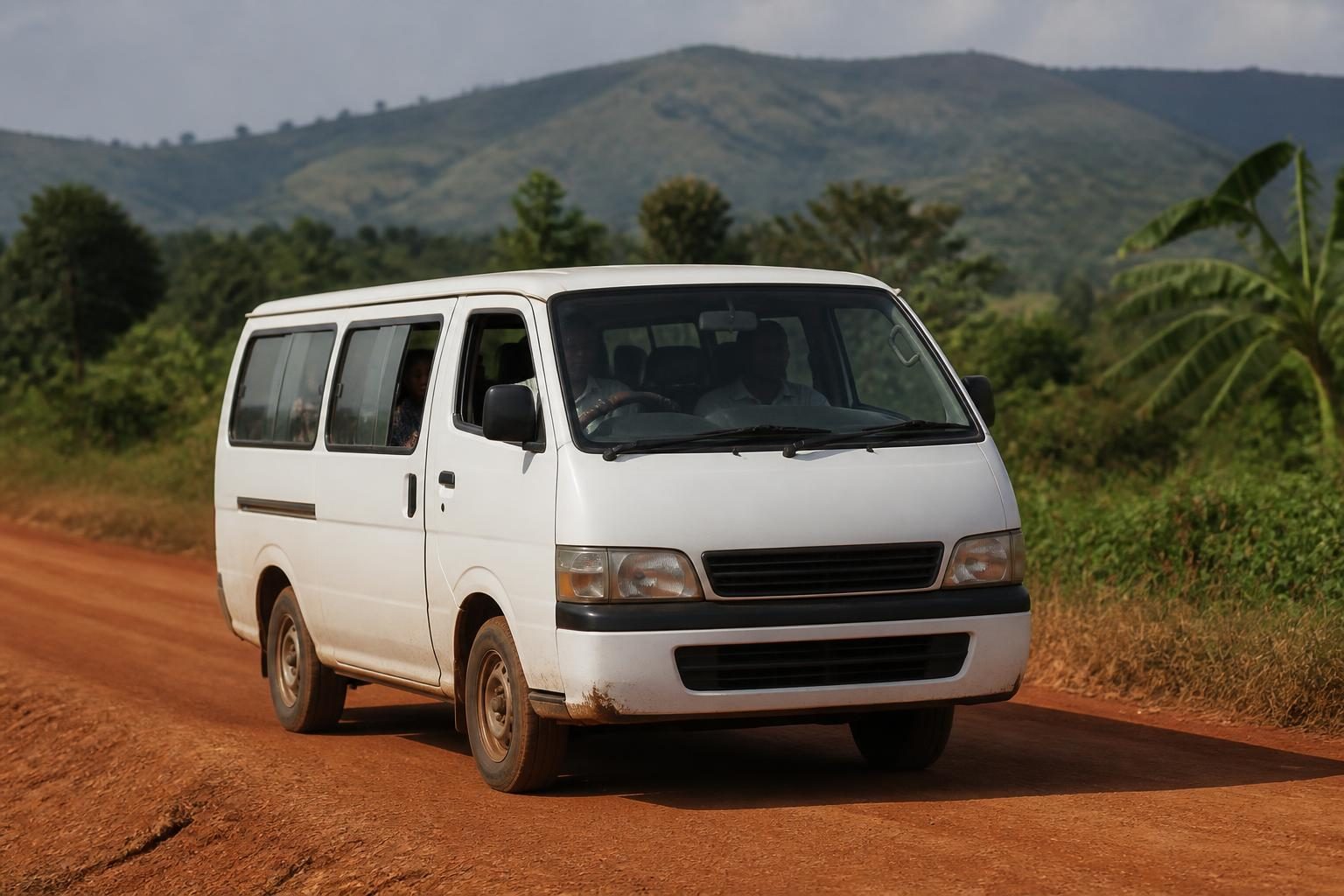 A white van travels along a red dirt road in a hilly rural landscape.
The important distinction is traction versus clearance. Four driven wheels can help the tyres keep moving, but they cannot prevent the floor or suspension from hitting a deep rut. In practical terms, a long-bodied van may be harder to place over sharp crests. A tall, loaded body also needs careful handling on uneven slopes. Check the exact vehicle’s dimensions and underbody condition rather than assuming every Hiace has the same clearance.
A factory Japanese Hiace 4WD should not be confused with an aftermarket conversion. Claims about lift kits, snorkels, low-range gearing or locking differentials may apply to a modified vehicle, not a standard Hiace. In my view, a Prado or Land Cruiser is a more suitable tool for deep mud, rocks, river crossings or difficult safari tracks. That judgement is based on the type of vehicle, its clearance, tyres and whether the specific version has low-range gearing. It is not a comparative test result.
Toyota Hiace 4WD versus 2WD: which suits your routes?
Toyota’s Hiace drivetrain choice comes down to route conditions rather than the badge. In 2026, Toyota’s Hiace FAQ states that the factory system sends torque 50:50 to the front and rear axles (Toyota Japan, “Hiace 4WD: Type and Torque Distribution”, 2026). The practical difference is extra traction, not a promise of better fuel economy, greater clearance or stronger performance on every road. Toyota’s cited specification does not document low-range gearing, so check the exact drivetrain record before treating the van as an off-road vehicle.
| Use case |
Hiace 4WD |
Hiace 2WD |
| Kampala traffic |
Capable, but extra traction may not be needed |
Usually adequate |
| Wet murram |
Better traction margin |
More likely to spin |
| Regular upcountry travel |
Stronger fit for slippery routes |
Fine when roads remain firm |
| Paved long-distance work |
Works well when maintained |
Simpler drivetrain |
| Maintenance |
More components to inspect |
Simpler layout |
| Deep mud and rocky tracks |
Still limited by van geometry |
Poor fit |
A Toyota Hiace 4WD is usually worth considering in Uganda when your work involves wet murram, loose gravel, steep rural access roads or muddy compounds. Toyota describes applicable Japanese Hiace variants as full-time 4WD with a 50:50 front-to-rear torque split (Toyota Japan, “Hiace 4WD: Type and Torque Distribution”, 2026). That can help the tyres maintain traction when a loaded van is climbing or moving across a slippery surface. It does not increase ground clearance or prevent the long body from grounding in deep ruts. Before importing one, confirm the exact model code, drivetrain, tyres, auction sheet and inspection report. A 2WD Hiace remains the simpler choice for mainly paved Kampala driving. If deep mud, rocks, river crossings or difficult safari tracks are normal, a Prado or Land Cruiser is likely to be a better fit.
Fuel economy must be judged against the exact engine, body, transmission and test cycle. Toyota publishes 13.5 km/L under JC08 and 12.4 km/L under WLTC for a particular 2WD DX 2.8-litre diesel configuration (Toyota Japan, “Hiace Van Features”, 2026). Those figures should not be presented as the fuel economy of every 4WD Hiace.
A 2WD Hiace makes more sense for an operator who mainly drives in Kampala or on paved highways. The 4WD version earns its extra complexity when slippery rural roads are a regular part of the job. Why pay for additional driveline parts if your route rarely needs them?
Confirmed 2021 Toyota Hiace GDH206V 4WD example
A specific Hiace should be judged from its own records, not only from the model name. In 2026, Toyota lists the 1GD-FTV diesel at 2.8 litres, 151 PS and 300 Nm in its Hiace feature information (Toyota Japan, “Hiace Van Features”, 2026). The 2021 GDH206V example uses that engine family, but its individual record still matters more than a generic Hiace description. Toyota specifications for related models can be reviewed through the Toyota vehicle specifications reference.
The 2021 Toyota Hiace GDH206V 4WD example is a useful example of the type of Japanese-market van this guide discusses. Its record shows a 2021 manufacture year, GDH206V model code, diesel fuel, automatic transmission, 117,000 kilometres, grade 3.5, a van body and three seats.
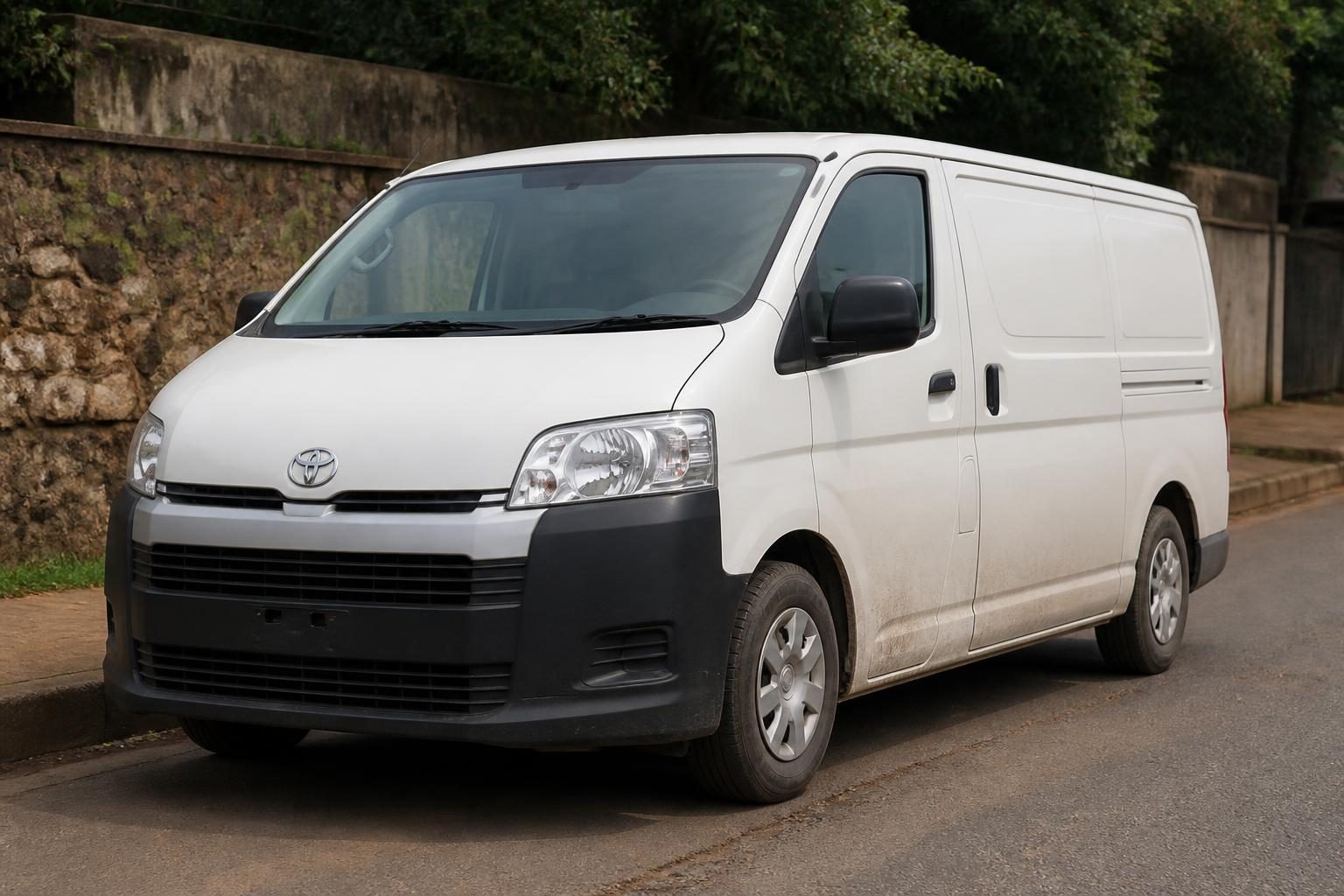 2021 Toyota Hiace
The 1GD-FTV is an inline four-cylinder turbo-diesel producing 151 PS and 300 Nm in Toyota’s published specification. The 70-litre tank is also listed in Toyota’s technical information for referenced configurations (Toyota Japan, “Hiace Van Owner’s Manual: Maintenance Data”, 2026).
That specification suits regular passenger, equipment or field-work use. However, 117,000 kilometres means service evidence deserves close attention. An auction grade is the Japanese auction’s recorded condition assessment, not a mechanical promise. The three-seat layout is specific to this vehicle and should not be treated as the seating capacity of every Hiace.
How reliable is a used Toyota Hiace 4WD?
A used Hiace 4WD can work hard for years when its engine, cooling system and extra driveline have been maintained. In 2026, Toyota’s owner manual separates 4WD maintenance data into front-differential and transfer sections (Toyota Japan, “Hiace Van Owner’s Manual: Maintenance Data”, 2026). That extra hardware gives the van more parts to inspect than a 2WD model, so service records matter.
Check the engine and cooling system
Start with a cold engine, not a warm one prepared before inspection. Look for difficult starting, excessive smoke, a rough idle, oil leaks and signs of overheating. Ask whether the cooling system has needed major work, especially if the van carried heavy loads or worked in hot conditions.
Toyota’s manual specifies diesel fuel, oil and maintenance requirements for the 1GD-FTV family. Using the wrong oil quality can shorten the life of emissions equipment, so service records should show more than routine oil changes. They should also show sensible filter replacement and attention to warning lights.
Check the 4WD system and driveline
Inspect the 4WD warning lights, front differential, rear differential, transfer case and driveshaft. Listen for whining, clunks or vibration under acceleration and deceleration. Uneven tyre wear can point to alignment, suspension or drivetrain problems.
As a practical precaution, use tyres that match in size and have similar tread depth, then ask a qualified technician to assess any mismatch before driving far. Do not accept “the light will go off later” as an explanation for a warning lamp.
Check commercial wear
Look for sagging springs, leaking shock absorbers, worn bushes, wheel-bearing noise and steering play. Inspect the chassis and underbody for scraping, repairs or impact damage. Sliding doors, seat rails, air conditioning and floor coverings also reveal how hard the van worked.
Fuel economy varies with load, traffic, road surface and maintenance. Treat any owner-reported figure as anecdotal rather than official testing, and do not use it to set Toyota’s service interval.
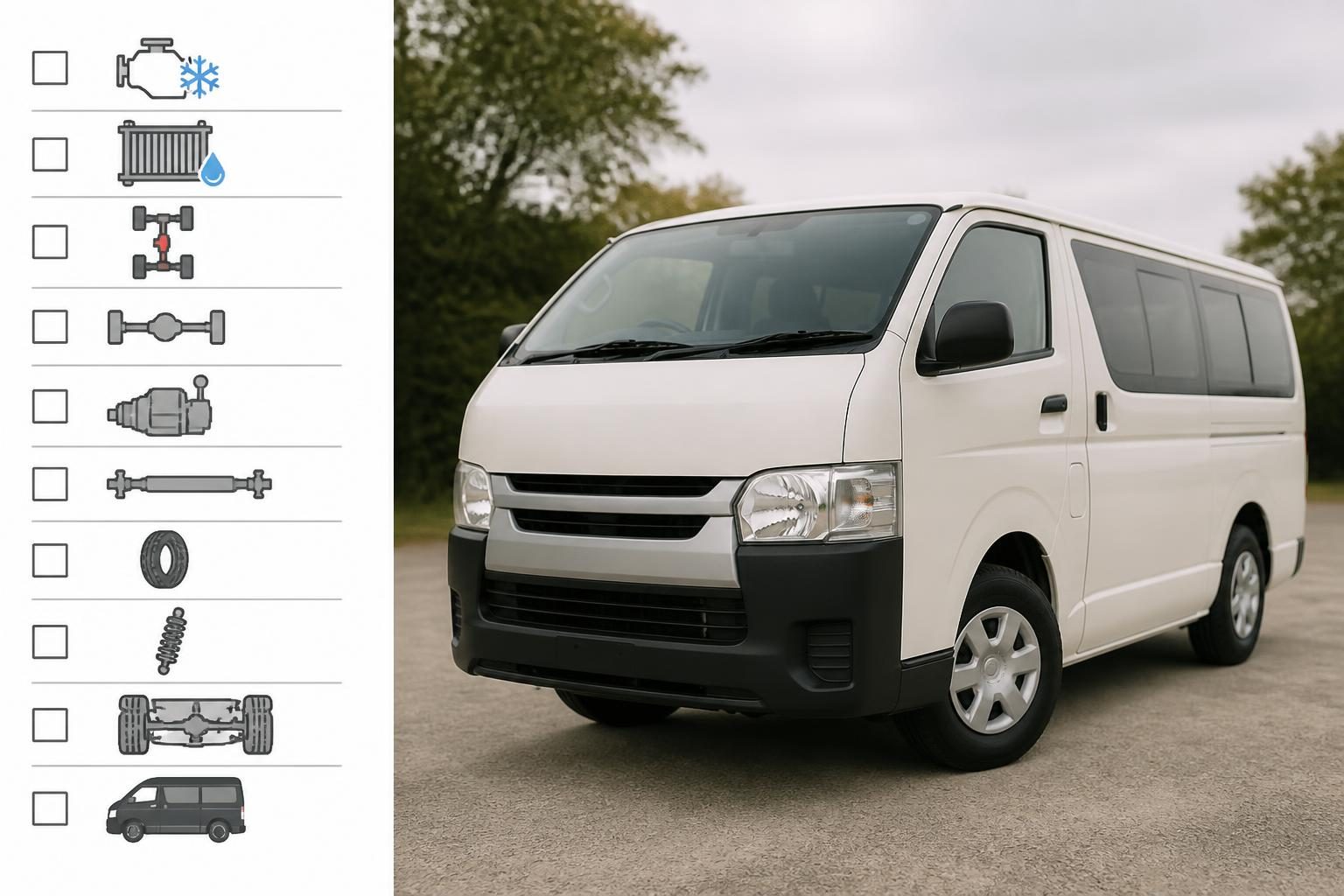 Used van inspection checklist graphic with a white Toyota Hiace-style van.
Which model years and costs should you check before importing?
The manufacture year and vehicle classification should be checked before comparing an older Hiace with a newer one. As of July 2026, Uganda Revenue Authority guidance says vehicles are generally prohibited from importation for registration at 15 years or older from manufacture, subject to vehicle classification, gross vehicle weight and current customs rules (URA, “Ask URA Commissioner General 27”, 2026). Gross vehicle weight is the permitted maximum weight of the vehicle when loaded. That makes the manufacture date a first-stage buying check, followed by inspection documents and a realistic estimate of costs after the Japan price.
How does the 15-year rule affect Hiace choices?
The rule concerns the year of manufacture, not simply the date shown in an advert. Ask for the exact manufacture record, chassis or model code and auction documentation before payment.
A 2012 model is approximately 14 years old during 2026 by a simple calendar calculation. That does not replace confirmation of the exact manufacture date, classification, gross vehicle weight or current customs treatment. Older vehicles close to the limit deserve extra caution, because classification can affect how the rule is applied.
URA also publishes age bands covering vehicles below 9 years, 9 to 15 years and above 15 years in an environmental-levy table. Those bands should not be treated as a universal eligibility or tax table, because treatment can also depend on vehicle category and gross vehicle weight. Its guidance says the used motor vehicle valuation database helps determine customs value, rather than relying only on the invoice (URA, “Import and Export FAQs”, 2026).
What remains after the vehicle price?
The Japan vehicle price should not be treated as your final Uganda cost. Import duty, VAT, port clearance, registration and other government or logistics charges remain separate. Road transport from Mombasa or Dar es Salaam to Uganda also forms part of the wider delivery calculation.
Landed cost is the estimated total cost of getting the vehicle to Uganda, including applicable import and delivery charges. Do not rely on a general online estimate. Use the individual vehicle page’s Estimated landed cost panel, then confirm the final figures on the official proforma invoice. The estimate can change with customs valuation, exchange movements and the exact vehicle record.
Which documents should you request?
Applicable imported vehicles must meet current conformity and roadworthiness requirements, including a Certificate of Roadworthiness where required. Check the current UNBS scheme before relying on any named inspection provider, because provider arrangements can change.
Request these documents:
- Exact manufacture year and model code.
- Japanese auction sheet and auction grade.
- Detailed vehicle inspection report.
- Export documentation.
- Certificate of Roadworthiness from the applicable recognised inspection provider.
- A clear breakdown of costs after the vehicle, shipping and inspection components.
Comparing Japan-sourced Hiace options
The Japanese Hiace range includes different body styles, seating layouts, engines and drivetrains, so the route and work requirement should guide the choice. As of 26 August 2026, the live Toyota Hiace page showed 13 listings, including eight marked 4WD and seven marked diesel (Carbarn, “Toyota Hiace Price in Uganda | Japan Stock”, 2026). This dated snapshot helps you compare examples, but it is not a promise that every Hiace listing has the same engine, seats or drivetrain.
Choose by route, not by badge
A Hiace 4WD makes sense if you carry passengers, tools or bulky equipment and regularly travel on wet murram or rural access roads. It is also a sensible choice for tourism support, construction, NGO and field-service work where a 2WD van may lose traction.
Choose a 2WD Hiace when your work stays mainly on paved roads and mechanical simplicity matters more. Choose a Prado or Land Cruiser when deep mud, rocky tracks, steep slopes and difficult safari routes are normal. A Hiace gives you better people and cargo capacity, while an SUV gives you a different type of off-road capability.
The practical verdict
The strongest case for Toyota Hiace 4WD in Uganda is not adventure styling. It is the combination of van capacity and extra traction on rough, slippery but passable roads. Its limitations are just as clear: ground clearance, long-wheelbase geometry and no automatic assumption of low-range hardware.
Buy it if:
- Your regular routes include wet murram, loose gravel or muddy compounds.
- You need passenger or cargo capacity alongside extra traction.
- You can verify the exact 4WD system and maintain its additional driveline components.
Skip it if:
- You mainly drive paved roads around Kampala.
- You want the simplest possible drivetrain.
- Your routes involve deep mud, rocks, river crossings or difficult safari tracks.
Carbarn’s Toyota Hiace options for Uganda are Japan-sourced vehicles for import, with Carbarn ownership, an official auction sheet, an in-house inspection report, pre-export roadworthiness inspection documentation, shipping through Mombasa or Dar es Salaam, dashboard access to invoices and certificates, live vessel tracking, and support through the Japan-based sales process.
For listings where the page states that shipping and inspection are included, the vehicle price covers the car, shipping and inspection, but not import duty, VAT, port clearance or registration. End-to-end delivery is estimated at about 6 to 10 weeks from purchase to delivery, including clearance and inland transport. The vehicle page’s Estimated landed cost panel is the next step.
Before committing, read how the Japan-to-Uganda buying process works, check the shipping schedule for vehicles to Uganda, and compare the exact drivetrain and inspection evidence on the individual listing.


