


A vehicle can look ready for muddy roads and still be a poor choice for steep tracks. Another SUV may handle potholes well but offer little benefit during a Kampala commute. The wrong drivetrain can also bring higher fuel, tyre and servicing costs without solving the roads you actually use.
This guide compares seven Japanese 4WD and AWD options for Ugandan buyers. It separates compact crossovers from genuine low-range 4WD vehicles, then matches each model to Kampala traffic, family travel, rural work and longer upcountry journeys.
Quick Answer
- The Toyota RAV4 is the strongest all-rounder for most buyers.
- The Suzuki Jimny is the most capable compact off-roader, with 2H, 4H and 4L modes.
- The Forester and XV suit buyers who value all-wheel traction and visibility.
- The X-Trail and Outlander offer more family space, but they are not low-range 4WDs.
- Check the exact drivetrain, manufacture year, inspection reports and landed cost before paying.
At a glance: which Japanese 4WD suits your roads?
| Model | Drivetrain type | Best fit | Main limitation |
|---|---|---|---|
| Toyota RAV4 | Variant-specific AWD or 4WD hybrid | Kampala, families and mixed roads | Not a low-range off-roader |
| Subaru XV | AWD crossover | Urban driving and moderate gravel roads | Smaller cabin and luggage area |
| Mitsubishi Outlander | Variant-specific 4WD crossover | Comfortable family travel | Petrol running costs and limited off-road hardware |
| Subaru Forester | Full-time AWD-style system | Mixed roads and family upcountry trips | Requires correct Subaru servicing |
| Nissan X-Trail | Variant-specific 4WD or AWD | Larger families and luggage needs | Transmission and drivetrain history matter |
| Suzuki Jimny | Part-time 4WD with low range | Mud, steep tracks and narrow rural roads | Small cabin and firm ride |
| Toyota Prado | Larger 4WD SUV | Heavy rural, tourism or business use | High fuel, tyre and ownership costs |
A four-wheel-drive badge does not tell the whole story. Some vehicles send power between axles automatically, while others let you select a low-range mode for difficult terrain. The table above is an editorial comparison, not a measured reliability or failure-rate study.
Choosing a Japanese 4WD for Ugandan roads
In 2026, the Suzuki Jimny Sierra uses three selectable modes, 2H, 4H and 4L, while most family crossovers rely on automatic traction management (Suzuki Japan, “Jimny Sierra Performance and Economy”, 2026). For Uganda, useful ground clearance, durable suspension, cooling, tyres and service support matter as much as the number of driven wheels.
Kampala driving brings traffic, speed humps, broken road edges and frequent stop-start use. Upcountry trips add gravel, potholes, rain, mud and steep sections. A compact AWD crossover can make sense for this mix, especially when most kilometres happen on paved roads.
AWD usually manages traction automatically when a wheel loses grip. It can help on wet roads, loose gravel and uneven surfaces. It does not automatically provide the slow, controlled climbing ability that low-range gearing offers.
Full-time 4WD keeps all four wheels involved as part of the normal drivetrain. Part-time 4WD gives the driver modes such as 2H, 4H and 4L. Low range reduces wheel speed and increases control, which helps when climbing steep tracks, crossing deep mud or recovering a stuck vehicle.
Ground clearance solves a different problem. It reduces the chance of scraping the floor, exhaust or bumpers. It cannot create grip when tyres are spinning. Good tyres, sensible speed and a clean underbody still matter.
AWD and 4WD capability ladder
| Level | System | Useful for |
|---|---|---|
| 1 | Front-wheel-drive crossover | Paved Kampala roads and ordinary daily use |
| 2 | Traction-focused AWD crossover | Wet roads, gravel and moderate uneven surfaces |
| 3 | Full-time 4WD SUV | Mixed terrain, family travel and longer rural routes |
| 4 | Part-time 4WD with low range | Mud, steep slopes, severe tracks and recovery work |
Many buyers ask for “4WD” when they really need clearance and better wet-road traction. If you spend most of your week in Kampala, a lighter crossover may serve you better than a heavy rural 4WD.
Which compact Japanese 4WD options suit Kampala and mixed roads?
In 2026, the 2019 Toyota RAV4 example records a 2.5-litre hybrid engine, automatic transmission, 4WD and five seats (the 2019 Toyota RAV4 vehicle page, retrieved 2026-08-15). Those features make this group useful for urban driving, family travel and occasional rough surfaces, rather than severe off-roading.
Toyota RAV4: the strongest all-rounder
The Toyota RAV4 is probably the best all-round choice for buyers who want family space, improved traction and upcountry flexibility without moving straight to a large SUV.
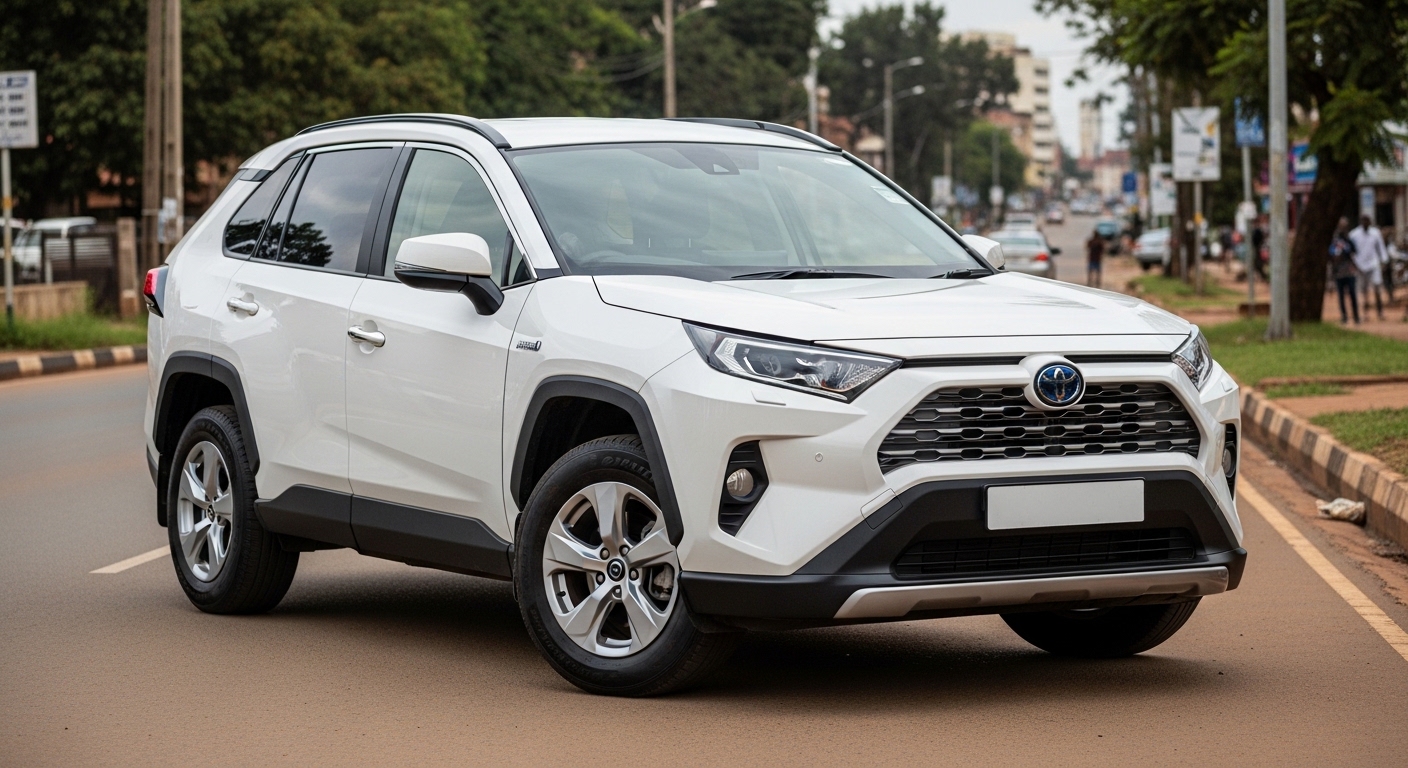 2019 Toyota RAV4
The 2019 example uses Toyota’s A25A-FXS 2.5-litre inline-four hybrid engine. Its vehicle page records automatic transmission, 4WD, five seats and 104,300 kilometres, with an auction grade of 3.5 (2019 Toyota RAV4 vehicle page, retrieved 2026-08-15). The hybrid system may suit stop-start Kampala traffic, but the battery and hybrid system still need proper inspection.
Toyota’s Japanese specification data reports 15.2 km/L WLTC for some 2.0-litre petrol 4WD variants and about 20.3 to 20.6 km/L WLTC for selected hybrid grades (Toyota Japan, “RAV4 Specification Sheet”, 2024). Those figures belong to specific variants, so don’t apply them to every used RAV4.
The RAV4 has useful road height and a comfortable cabin for five people. It remains a crossover, however. If you regularly drive deep mud, steep tracks or heavily loaded rural routes, a Jimny or larger 4WD may fit better.
Good for:
- Kampala commuting with occasional upcountry travel.
- Families wanting more space than a hatchback.
- Buyers seeking a balance between comfort and traction.
Consider another vehicle if:
- You need low-range gearing.
- You carry heavy loads on severe tracks.
- You expect expedition-level off-road ability.
For exact equipment and variant differences, compare Toyota RAV4 vehicle specifications with the model code shown on the individual vehicle page.
Subaru XV: a smaller urban-friendly AWD choice
The Subaru XV suits Kampala drivers who want a raised driving position and four-wheel traction without the size of a Forester or Prado.
The 2017 example uses a 2.0-litre FB20 horizontally-opposed four-cylinder petrol engine. Its page records automatic transmission, 4WD, five seats and 100,000 kilometres, with an auction grade of 3.5 (2017 Subaru XV vehicle page, retrieved 2026-08-15). Its compact size helps in traffic, parking areas and narrow town roads.
The XV is better described as a traction-focused crossover than a serious 4WD. Its system can help on wet roads, gravel and uneven surfaces, but unlike the Jimny it is not presented as a selectable low-range 4WD. Suspension wear, tyre condition and underbody damage deserve close attention after rough-road use.
Good for:
- Kampala commuters.
- Small families.
- Drivers who want compact dimensions and extra traction.
Consider another vehicle if:
- You need three rows or a large boot.
- You carry heavy loads.
- Your route requires low-range gearing.
Correct servicing matters with any Subaru. A buyer should know where to find a mechanic familiar with the engine, drivetrain and transmission before choosing this model.
Mitsubishi Outlander: a comfortable family crossover
The Mitsubishi Outlander is worth considering when family space and a comfortable driving position matter more than serious off-road hardware.
 2018 Mitsubishi Outlander
The 2018 example uses a 2.4-litre 4B12 four-cylinder petrol engine with automatic transmission, 4WD and five seats. Its vehicle page records 82,000 kilometres and an auction grade of 4 (2018 Mitsubishi Outlander vehicle page, retrieved 2026-08-15). The larger engine and heavier body make fuel planning more important than with a smaller crossover.
The Outlander offers useful luggage space and a relaxed driving position for longer trips. It can handle gravel, potholes and moderate uneven roads when fitted with suitable tyres. It should not be treated as an alternative to a Jimny on steep, muddy tracks.
Before payment, confirm that the drivetrain shown on the vehicle page matches the auction sheet. Check warning lights, transmission behaviour, suspension condition and the underbody.
Good for:
- Families travelling between Kampala and upcountry districts.
- Buyers wanting more space than an XV.
- Drivers who value comfort on longer journeys.
Consider another vehicle if:
- You need low-range 4WD.
- You regularly drive severe mud or steep tracks.
- You want the lightest possible running costs.
Which family SUVs make sense for longer upcountry travel?
In 2026, the Forester example records a 2.0-litre petrol engine, 4WD, five seats and 78,000 kilometres (2016 Subaru Forester vehicle page, retrieved 2026-08-15). The X-Trail example adds seven seats and a 2.0-litre petrol engine, showing why cabin space can matter as much as drivetrain hardware.
Subaru Forester: stable traction and family practicality
The Subaru Forester makes a lot of sense for drivers who value visibility, stable all-wheel traction and practical family space across Kampala and longer upcountry journeys.
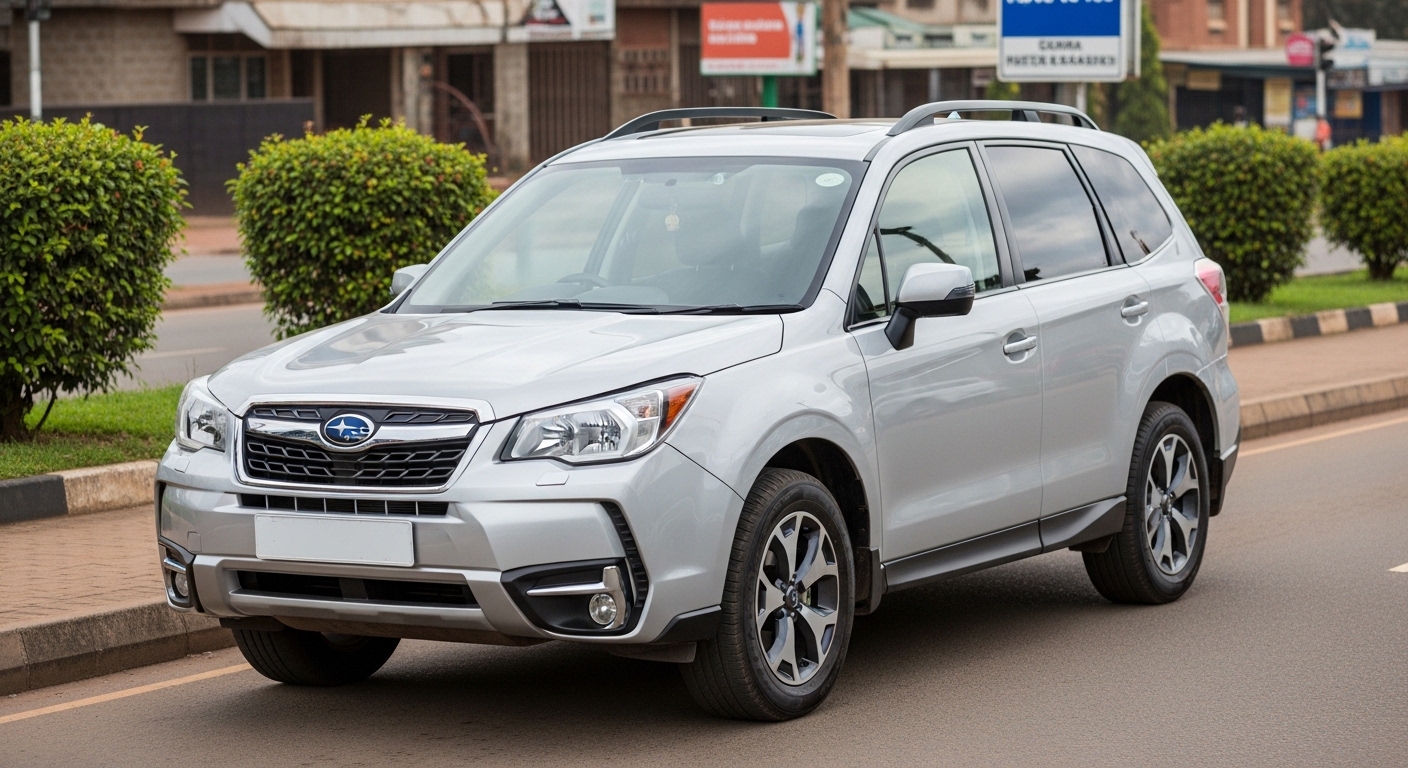 2016 Subaru Forester
The 2016 example uses Subaru’s FB20 2.0-litre horizontally-opposed four-cylinder petrol engine. Its page records a manual transmission, 4WD, five seats, 78,000 kilometres and an auction grade of 3.5 (2016 Subaru Forester vehicle page, retrieved 2026-08-15). That manual gearbox makes this particular vehicle different from many automatic Foresters.
The Forester’s outward visibility and raised seating position suit broken road edges and long journeys. Its all-wheel traction can help on wet or loose surfaces, but it won’t overcome worn tyres, excessive speed or poor suspension condition.
Subaru’s historical SJ5 specification confirms the relevant generation-specific details for this 2016 imported example (Subaru used-car catalogue). Compare the exact engine, transmission and model code before estimating fuel use.
Good for:
- Families travelling on mixed surfaces.
- Drivers who want a stable, practical SUV.
- Buyers with access to Subaru-capable servicing.
Consider another vehicle if:
- You want the simplest mechanical arrangement.
- You cannot verify the maintenance history.
- Fuel pressure is your first priority.
For wider Subaru comparisons, compare the exact engine, transmission and model code before estimating fuel use.
Nissan X-Trail: a practical family 4WD option
The Nissan X-Trail is a practical choice for families needing more passenger and luggage space, provided the exact 4WD system and transmission history are verified.
The 2015 example uses a 2.0-litre MR20DD inline-four petrol engine with automatic transmission. Its page identifies the vehicle as 4WD with seven seats, 105,730 kilometres and an auction grade of 3.5 (2015 Nissan X-Trail vehicle page, retrieved 2026-08-15). That seven-seat layout gives it a clear family advantage over the five-seat crossovers.
This X-Trail is best treated as a family crossover rather than a low-range rural 4WD. Its higher seating position and four-wheel traction can help on wet roads and uneven surfaces. The CVT and drivetrain deserve careful inspection, especially where service records are incomplete.
Nissan’s current X-Trail data lists separate 2WD and 4WD versions. A specified newer 4WD e-POWER grade reports 18.1 km/L WLTC, but that figure does not apply to this older petrol model (Nissan Japan, “X-Trail Environmental Information”, 2026).
Good for:
- Families needing more passenger space.
- Occasional upcountry journeys.
- Buyers prioritising comfort and luggage capacity.
Consider another vehicle if:
- You need a transfer case with low range.
- The CVT service history is unclear.
- You want a simpler mechanical setup.
Is the Suzuki Jimny the right genuine 4WD for Uganda?
In 2026, Suzuki’s official Jimny Sierra page lists 210 mm of minimum ground clearance and a 4.9-metre minimum turning radius (Suzuki Japan, “Jimny Sierra Performance and Economy”, 2026). Those figures explain why the Jimny can tackle narrow tracks that larger crossovers may avoid.
Suzuki Jimny: the genuine compact off-roader
The Suzuki Jimny is the most serious off-road vehicle here for its size, but its small cabin and limited luggage space make it a specialised choice.
The 2024 example uses Suzuki’s K15B 1.5-litre petrol engine with manual transmission, 4WD and four seats. Its page records 5,000 kilometres and an auction grade of 5 (2024 Suzuki Jimny vehicle page, retrieved 2026-08-15). Suzuki lists 101 PS and 130 Nm for the K15B engine, while the official table gives 15.6 km/L in WLTC high-speed mode for the manual configuration and 14.8 km/L in WLTC high-speed mode for the automatic configuration (Suzuki Japan, “Jimny Sierra Detail Specifications”, 2026).
The Jimny’s ladder frame, rigid axles and transfer lever separate it from ordinary AWD crossovers. Its 2H mode suits normal roads, 4H helps on loose surfaces, and 4L provides slower, stronger control for mud and steep climbs. Use 4L only where the surface and vehicle instructions call for it.
The trade-off is comfort. The short wheelbase, narrow body and firm suspension help on rough tracks but give less high-speed stability and luggage space. Four adults can fit, but a growing family may need a larger vehicle.
Good for:
- Rural roads, steep tracks and muddy access routes.
- Farming, field work and narrow roads.
- Buyers who need genuine low-range 4WD.
Consider another vehicle if:
- You regularly carry five adults.
- You need a large boot.
- Most driving happens on paved Kampala roads.
- Long-distance family comfort matters more than access.
The Jimny is not automatically the best 4WD for every Ugandan buyer. It is the best tool here for a specific job, getting through difficult terrain in a small footprint.
Which Japanese 4WD should you choose by use case?
In 2026, the individual vehicle pages show meaningful differences in size and layout, from the four-seat Jimny to the seven-seat X-Trail (2024 Suzuki Jimny and 2015 Nissan X-Trail vehicle pages, retrieved 2026-08-15). Your road pattern and passenger needs should decide the choice, not the badge alone.
| Buyer need | Best-fit model | Why |
|---|---|---|
| Kampala commuting with occasional rough roads | Toyota RAV4 or Subaru XV | Easier daily use than a large 4WD |
| Family trips on mixed roads | RAV4 or Forester | Good balance of traction, comfort and space |
| More passenger capacity | Nissan X-Trail | Seven-seat layout on the selected example |
| Comfortable family crossover | Mitsubishi Outlander | Five-seat practicality and a relaxed driving position |
| Mud, steep tracks and narrow rural routes | Suzuki Jimny | Low-range 4WD and compact dimensions |
| Heavy rural or business use | Research larger SUVs, including Prado | More capacity, but higher ownership costs |
| Lowest fuel pressure | Compare smaller, exact variants | Official figures vary by engine and drivetrain |
The RAV4 is the strongest all-rounder. The Jimny is the best genuine compact off-roader. The Forester suits buyers who value stable traction and visibility. The X-Trail is the practical family choice when seven seats matter.
The Toyota Prado belongs in a different category. It may suit frequent rural work, tourism, long-distance travel or heavy loads. It can be poor value for Kampala-only driving because fuel, tyres, parking and maintenance demand more of the budget. Research the Toyota Prado’s size, fuel, tyre and maintenance demands before treating it as the automatic answer.
Editorial buyer-fit scores
| Model | Rough-road ability | Kampala practicality | Fuel-cost pressure | Service simplicity |
|---|---|---|---|---|
| Toyota RAV4 | 3/5 | 5/5 | 4/5 | 4/5 |
| Subaru Forester | 4/5 | 4/5 | 3/5 | 3/5 |
| Nissan X-Trail | 3/5 | 4/5 | 3/5 | 3/5 |
| Suzuki Jimny | 5/5 | 3/5 | 3/5 | 4/5 |
| Toyota Prado | 5/5 | 2/5 | 1/5 | 4/5 |
| Subaru XV | 3/5 | 5/5 | 3/5 | 3/5 |
| Mitsubishi Outlander | 3/5 | 4/5 | 3/5 | 3/5 |
These scores describe editorial fit. They are not an independent study of breakdown rates or long-term reliability.
What should you check before importing a Japanese 4WD?
In 2026, Carbarn’s current Uganda eligibility guidance says vehicles aged 15 years or more from the year of manufacture cannot be imported for registration (Uganda import rules and eligibility guidance). A parliamentary proposal discussed prohibiting vehicles 13 years or older (Uganda Parliament Bill Tracker, 2026). The bill was withdrawn on 21 April 2026, so it should not be used as the current eligibility threshold.
Start with the year of manufacture, not the registration year. Check the current Uganda import rules and eligibility guidance before payment, especially if the legal position changes.
Then review the vehicle evidence:
- Auction sheet and grade: Read the damage marks, repair notes and grade rather than relying on the model badge.
- Inspection report: Check bodywork, tyres, windows, cabin, underbody and mechanical comments.
- Odometer: Compare the displayed kilometres with auction records and inspection photographs.
- Underbody: Look for rust, impact damage, oil leaks and bent suspension components.
- Tyres: Confirm matching sizes, tread and suitable condition for wet and rough roads.
- Drivetrain: Check warning lights and confirm 4WD operation.
- Transfer case: On a Jimny or another selectable 4WD, confirm that 2H, 4H and 4L operate correctly.
- Transmission: Pay close attention to CVT history and service evidence on applicable X-Trail models.
- Hybrid system: For a hybrid RAV4, request the available battery and system information.
- Total cost: Separate the vehicle price from the estimated landed cost and final registration expenses.
URA explains that customs value can include the price paid or payable, insurance and freight for sea transport. It also says alternative valuation methods may apply when the transaction value cannot be used (URA, “Import and Export FAQs”, retrieved 2026-08-15).
The quoted vehicle price is not the final on-road amount. Import duty, VAT, port clearance and registration are separate costs. Use the vehicle page’s Estimated landed cost panel as a planning tool, then confirm the final amount before paying.
When reviewing Japanese 4WD vehicles, inspection evidence often reveals more than the badge. A clean underbody, matching tyres and clear drivetrain comments can matter more than choosing a famous model.
4WD value for Kampala driving
In 2026, Suzuki’s official Jimny data shows 14.8 to 15.6 km/L in WLTC high-speed mode depending on transmission, while Toyota’s RAV4 figures vary by engine and drivetrain (Suzuki Japan, “Jimny Sierra Detail Specifications”, 2026; Toyota Japan, “RAV4 Specification Sheet”, 2024). Laboratory figures do not predict exact Kampala consumption.
If you mostly drive paved roads, a heavy 4WD may add cost without adding much daily value. Extra weight, larger tyres, more drivetrain components and higher suspension loads can increase ownership pressure.
A compact AWD crossover may be enough when your main concerns are potholes, wet roads, gravel shoulders and occasional upcountry travel. Low range becomes more valuable when you regularly face steep climbs, deep mud, rough tracks or recovery situations.
Ask yourself:
- How often do I leave paved roads?
- Do I drive through mud or steep terrain?
- Do I carry people, tools or heavy loads?
- Can I support the fuel and tyre costs?
- Can I access a mechanic familiar with the model?
- Is the manufacture year still eligible under current rules?
If most answers point to Kampala, the RAV4, XV or Outlander may be more sensible than a large 4WD. If your work takes you into difficult rural areas, the Jimny’s hardware may justify its compromises.
How does the Japan-to-Uganda buying process work?
In 2026, the published shipping schedule lists weekly routes from Japanese ports to Mombasa or Dar es Salaam (Japan-to-Uganda shipping schedule, retrieved 2026-08-15). Plan for about 6 to 10 weeks from purchase to delivery in Uganda because clearance and inland transport follow shipping.
A managed import process should give you the official auction sheet and an additional inspection report before payment. It should also show the manufacture year, drivetrain, odometer, auction grade and condition comments clearly.
After purchase, the vehicle is inspected before export and shipped by RoRo to Mombasa or Dar es Salaam. It then travels by road to Uganda. The full journey takes about 6 to 10 weeks from purchase to delivery, with clearance and inland delivery following shipping to port.
The buyer should also receive an official proforma invoice, shipping documents, inspection certificates and a bill of lading. A dashboard with vessel tracking and document downloads makes it easier to prepare for clearance.
For buyers who want this route, Carbarn Uganda provides the official auction sheet and an additional inspection report before payment. Vehicles are shipped by RoRo to Mombasa or Dar es Salaam, then sent by road to Uganda. Its dashboard provides invoices, inspection documents, certificates, a bill of lading and vessel tracking. The vehicle price covers the vehicle, shipping and inspection, while import duty, VAT, port clearance and registration remain separate.
Conclusion
The best Japanese 4WD for Uganda depends on the road, not the badge.
The Toyota RAV4 is the strongest balance for Kampala, families and mixed roads. The Forester and XV suit buyers who value all-wheel traction and visibility. The X-Trail and Outlander offer useful family space. The Jimny is the clearest choice for genuine low-range capability on narrow, muddy or steep tracks.
Before paying, confirm the manufacture year, drivetrain, inspection evidence and estimated landed cost. Compare the relevant vehicle pages, then review the Japanese import process and current Uganda eligibility rules.