Petrol cost Shs6,774 a litre in Uganda in October 2026, according to the Uganda Bureau of Statistics (UBOS). That figure is the national retail price in the UBOS Consumer Price Index release for October 2026, and UBOS reports that petrol prices rose 34.3% in the year to October 2026.
If you drive into Kampala every working day, or run upcountry at weekends, that jump lands straight in your monthly budget. It also changes which car makes sense to buy next. This guide explains what the UBOS figure is, gives you a fuel bill you can redo with your own numbers, and shows which kinds of car feel dearer petrol the least.
Quick Answer
- UBOS's national retail price for petrol in October 2026 is Shs6,774 a litre, and UBOS reports petrol prices up 34.3% in the year to October.
- Diesel is dearer at Shs7,014 a litre in the same UBOS release, so diesel no longer saves money at the pump.
- The rise bites hardest on long-distance drivers and stop-start Kampala commuters.
- A hybrid or small petrol car cuts the litres you burn. That helps more than waiting for pump prices to fall.
- Import duty, VAT and registration are paid on top of a car's listed price.
What did UBOS actually measure?
UBOS collects retail prices every month for its Consumer Price Index, the survey behind Uganda's inflation rate. The retail price table in the October 2026 release lists petrol at Shs6,774 a litre and diesel at Shs7,014 a litre. These are national figures for the month, built from prices gathered across the country, not a reading from one Kampala forecourt.
UBOS puts annual headline inflation at 5.8% in October 2026, up from 4.6% in September.
What does Shs6,774 a litre do to a monthly fuel bill?
Your monthly fuel bill is the litres you burn multiplied by the price per litre. Litres depend on how far you drive and how much fuel your car uses per 100 kilometres.
Here is the sum you can repeat with your own numbers:
Litres a month = kilometres a month ÷ 100 × litres per 100 km
Fuel bill = litres a month × price per litre
The table below uses 1,000 km a month, which is roughly a daily Kampala commute plus a couple of longer trips. The consumption values are illustrative only. They are not the figures of any specific car, and real-world use in traffic is usually worse than any brochure number.
| Illustrative consumption |
Litres a month (1,000 km) |
Fuel bill at Shs6,774 a litre |
| 5 L/100 km |
50 |
Shs338,700 |
| 8 L/100 km |
80 |
Shs541,920 |
| 10 L/100 km |
100 |
Shs677,400 |
On the same 1,000 km, a car using 5 L/100 km costs Shs338,700 less a month to fuel than one using 10 L/100 km.
Redo the sum with what your station charges.
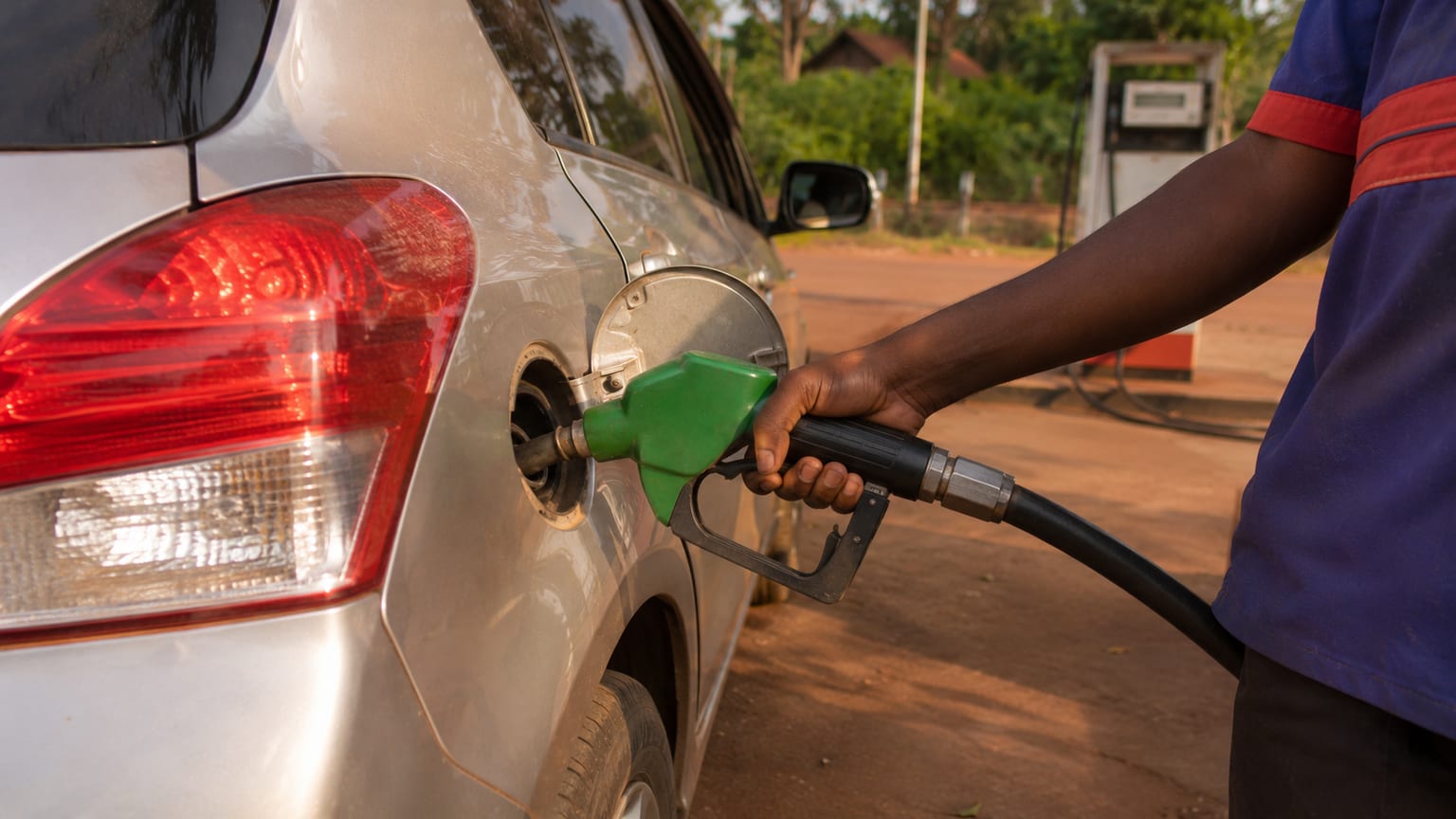 Illustration: A silver car being refuelled at a petrol station.
Is diesel still the cheaper option?
Not at the pump. UBOS puts diesel at Shs7,014 a litre for October 2026, against Shs6,774 for petrol, so each litre of diesel now costs more than a litre of petrol. UBOS recorded a 49.2% annual rise in diesel prices in the year to October 2026, a steeper climb than petrol's 34.3%.
Diesel engines still burn fewer litres for the same distance, especially on long, steady runs. A diesel pickup covering long upcountry distances may still make sense. A diesel saloon doing short Kampala hops probably does not.
Which cars feel dearer petrol the least?
Hybrids and small petrol cars feel a price rise least, because they burn the fewest litres per kilometre. Large V8 engines and big SUVs feel it most.
Hybrids. The Toyota Aqua is a well-known hybrid choice. Toyota Japan's catalogue rates the Aqua G built between December 2011 and May 2013 at 35.4 km per litre on the JC08 test cycle. JC08 is a laboratory test, so expect less on real roads, but the direction is clear. The Corolla Fielder Hybrid adds wagon space, and the Corolla Cross Hybrid adds ride height, both using the same basic hybrid approach.
Small petrols. The Vitz, Raize and Passo are the sensible non-hybrid choices. Their small engines and light bodies keep fuel use down without the extra purchase cost of a hybrid system.
Large engines. A V8 Land Cruiser or a big-engined Prado will always be thirsty, and every rise at the pump lands hardest on cars like these.
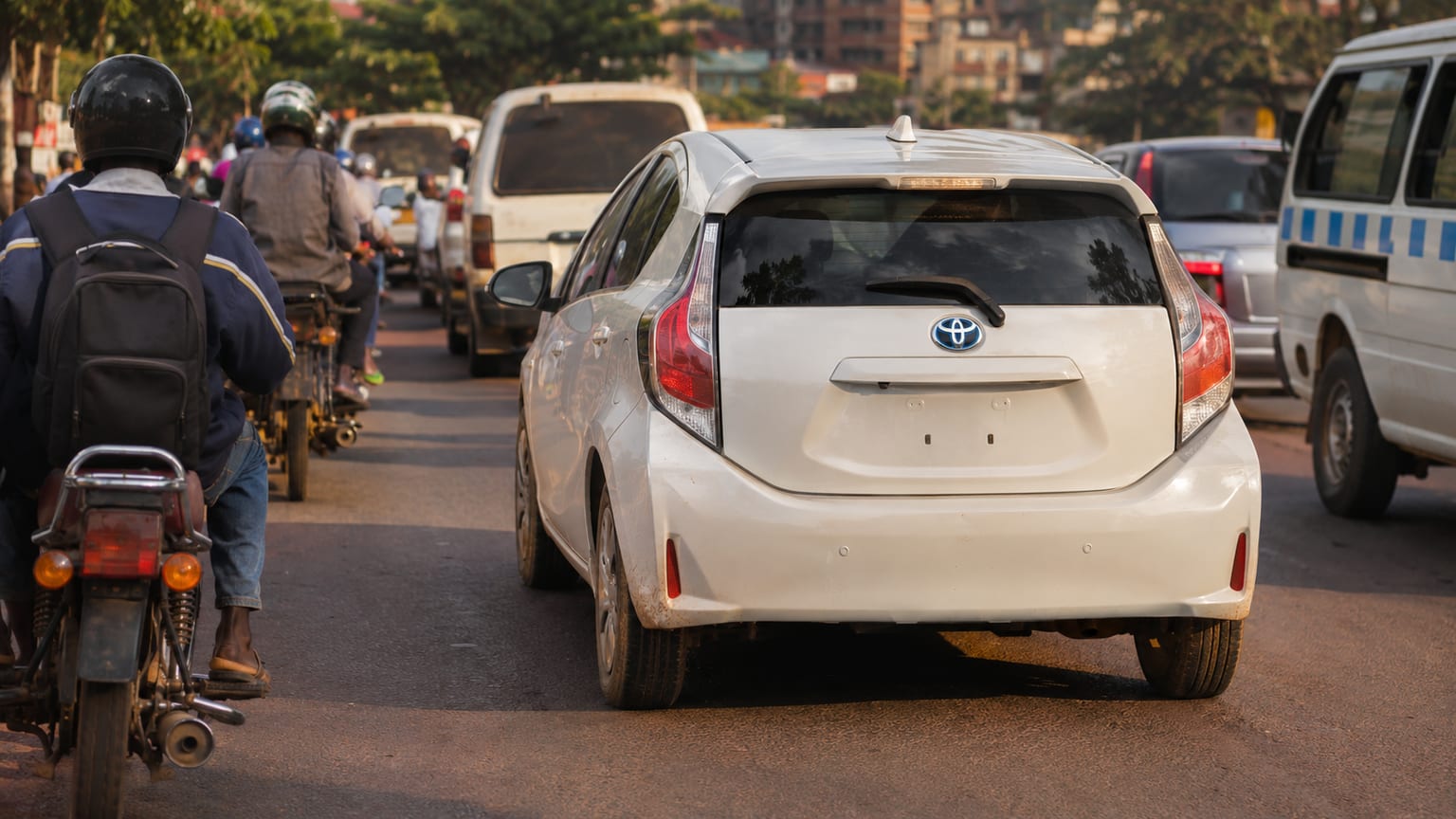 Illustration: A white Toyota Aqua shares a busy road with motorcycles and minibuses.
Which car fits how you drive?
The right answer depends on where your kilometres happen. A hybrid saves most in slow traffic, a small petrol suits light use, and a taller car earns its fuel on rough roads.
If you commute daily in Kampala, a hybrid makes a lot of sense. Stop-start driving is where a hybrid's electric motor does the most work. The trade-off is purchase price, so the fuel saving has to repay that gap over your years of ownership.
If you mostly drive upcountry on long runs, weigh fuel economy against ground clearance. A low hatchback is economical but can struggle on murram and deep ruts. A Corolla Cross Hybrid or a small petrol crossover like the Raize may be the better compromise.
If you cover few kilometres a month, a cheap small petrol may be enough. A dearer hybrid could take many years to pay back.
Hybrid batteries do age, and not every garage is equipped for them, so ask about service near you before you buy.
Order a fuel-efficient car from Japan
Carbarn sells used Japanese cars direct from Japan to Ugandan buyers, as an import to order. Before you pay, you see two inspection reports: the official Japanese auction sheet, which is the independent grading given to the car at auction, and Carbarn's own inspector report. Each car then completes its EAA pre-shipment inspection before it leaves Japan.
Cars ship by RoRo to Mombasa or Dar es Salaam, then travel by road to Uganda. You can check departures on the shipping schedule and follow your vessel from your dashboard.
The listed price covers the vehicle, shipping and inspection. It does not include Uganda's import duty, VAT or registration, which you pay on arrival. You pay by bank transfer or card against a proforma invoice.
Start with the full inventory, read the how to buy guide for the five steps, and check the import rules before you buy.
What this does not show
The UBOS price is a national monthly figure. It does not show what any one station charged on any one day, and it does not show prices after October 2026. Your receipt may be higher or lower.
The fuel bill table does not show the real consumption of any specific car. The 5, 8 and 10 L/100 km values are illustrative, and real driving in Kampala traffic usually uses more fuel than a brochure figure. The Aqua's 35.4 km per litre is a JC08 laboratory result, not a road result.
Nothing here shows the purchase price gap between a hybrid and a petrol car, or the duty, VAT and registration you pay on arrival. Those are set when the car is cleared in Uganda.
Method and sources
- Petrol at Shs6,774 and diesel at Shs7,014 a litre, the 34.3% and 49.2% annual rises and 5.8% headline inflation: UBOS Consumer Price Index release for October 2026, Table 7 and its text on fuel prices. Checked 21 November 2026.
- Toyota Aqua G fuel economy of 35.4 km per litre (JC08): Toyota Japan used-car catalogue. Checked 21 November 2026.
- The fuel bill table uses 1,000 km a month and illustrative consumption values of 5, 8 and 10 L/100 km, multiplied by the UBOS petrol price.