Fuel costs can change the way you think about every Kampala commute. Yet the car with the lowest brochure figure may not be the cheapest or most suitable one to own.
Petrol may suit lower-mileage private use. Diesel can suit distance, loads and commercial work, while a hybrid is worth considering for stop-start Kampala traffic when its battery and hybrid system pass inspection. In short, petrol vs diesel vs hybrid in Uganda comes down to how and where you drive.
This guide compares the three choices for Kampala, upcountry journeys and everyday Ugandan ownership, so you can match the fuel type to your driving pattern before checking maintenance, import eligibility and landed cost. It also covers maintenance checks, the 15-year import-age rule and costs beyond the vehicle price. For a wider budget view, see these fuel-efficient cars under 20M UGX.
Quick Answer
- A full hybrid is worth considering if most of your driving is stop-start urban traffic and the system passes inspection.
- Diesel can suit high-mileage, commercial, heavy-load and regular upcountry use.
- Petrol may suit lower-mileage buyers who value a simpler ownership path, subject to local parts and diagnostic access.
- For 2011–2013 model data, Toyota’s Aqua achieved 35.4 km/L on Japan’s JC08 cycle, a laboratory result rather than a Kampala promise (Toyota Japan, Aqua fuel-economy catalogue, 2011–2013).
- Vehicle condition, import eligibility and landed cost matter more than the fuel badge alone.
What Should You Compare Before Choosing a Fuel Type?
Your driving pattern should decide the starting point: urban traffic favours a well-inspected hybrid, while mileage, loads and route length can favour diesel or petrol. Passenger vehicles generally face a 15-year threshold from manufacture, but commercial and goods vehicles can fall into different categories. Confirm eligibility using the vehicle’s stated manufacture year in the Uganda import rules and eligibility guidance.
Start with your normal week. How many kilometres do you drive? Do you spend hours in Kampala traffic, carry passengers, travel upcountry or use the vehicle for business?
Then compare the whole vehicle, not only the engine. Consider ground clearance, passenger space, purchase bracket, repair access, tyre costs and inspection evidence. A small petrol hatchback may cost less overall than a larger hybrid SUV.
Prices move with auctions and exchange rates, so compare the current vehicle price with its estimated landed cost rather than relying on an old article figure.
| Factor |
Petrol |
Diesel |
Hybrid |
| Kampala traffic |
May suit short trips, depending on the vehicle |
Consider emissions-system needs on repeated short trips |
Worth considering for stop-start driving if inspected |
| Long-distance use |
Can suit an efficient engine |
Can suit high mileage and loads |
Depends on size, ground clearance and condition |
| Maintenance |
Often a simpler starting point, but varies by model |
Injectors and turbo systems may need careful checks |
Battery and hybrid-system condition need checking |
| Possible buyer fit |
Lower-mileage private user |
Commercial or high-mileage user |
Frequent urban commuter |
| Main caution |
A large engine can increase fuel use |
Repair cost varies by model and parts access |
Fuel savings do not remove battery risk |
Which Fuel Type Suits Kampala Traffic?
For mainly urban driving, a well-inspected full hybrid is often worth considering because electric assistance and regenerative braking can help during repeated slowing and acceleration. Toyota’s Aqua G figure of 35.4 km/L JC08 illustrates the technology’s potential, but it is not a promise of Kampala consumption (Toyota Japan, Aqua fuel-economy catalogue, 2011–2013).
 Slow-moving city traffic with cars, vans, and a motorcycle on an urban road.
A hybrid can use its electric motor at low speeds, then restart the petrol engine when more power is needed. Braking also sends some energy back to the battery. It still uses petrol, though. It is not an electric vehicle.
Petrol remains practical if you drive short distances or cover few kilometres each year. Diesel’s advantages may be less useful for a vehicle that mostly idles or makes short trips, particularly where its emissions equipment needs suitable running conditions.
Actual consumption depends on traffic, tyre pressure, passenger load, air-conditioning, road condition and vehicle health. What looks efficient on paper can disappoint if the car has poor maintenance or spends every morning crawling through congestion.
Citation capsule: A full hybrid often suits Kampala’s stop-start traffic better than a comparable petrol or diesel vehicle. Toyota Japan lists the 2011–2013 Aqua at 35.4 km/L on the JC08 laboratory cycle, but that figure cannot be treated as guaranteed fuel consumption on Ugandan roads.
| Vehicle and configuration |
Published result |
Test cycle |
How to read it |
| Toyota Aqua |
35.4 km/L |
JC08 |
Small hybrid hatchback example |
| Corolla Fielder petrol |
16.6 km/L |
JC08 |
Petrol estate example |
| Prius G |
26.0 km/L |
WLTC combined |
Larger hybrid example |
| HiAce diesel |
12.4 km/L |
WLTC combined |
Commercial diesel example |
These figures are not a like-for-like ranking. The vehicles differ in size, purpose, model year and test cycle.
When Does Diesel Make More Sense in Uganda?
Diesel makes more sense when you cover high kilometres, carry heavy loads, travel regularly upcountry or operate a commercial vehicle. Toyota’s HiAce diesel records 12.4 km/L on the WLTC combined cycle for one published configuration, but that is a commercial-vehicle example, not a universal diesel benchmark. The HiAce should therefore be judged by its work pattern and condition (Toyota Japan, HiAce feature and specification information, 2026).
 Loaded white minibus travels a dusty red rural road past fields and distant green hills.
Diesel can provide useful low-speed pulling power, depending on the engine and gearing. That can help when a vehicle is loaded with people, goods or equipment. For long-distance work, consider the vehicle’s range, route and service history rather than assuming every diesel will be the better choice.
The trade-off is greater mechanical complexity in many modern diesel vehicles. Injectors, turbochargers, fuel systems and emissions-related equipment need careful checking. Repair cost depends on the model, parts access, diagnosis and failure, so do not assume a diesel will always cost more.
A large diesel SUV used mainly for short Kampala commutes may not recover its added purchase and repair complexity. Older diesel vehicles near the age limit deserve closer attention because poor maintenance can erase their apparent value.
Citation capsule: Diesel is usually better suited to high-mileage, commercial and heavy-load driving than short urban trips. Toyota Japan publishes 12.4 km/L WLTC combined for one HiAce diesel configuration, showing why model size and vehicle purpose must be considered before comparing fuel types.
Why Can Petrol Still Be the Sensible Choice?
Petrol can be a practical starting point for lower-mileage private drivers. Toyota’s October 2015 specification for one Corolla Fielder 1.8S petrol variant lists 16.6 km/L on the JC08 cycle, although the exact result changes with engine, grade and drivetrain (Toyota Japan, Corolla Fielder 1.8S specification, 2015).
Petrol can suit occasional driving, short commutes, first-time ownership and buyers seeking a broader choice of vehicles. It may also be easier to service in some areas, but confirm local parts and diagnostic access before choosing.
The main weakness is fuel use in heavy traffic. A comparable hybrid may use less petrol while crawling through town. However, a small petrol hatchback can still cost less to own than a larger hybrid SUV.
Engine size and vehicle configuration matter. Larger engines, four-wheel-drive systems and heavier bodies can increase fuel use, although the powertrain can offset part of that effect. Simpler ownership does not remove the need to inspect cooling systems, oil history, transmissions, suspension, tyres and accident repairs.
Toyota’s Corolla Fielder data shows why variant details matter. Across model years and configurations from May 2012 to November 2025, the published range spans 15.6–27.8 km/L WLTC and 16.0–34.4 km/L JC08. Those ranges include different engines and powertrains, so they should never be used as one ranking (Toyota Japan, Corolla Fielder fuel-economy information, May 2012–November 2025).
Citation capsule: Petrol remains a sensible choice when annual mileage is low and simple ownership matters more than maximum urban efficiency. Toyota Japan lists 16.6 km/L JC08 for one 2015 Corolla Fielder petrol variant, but engine size, vehicle condition and test cycle all affect the result.
Ownership Costs Beyond Fuel
Fuel economy is only one part of ownership cost. Toyota’s Prius G specification for October 2024 to July 2025 lists 26.0 km/L WLTC combined, but a newer or larger hybrid can still cost more to buy than a simpler petrol car (Toyota Japan, Prius G specification, October 2024–July 2025).
How Should You Compare Maintenance Risk?
Petrol checks should cover engine oil history, cooling performance, transmission operation, accident repairs and suspension wear. A conventional engine has fewer hybrid components, but neglect can still create expensive problems.
Diesel checks should include cold starts, smoke, injector condition, turbocharger response and service records. Listen for unusual noises and ask whether the vehicle has worked as a commercial hauler.
As practical inspection points, check for battery-health evidence, warning lights, inverter condition, battery cooling fans and hybrid-system diagnostics. Ask a suitably equipped technician what can be tested on that model. Do not assume a battery is healthy or faulty from age alone.
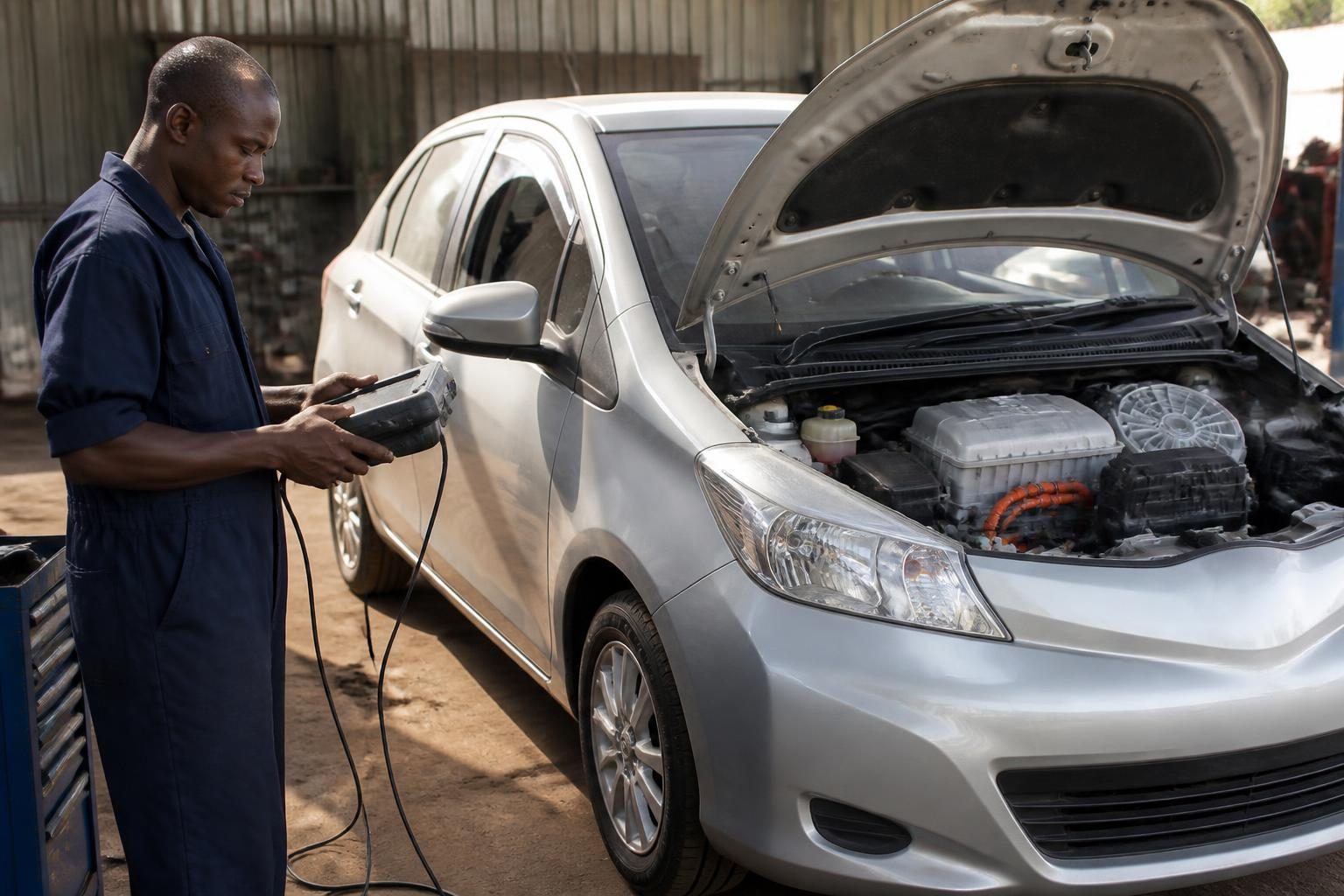 A mechanic inspects a silver hatchback with diagnostic equipment in a workshop.
A well-inspected petrol car can be a better purchase than a neglected hybrid or diesel. No fuel type removes the need for a thorough inspection.
How Do Age and Import Costs Change the Calculation?
Eligibility and landed cost can change the buying decision before fuel economy enters the calculation. For passenger vehicles, check whether the vehicle falls below the current 15-year threshold from manufacture. Confirm the rule for any commercial or goods vehicle before comparing fuel consumption or trim level.
URA explains that used-car customs valuation uses its Used Motor Vehicle Valuation Database. The buyer’s invoice is therefore not the only factor in the final customs calculation (Uganda Revenue Authority, Import and Export FAQs, accessed 2026).
Import duty, VAT, port clearance and registration are separate costs. Do not treat a vehicle price as the on-road total. Open the individual vehicle page and review its Estimated landed cost panel before making a decision.
Citation capsule: Fuel economy must be weighed against vehicle age, condition, import eligibility and customs valuation. For passenger vehicles, confirm the current applicable 15-year threshold and check the rule for the vehicle class, while URA provides a Used Motor Vehicle Valuation Database for customs valuation.
Fuel Type by Driving Pattern
Your normal week is a better guide than the most attractive brochure figure. In the Prius G specification for October 2024 to July 2025, WLTC results range from 23.7 km/L in city driving to 28.7 km/L in suburban driving, showing that even one hybrid changes with conditions (Toyota Japan, Prius G specification, October 2024–July 2025).
| If you mainly… |
Start by considering… |
Why |
Check carefully |
| Drive in Kampala traffic |
Hybrid |
Efficient stop-start operation |
Battery and hybrid-system condition |
| Travel long distances |
Diesel or efficient petrol |
Better fit for regular cruising |
Service history and road suitability |
| Carry goods or passengers |
Diesel |
Torque and commercial practicality |
Injectors, turbo and operating costs |
| Drive fewer kilometres |
Petrol |
Simpler ownership path |
Engine size and fuel use |
| Use mixed or rough roads |
Any suitable powertrain |
Vehicle design matters as much as fuel type |
Ground clearance, tyres and condition |
A hybrid is often worth considering for private Kampala commuters whose driving is mostly stop-start, provided the system passes inspection. Diesel can suit commercial, high-mileage and heavy-load work. Petrol may fit drivers covering fewer kilometres or seeking a simpler ownership path, subject to local service access.
Citation capsule: Fuel economy changes with driving conditions, even within the same powertrain. Toyota’s Prius G specification lists 23.7 km/L WLTC in city driving, 28.7 km/L suburban and 25.5 km/L motorway, so brochure figures need real-world context.
How Can You Compare Eligible Japanese Cars for Uganda?
A Japanese import should be judged from its documents, inspection evidence and estimated landed cost, not only its fuel type. For passenger vehicles, confirm that the vehicle falls below the current applicable 15-year manufacture-age threshold. Commercial and goods vehicles may be treated differently, so check the rule for the vehicle class in the Uganda import rules and eligibility guidance before ordering.
The Japan-to-Uganda buying process explains the documents and checks buyers should review, including an official Japanese auction sheet and an inspection report before payment.
The buying guide also describes EAA pre-shipment certification, RoRo shipping and dashboard access for invoices, inspection reports, bills of lading and shipment tracking. Vehicles can arrive through Mombasa or Dar es Salaam, then continue through the inland delivery and customs process.
Total delivery can take longer because shipping, customs, inland transport and port processing add variables. Treat about 6 to 10 weeks from purchase confirmation to delivery in Uganda as an estimate, not a promise. The quoted vehicle price covers the car, shipping and inspection. Import duty, VAT, port clearance and registration remain separate, so review the Uganda import rules and eligibility guidance and the vehicle page’s Estimated landed cost panel.
What Is the Practical Answer for Uganda?
The practical answer depends on use: a well-inspected full hybrid is a strong starting point for many private Kampala buyers, diesel suits regular loads and distance, while petrol fits lower-mileage ownership. Toyota’s Prius G data shows 26.0 km/L WLTC combined, but separate city, suburban and motorway results show why laboratory figures need careful interpretation (Toyota Japan, Prius G specification, 2024–2025).
Diesel still makes strong sense for commercial work, heavy loads, long-distance travel and frequent upcountry journeys. Petrol remains the sensible option for lower-mileage buyers who value familiar maintenance and a wide choice of vehicles.
Before choosing, check the vehicle’s manufacture year, inspection evidence, battery or diesel-system condition, ground clearance and estimated landed cost. The fuel badge matters, but the condition of the actual car matters more.


