


An eight-seater sounds simple until you picture Kampala traffic, school bags, shopping and a full trip to Jinja. The cheapest-looking van may be too old to import, too thirsty for daily driving or a seven-seater in the exact trim.
Japanese people movers also fall into different groups. Compact MPVs suit family use, luxury vans focus on passenger comfort, while HiAce models suit repeated group transport. They do not offer the same driving experience or running costs.
This guide ranks them using six practical tests: seating certainty, urban usability, fuel and powertrain, passenger comfort, UGX budget fit and import practicality. No single model wins every test, so the recommendation depends on how you carry people and where you drive.
This 2026 guide compares the main choices by usable space, fuel and engine type, Kampala practicality, upcountry comfort, UGX budget brackets and import eligibility. It also explains why the model name alone cannot confirm eight seats.
Quick Answer
- Best all-round starting point: Toyota Noah, provided the exact grade has eight seats.
- Strong alternative: Toyota Voxy, with the same need for variant-level verification.
- Best confirmed practical example: The 2016 Nissan Serena vehicle page identifies an eight-seat, 2.0-litre hybrid example.
- Best for comfort: The 2021 Toyota Alphard, listed as an eight-seater with a 2.5-litre petrol engine.
- Important in 2026: Confirm the genuine manufacture year, exact seat count and vehicle-specific landed cost before importing.
For deeper model specifications, use the Japanese-market specification database alongside the exact vehicle page.
What should you look for in an 8-seater car for Uganda?
In 2026, Toyota’s Alphard seating FAQ confirms that the model is available with six, seven or eight seats (Toyota, “Alphard: How many passengers?”, 2026). The best 8-seater for Uganda therefore depends on the exact grade, cabin layout, road use and budget.
A useful family MPV needs sliding doors, sensible dimensions and easy third-row access. Those details matter during school runs, church events and busy parking. A large cabin helps, but only if children and adults can enter without climbing over the second row.
Luggage space is the test many buyers miss. Eight people can fill the cabin quickly, leaving little room for suitcases, food or shopping. A seven-seat layout with captain’s chairs may feel better for adults, but it cannot replace a genuine eight-seat bench when capacity matters.
Kampala driving can favour a more compact body, but the practical difference depends on the exact dimensions, suspension and route. Noah, Voxy, Serena and Esquire are shorter than the referenced Alphard, while ground clearance and rough-road suitability should be checked from the exact vehicle rather than assumed from the model name.
Check the genuine manufacture date before comparing equipment or price. Uganda’s passenger-vehicle eligibility depends on the genuine manufacture date and the applicable clearance or shipment date, not simply the registration year. URA’s current import guidance explains that customs uses the applicable valuation and clearance rules, so buyers should verify the vehicle’s documents and manufacture year before shipment (Uganda Revenue Authority, “Import and Export FAQs”, 2026).
| Model | Main role | Strongest fit | Main caution |
|---|---|---|---|
| Toyota Noah | Compact family MPV | Balanced family use | Exact grade may be seven-seat |
| Toyota Voxy | Compact family MPV | Flexible urban family transport | Seat layout varies |
| Nissan Serena | Family MPV | Non-Toyota alternative | Powertrain needs verification |
| Toyota Alphard | Luxury people mover | Passenger comfort | Size, fuel use and layout |
| Toyota Esquire | Compact MPV | Lower or middle budget | Older examples need checks |
| Toyota HiAce | Commercial people mover | Group or business transport | Less car-like in town |
Editorial fit guide: Noah and Voxy lead for normal family use. Serena is the strongest Nissan alternative. Alphard makes more sense when comfort matters more than fuel cost. HiAce belongs in a separate commercial category.
For model-specific comparisons, see the Toyota Noah guide, Toyota Voxy guide and Toyota Alphard guide.
Is Toyota Noah the strongest all-round starting point?
In 2026, selected Japanese-market Toyota Noah variants are offered with eight seats, while current listed Noah examples can still be seven-seat (Toyota, “Noah seating information”, 2026). That makes the Toyota Noah the best starting point, but not an automatic eight-seat choice.
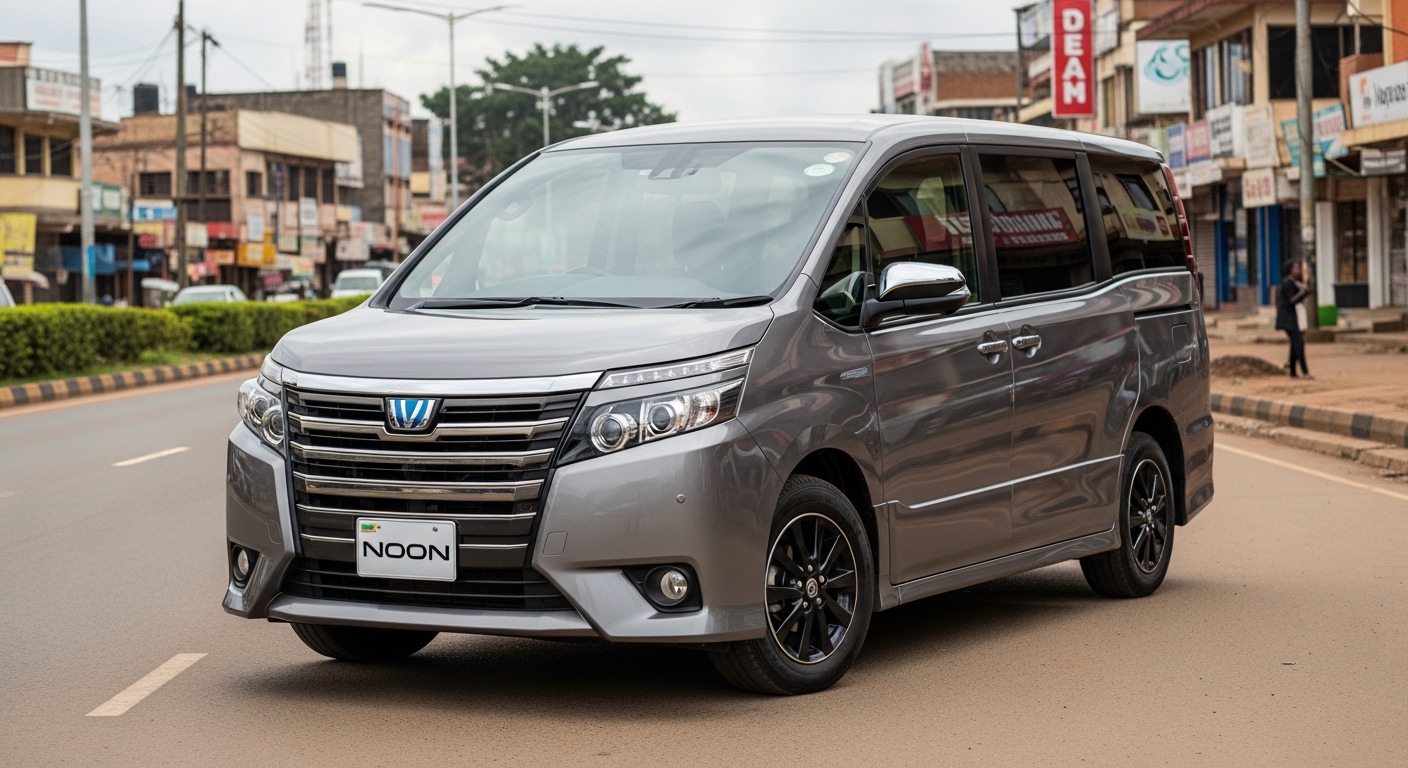 2020 Toyota Noah
Noah uses a tall, sliding-door MPV body that works well for children and older passengers. The cabin is easier to manage in Kampala than an Alphard, while still offering flexible rows for family trips. Petrol and hybrid powertrains exist across different generations, so the engine code matters.
Current category information covers 1.8-litre and 2.0-litre versions, automatic CVT transmissions and 2WD configurations. A supplied 2024 Noah example has an 1.8-litre hybrid engine, FWD and seven seats, while a newer 2026 example is also listed as seven-seat. Those pages show why the grade and seat count must be checked separately.
Noah is probably the best fit for a family balancing Kampala errands with trips to Entebbe, Jinja or upcountry towns. It offers sensible access and good running-cost potential. However, eight adults plus luggage may push the compact cabin beyond its comfortable limit.
Who should choose it?
- Families wanting one vehicle for school runs and holidays.
- Buyers who prefer a compact MPV over a luxury van.
- Drivers who value hybrid or petrol choice by generation.
Who should skip it?
- Buyers carrying eight adults and large luggage often.
- Drivers who need serious rough-road clearance.
- Anyone unwilling to verify the exact trim and powertrain.
Toyota’s current Noah information confirms that eight-seat versions exist, but the supplied 2024 and 2026 vehicle pages each show seven seats. The practical lesson is simple: the Noah badge identifies the model family, not the exact seating arrangement.
Is Toyota Voxy a close family-focused alternative?
In 2026, the supplied Toyota Voxy category snapshot shows four examples, all recorded as seven-seat vehicles (Carbarn Uganda, Toyota Voxy category page, 2026). Toyota’s official Voxy FAQ also confirms that eight-seat layouts exist (Toyota, “Voxy seating information”, 2026). The Toyota Voxy remains an eight-seat-capable alternative, but buyers must confirm the individual grade.
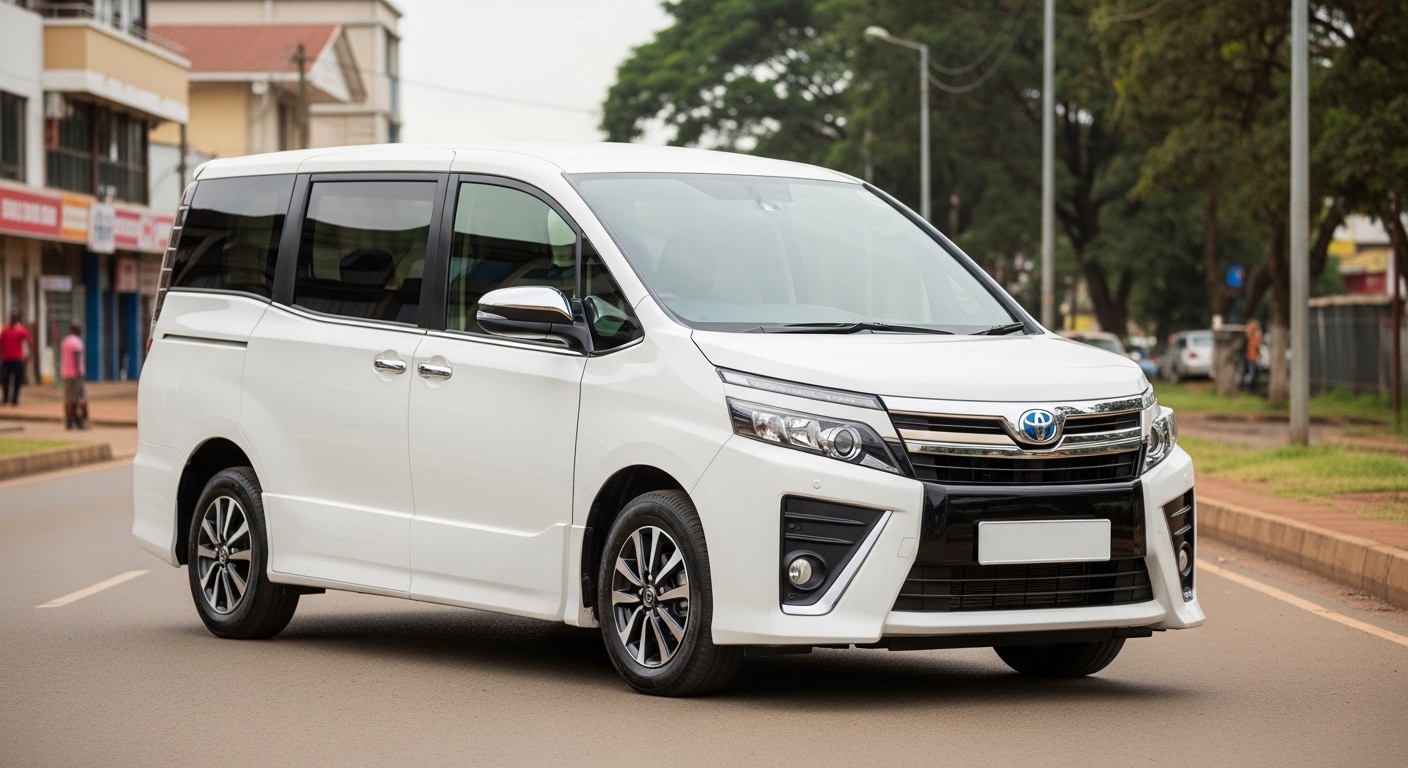 2020 Toyota Voxy
Voxy shares much of its family-MPV thinking with Noah. It has a tall cabin, sliding doors and flexible seating, which helps with children and crowded car parks. Styling and equipment can differ, so some buyers prefer the Voxy even when a similar Noah offers the same basic practicality.
The supplied Voxy category data includes 1.8-litre versions, automatic CVT transmission, 2WD and a body measuring about 4,695 mm long in the referenced configuration. The 2023 vehicle example is a hybrid with 55,000 kilometres, grade 4.5 and seven seats. The older 2014 example is petrol, has 142,000 kilometres, grade 3.5 and seven seats.
| Factor | Toyota Noah | Toyota Voxy |
|---|---|---|
| Main strength | Broad family practicality | Similar practicality with different styling |
| Seating | Variant-dependent | Variant-dependent |
| Urban use | Strong | Strong |
| Powertrains | Petrol and hybrid by generation | Petrol and hybrid by generation |
| Main check | Exact grade and seat count | Exact grade and seat count |
Voxy suits families who want a high-roof MPV for school runs, family visits and mixed urban driving. For rough roads or heavy loading, check the exact vehicle’s ground clearance, suspension and underbody rather than assuming suitability from the model name.
Who should choose it?
- Families who prefer its styling or equipment.
- Buyers wanting a sliding-door MPV for Kampala.
- Drivers comfortable comparing petrol and hybrid grades.
Who should skip it?
- Buyers who need maximum ground clearance.
- Families who regularly carry eight adults and luggage.
- Anyone relying on the model name instead of the vehicle page.
Voxy and Noah are close rivals, so condition, manufacture year and seating layout should decide the purchase. A clean seven-seater may still suit some families better than a tired eight-seater, but capacity should never be assumed.
Is Nissan Serena the strongest non-Toyota contender?
In 2017, Nissan’s official Serena specification sheet listed eight-seat configurations and variant-specific JC08 fuel figures by grade and drivetrain (Nissan, “Serena Specification Sheet”, 2017). The Nissan Serena is therefore worth serious consideration; confirm the applicable figure for the exact vehicle before comparing it with another model.
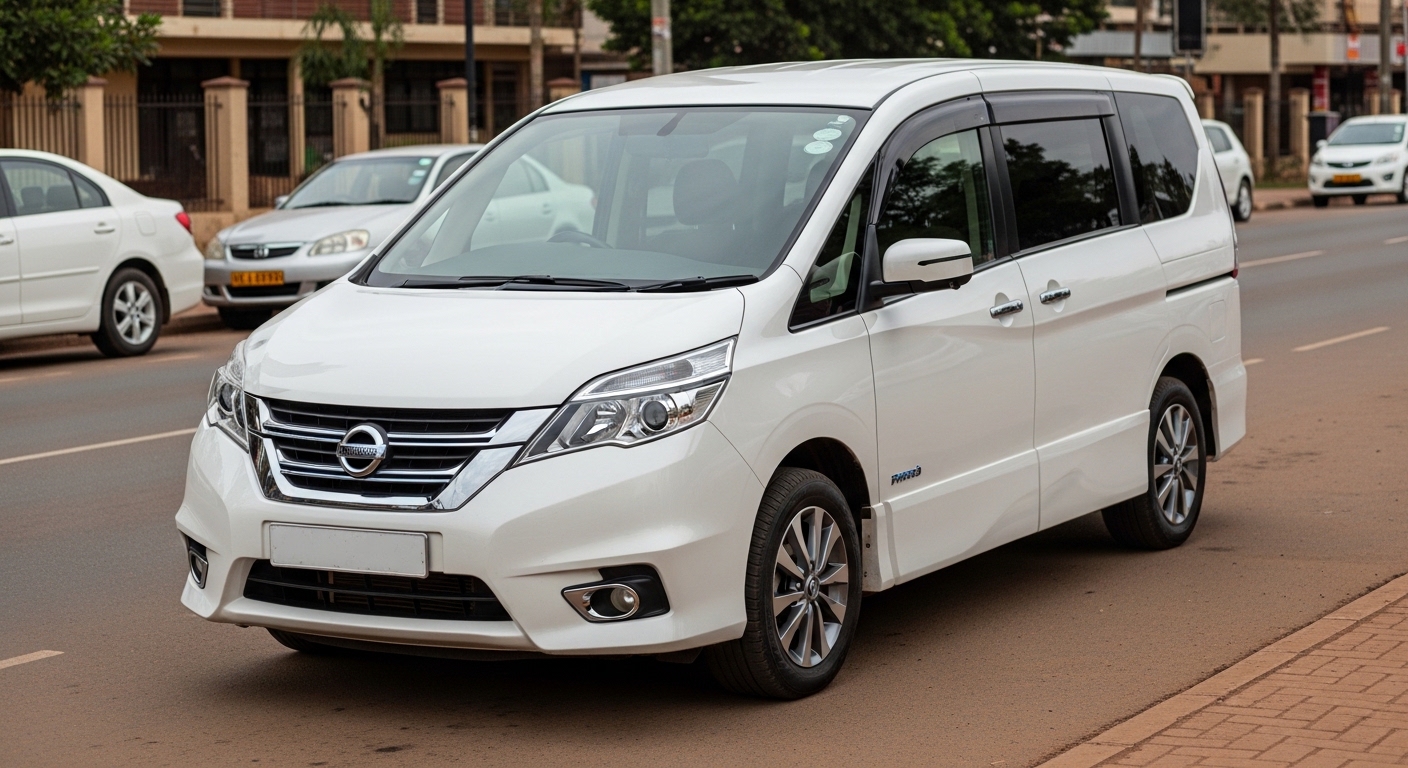 2016 Nissan Serena
The supplied 2016 Serena example is identified as an eight-seater with a 2.0-litre engine, FWD, automatic transmission, 110,000 kilometres and auction grade 4. Its vehicle page labels the fuel type as hybrid. Confirm the precise hybrid system and service history before payment, because Serena descriptions vary between petrol, S-Hybrid and other powertrain arrangements.
The same vehicle page lists the MR20DD engine and 150 PS output. Nissan’s official figures use the JC08 test cycle, which should not be compared directly with newer WLTC figures. A supplied 2018 Serena example shows the problem clearly: it is labelled hybrid but has a 1.2-litre engine and seven seats.
Serena’s sliding doors and flexible interior make it useful for school runs, family travel and passenger access. It offers a credible alternative when Toyota pricing or seating layouts do not fit. The catch is documentation. You need the exact engine, seat count, auction sheet and inspection report.
Who should choose it?
- Buyers open to a Nissan family MPV.
- Families wanting eight seats and sliding-door access.
- Drivers prepared to verify the powertrain carefully.
Who should skip it?
- Buyers wanting a simple badge-based decision.
- Anyone unable to check the hybrid system or service records.
- Buyers comparing JC08 and WLTC figures as if they were identical.
The Serena is not always a full hybrid, and not every Serena is an eight-seater. The exact vehicle page matters more than the model label.
Toyota Alphard and Vellfire: comfort before economy
In 2026, Toyota’s official Alphard seating FAQ confirms six-, seven- and eight-seat configurations across different grades and powertrains (Toyota, “Alphard: How many passengers?”, 2026). The Toyota Alphard is the comfort choice, while Vellfire should only be considered after confirming the exact layout.
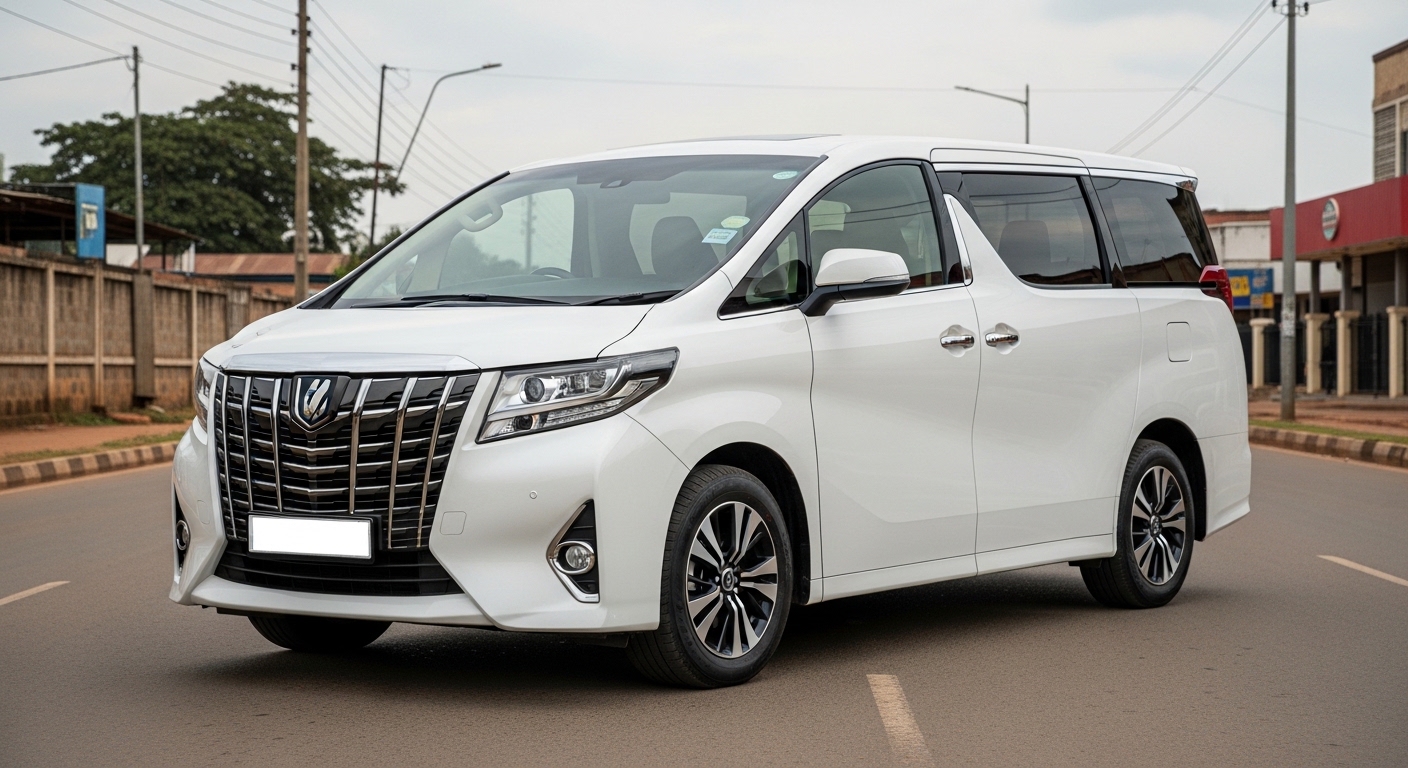 2021 Toyota Alphard
The supplied 2021 Alphard is an eight-seat, 2.5-litre petrol vehicle with FWD, automatic CVT transmission, 121,000 kilometres and auction grade 4. Its listed dimensions are 4,945 mm long, 1,850 mm wide and 1,935 mm high. That gives passengers useful cabin room, but it also makes Kampala parking and narrow roads harder.
Alphard suits long journeys, executive family transport and buyers who place passenger comfort first. The larger body and petrol engine can bring higher fuel and maintenance costs than a compact MPV. The 2015 supplied example is also eight-seat, but it is a 2.5-litre hybrid with 4WD, 145,000 kilometres and grade 3.5, so age and condition matter.
Vellfire offers a related luxury-van experience, but the supplied 2014 Toyota Vellfire example is recorded as a seven-seater. It has a 2.4-litre hybrid engine, 4WD, 161,000 kilometres and grade 3.5. It should not be ranked as an eight-seater.
Who should choose Alphard?
- Families prioritising passenger comfort and cabin space.
- Buyers with a higher budget bracket.
- People carrying passengers on longer highway journeys.
Who should skip it?
- Drivers focused mainly on fuel economy.
- Buyers who park frequently in tight Kampala spaces.
- Anyone who needs eight seats but has not checked the exact grade.
Toyota confirms multiple Alphard layouts, so an eight-seat claim must always be tied to the exact vehicle page. Vellfire needs the same caution.
Toyota Esquire: a compact option for careful cost planning
In 2020, Toyota’s Esquire Gi catalogue listed eight seats, a 1,986 cc petrol engine, 152 PS and 193 Nm, with a WLTC figure of 13.6 km/L (Toyota, “Esquire Gi Vehicle Information”, 2020). The Toyota Esquire vehicle example shows why the exact year and grade still matter.
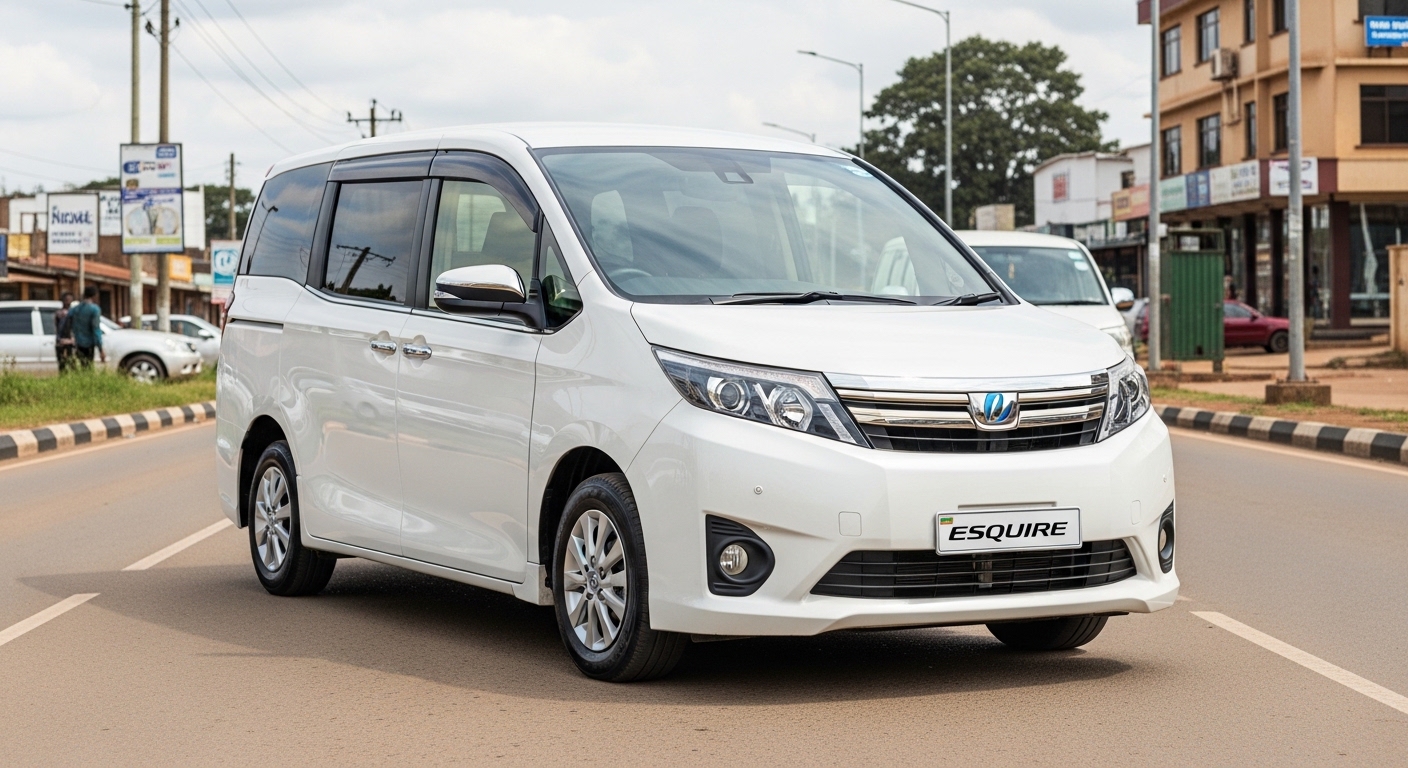 2019 Toyota Esquire
Esquire uses a compact MPV body with sliding doors, a 4,695 mm length and a 1,695 mm width in the referenced Toyota specification. It is easy to place in Kampala and shares the family-friendly shape many buyers want. Selected versions also use an 1.8-litre hybrid system.
The supplied 2015 vehicle page, however, identifies that exact example as a seven-seater. That does not cancel Esquire as a model-family recommendation, but it prevents using that vehicle as confirmed eight-seat evidence. Older examples also require careful manufacture-year checks in 2026.
Esquire makes sense for buyers who want Toyota people-mover practicality without the larger Alphard body. Whether it suits eight adults with luggage depends on the exact layout and trip. Confirm the seat count, engine, auction grade, inspection notes and vehicle-specific landed estimate before deciding.
Toyota HiAce: the high-capacity passenger option
HiAce passenger specifications vary substantially by body style, model code and any conversion. The cited 2021 vehicle page could not be verified, so this guide does not use it to claim a particular mileage, auction grade, fuel type or seat count. Confirm the exact factory model code, passenger configuration and inspection documents before importing. HiAce is best treated as a group-transport vehicle, not a direct Noah rival.
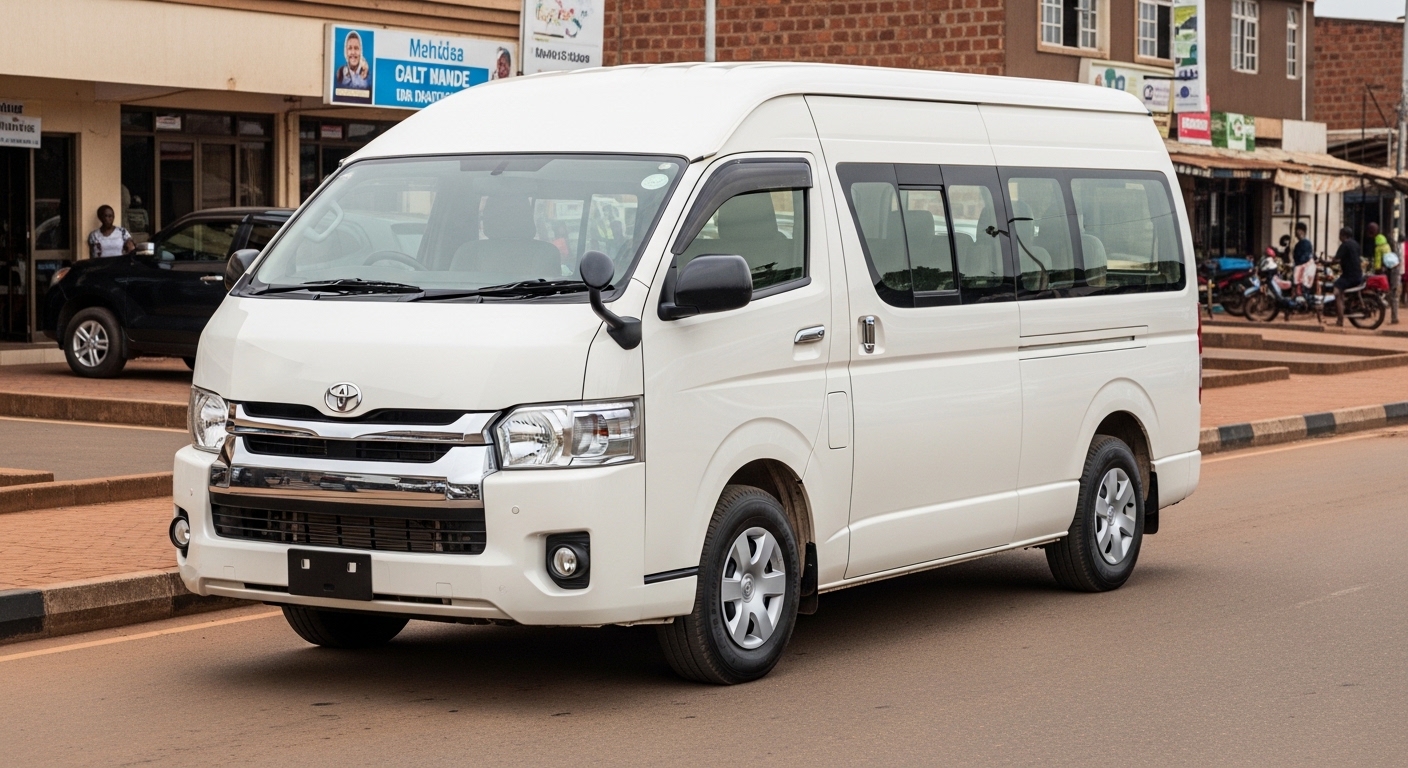 2020 Toyota HiAce
HiAce offers more room for repeated passenger work, church groups, events and business transport. Engines and body styles vary, including diesel and petrol versions, so a single fuel figure would be misleading. The exact factory seating layout or conversion must be confirmed before import.
A HiAce is taller and less car-like than a compact MPV. Parking, turning and loading in Kampala require more planning. The reward is greater passenger and luggage potential, especially when the vehicle is used for organised transport rather than ordinary family errands.
Who should choose it?
- Businesses carrying groups repeatedly.
- Churches and event organisers.
- Families who regularly transport many passengers and luggage.
Who should skip it?
- Buyers wanting an easy school-run vehicle.
- Drivers who regularly use tight urban parking.
- Anyone who has not verified the passenger conversion and seat count.
Explore Toyota HiAce passenger vans when your main need is organised group transport.
What budget and age limit should you plan for in 2026?
In 2026, URA describes its used-motor-vehicle valuation database as a current guide and risk-management reference, not automatically the final customs value (Uganda Revenue Authority, “Import and Export FAQs”, 2026). Customs valuation still follows the applicable sequential valuation methods. Use UGX brackets only for rough planning, then check the exact vehicle’s estimate and documentation.
Around 50M and below
Do not assume that an imported eight-seater will fit under 30M or even within the 30–50M range. The current cited 2016 Serena and 2014 Voxy examples have vehicle-specific landed estimates around or above 50M, while the 2015 Esquire example is higher still. Any lower bracket needs direct evidence from the exact vehicle page. Prices move with auction results and exchange rates.
A lower-priced vehicle can also create a higher ownership burden. Check the auction grade, underbody, suspension, air conditioning, hybrid system and inspection comments. A seven-seater may still be the better fit, but the seat count and landed cost must be verified.
Above 50M
The current cited Serena and Voxy examples, as well as the 2015 Esquire example, show why many imported eight-seaters should be planned for above 50M once the vehicle-specific landed estimate is considered. Newer Noah, Voxy and Serena vehicles, plus selected Alphard and Vellfire examples, need their own current estimates rather than a general model assumption.
The vehicle price and landed cost are not interchangeable. More equipment may improve comfort, but it does not automatically reduce fuel or maintenance costs. Budget for the way you will use the vehicle, not only for its equipment list.
What the vehicle price does and does not cover
The quoted vehicle price covers the vehicle, shipping and inspection as described in the buying process. It does not cover Uganda import duty, VAT, port clearance or registration. Customs valuation can also consider the vehicle, insurance and freight value.
The vehicle page’s Estimated landed cost panel is the right place to check a vehicle-specific figure. Keep that estimate separate from your family budget for local clearance and registration.
| Budget bracket | Evidence-led planning direction | Main caution |
|---|---|---|
| Around or below 50M | Do not assume an imported eight-seater fits this range | Check the exact landed estimate |
| Above 50M | Current cited Serena, Voxy and Esquire examples sit around or above this level | Prices move with auctions and exchange rates |
| Higher brackets | Newer MPVs or premium vans may require more | Compare size, fuel and maintenance |
Check Uganda’s vehicle import rules for age-limit and documentation guidance.
Which 8-seater fits Kampala, upcountry or business use?
In 2026, the supplied 2021 Alphard example measures 4,945 mm long, while the referenced compact MPV examples measure about 4,695 mm (2021 Toyota Alphard vehicle page, 2026). That 250 mm difference can matter in Kampala parking, turning and narrow access roads.
| Buyer profile | Recommended direction | Why |
|---|---|---|
| Kampala school-run family | Noah, Voxy or Serena | Sliding doors and manageable size |
| Entebbe or Jinja family trips | Noah, Voxy or Serena | Highway comfort and flexible seating |
| Regular upcountry travel | Serena, Noah or larger van | Passenger comfort and luggage |
| Comfort-focused buyer | Alphard | Larger passenger cabin |
| Fuel-conscious daily user | Verified hybrid MPV | Better potential in traffic |
| Business or event transport | HiAce | Repeated group capacity |
| Tighter budget | Eligible Esquire or older MPV | Condition matters more than badge |
A compact MPV may be easier to place in Kampala because the referenced examples are shorter than the Alphard, but parking ease, clearance and luggage capacity depend on the exact vehicle. Check the dimensions, suspension, tyres, underbody and air conditioning if you regularly travel beyond the main highways.
The Alphard is larger than the referenced compact MPVs, while its comfort level should be treated as a model and trim characteristic rather than a measured promise. HiAce offers a different, group-transport format. Which compromise matters most to your household?
Five checks before choosing
- Can it carry eight people and your normal luggage?
- Does the exact vehicle page confirm eight seats?
- What is the genuine manufacture year?
- Is the fuel figure labelled JC08 or WLTC?
- Does the Estimated landed cost fit your wider budget?
The most useful family comparison is not “which badge is strongest?” It is “which vehicle will carry our people, luggage and fuel costs without becoming difficult to use?”
For a wider shortlist, compare Toyota family cars for Kampala and upcountry driving.
How does the Japan-to-Uganda import process work?
On the published 2021 Alphard page, the vehicle record shows two reports: an auction report and a post-purchase inspection report (2021 Toyota Alphard vehicle page, 2026). Importing an eight-seater involves verifying the exact car, reviewing documents, arranging payment, shipping it to East Africa and completing local clearance.
The usual process
- Choose a vehicle and confirm the exact seat configuration.
- Check the genuine manufacture year against Uganda’s 15-year rule.
- Review the Japanese auction sheet and auction grade.
- Review the in-house inspection report before payment.
- Confirm the official proforma invoice.
- Arrange full payment through the stated payment process.
- Complete pre-shipment inspection and certification requirements.
- Ship by RoRo from Japan to Mombasa or Dar es Salaam.
- Continue by road transport to Uganda.
- Complete customs, clearance, inspection and registration.
- Track documents and shipment progress through the buyer dashboard.
The shipping schedule lists weekly sailings from Japanese ports to Mombasa and Dar es Salaam, with port transit figures of about 35 to 42 days (Japan car shipping schedule, 2026). Carbarn describes the full journey from purchase confirmation to delivery in Uganda as an operational estimate of about 6 to 10 weeks, not a promise. That estimate is separate from the shipping schedule’s cited 35–42 days of port transit.
The vehicle price excludes Uganda import duty, VAT, port clearance and registration. Customs figures can change, and the vehicle page’s Estimated landed cost panel should be used for the specific vehicle rather than a general internet estimate.
The cited sales and support pages list Japan-based management and payment information. Carbarn Uganda provides Japan-sourced vehicles, two inspection reports before payment, pre-shipment certification, weekly RoRo shipping to Mombasa or Dar es Salaam, road transport arrangements to Uganda, proforma invoices and a dashboard containing inspection sheets, bills of lading, certificates and vessel tracking.
Follow the how to buy a vehicle from Japan guide for the purchase steps.
What should you check before choosing an eight-seater?
In 2026, official Toyota data confirms that the Esquire Gi specification has eight seats, 152 PS, 193 Nm and a 13.6 km/L WLTC figure (Toyota, “Esquire Gi Vehicle Information”, 2020). Exact trim data matters, so use this checklist before comparing any model.
- Seat count: Is the exact vehicle genuinely an eight-seater?
- Manufacture year: Is the genuine production year within Uganda’s age rule?
- Layout: Does it use an eight-seat bench or seven-seat captain’s chairs?
- Luggage: What remains when every seat is occupied?
- Powertrain: Is it petrol, hybrid, S-Hybrid or diesel?
- Fuel cycle: Is the official figure JC08 or WLTC?
- Auction grade: What grade appears on the official auction sheet?
- Inspection reports: Have you reviewed both reports before payment?
- Road suitability: Does the body and suspension suit Kampala and your upcountry routes?
- Landed cost: What does the vehicle page’s Estimated landed cost panel show?
- Separate charges: Have you budgeted for customs, port clearance and registration?
A grade 4 vehicle can still need close reading. The auction grade is a broad condition indicator, while the detailed report explains dents, scratches, tyre condition, underbody condition and interior issues.
Do not choose a hybrid simply because its label sounds economical. Confirm the exact system, battery evidence and official figure. Also remember that a test-cycle result is a comparison tool, not a promise about fuel use in Kampala traffic.
Compare the 2016 Nissan Serena inspection reports and landed-cost estimate on its vehicle page.
Which Japanese 8-seater should you start with?
Toyota Noah is the best starting point for many Ugandan families because it balances passenger access, cabin flexibility and manageable size. Toyota Voxy offers a close alternative, while Nissan Serena deserves attention when its powertrain and documents are clear.
Toyota Alphard is better viewed as a comfort choice than a universal family answer. HiAce belongs with business and group transport. Esquire can make sense for a tighter budget, provided the exact vehicle is eligible and genuinely eight-seat.
Before importing, confirm the seat count, manufacture year, auction sheet, inspection report, official fuel cycle and Estimated landed cost. Then compare the vehicle with the trips you actually make, not only the number printed in the model name.