A fuel-efficient car is not automatically an easy car to resell. The next buyer will also ask whether the vehicle can be diagnosed, repaired and maintained without confusion.
Toyota Japan lists 37.0 km/L for some historical Aqua grades on the Japanese JC08 test cycle, while the first-generation range reaches 38.0 km/L (Toyota Japan, “Aqua vehicle information”, 2026). These are laboratory figures, and they cannot answer every ownership question.
This guide looks at Toyota Aqua parts and service in Uganda from a resale point of view. It covers NHP10 and Prius c identification, routine servicing, hybrid battery checks, documents and the situations where you should think twice.
Quick Answer
- A Toyota Aqua can suit resale-focused buyers when its year, records and hybrid condition are clear.
- Routine parts are easier to identify than hybrid electronics.
- Toyota lists selected NHP10 grades at 37.0 km/L on JC08; historical first-generation figures reach 38.0 km/L, not Kampala roads.
- Prius c is a useful search reference, but not every Prius c part fits every Aqua.
- Battery reports, inspection sheets and service invoices can support future buyer confidence.
For the broader Japan-to-Uganda hybrid import process, review the vehicle records and eligibility requirements before you compare resale prospects.
Is the Toyota Aqua a sensible resale purchase in Uganda?
Yes, potentially. Toyota’s first Aqua used a 1,496cc 1NZ-FXE hybrid system and a five-door body; Toyota Japan’s catalogue identifies it as a five-seat model (Toyota Global, “Vehicle Lineage: Aqua”; Toyota Japan, “Aqua vehicle information”, 2011). Those facts support its compact-city appeal, but resale depends more on condition, records, battery confidence and age headroom.
The Aqua makes sense for a buyer who mostly drives in Kampala traffic, wants a small automatic hatchback and values lower fuel use. Its compact body is easier to place in busy streets than a larger family vehicle. The hybrid system can also make stop-start driving less wasteful than a conventional petrol car.
That does not make it the right fit for everyone. A family needing generous rear-seat space may prefer a larger Toyota. A driver who regularly uses rough rural roads should also consider ground clearance and underbody condition. The model page itself identifies limited rough-road suitability as a weakness, so that trade-off deserves attention before purchase.
Fuel economy can support demand, but it does not guarantee a strong resale outcome. A clean, well-documented Aqua with a healthy hybrid system will usually be easier to explain than one with warning lights, missing records or an unclear manufacture year.
In Uganda, the genuine year of manufacture matters for import eligibility and future buyer confidence. Registration year is not a substitute. Current URA guidance says vehicles 15 years old or older cannot be imported for registration, so an eligible vehicle must be under 15 years old from its year of manufacture. URA also warned in 2023 that manufacture years had been altered to bypass the restriction (Uganda Revenue Authority, “URA Meets Car Importers Over Impounded Vehicles”, 2023).
| Ownership question |
Lower concern |
Higher concern |
What protects future resale? |
| Routine servicing |
Filters, tyres, brakes and suspension |
Incorrect variant-specific parts |
Chassis-code and part-number records |
| Hybrid system |
Written scan report and clean dashboard |
Unresolved warning lights |
Diagnostic reports and repair invoices |
| Battery |
Tested condition and clear history |
Unknown battery condition |
Battery health evidence |
| Documentation |
Genuine year and complete papers |
Unclear year or missing records |
Auction sheet and inspection documents |
| Buyer appeal |
Clean, standard and well-kept car |
Poor repairs or unexplained modifications |
Honest condition disclosure |
Citation capsule: The Toyota Aqua is a five-seat, five-door hybrid hatchback using a 1,496cc 1NZ-FXE engine in early NHP10 versions. Toyota Global recorded 35.4 km/L on the JC08 cycle for the first model, while Toyota Japan identifies the five-seat specification. Uganda resale depends on documented condition, battery health and genuine manufacture year, not laboratory economy alone (Toyota Global, “Vehicle Lineage: Aqua”; Toyota Japan, “Aqua vehicle information”, 2011).
Toyota Aqua parts that are usually straightforward to source
Routine parts are the least worrying area. Toyota’s 2015 Prius c catalogue covers filters, batteries, engine, electrical and body categories, while its search function asks for a vehicle or VIN (Toyota Parts, “2015 Toyota Prius C Parts and Accessories”, 2015). That supports research, not a promise of local stock.
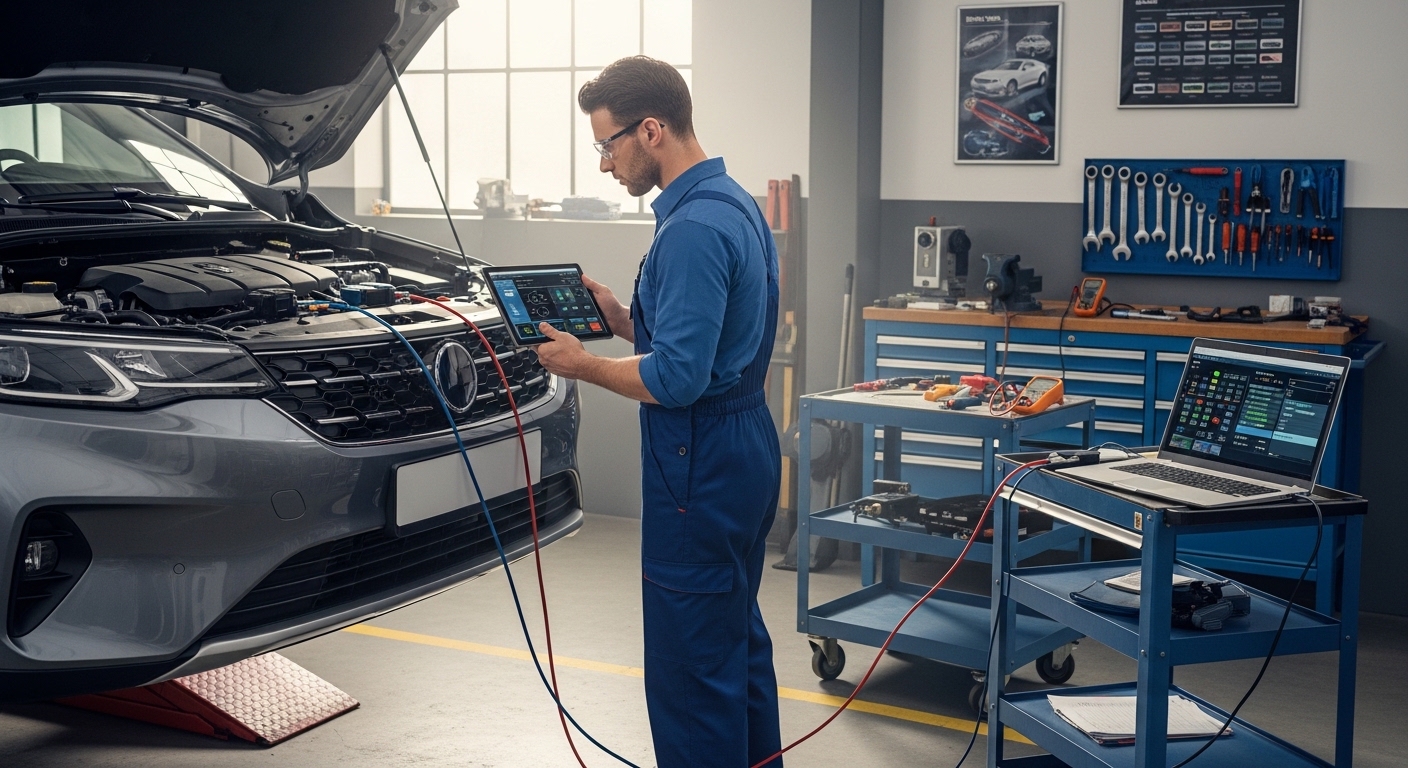 A mechanic runs diagnostics on a car in a well-equipped auto workshop.
Items such as engine oil filters, air filters, cabin filters, wiper blades, tyres, bulbs and some brake components are often easier to identify or order than hybrid electronics. Suspension bushes, shocks and steering parts may also be serviceable through normal workshops, but the exact grade and chassis details still matter.
Body panels, lamps, interior electronics and control modules need more care. A supplier may recognise the word “Aqua” but still need the chassis number, model year, trim and part reference. A part that looks similar can have different mounting points, wiring or software.
The safest parts request includes five details:
- Toyota Aqua name.
- NHP10 or another model code.
- Manufacture year.
- Chassis or VIN number.
- Exact part number, with a photo when needed.
The 2019 example used in this guide has the early 1NZ-FXE engine code and 1,500cc displacement. A later Aqua may use a different engine family, so year and model code are not optional details.
| Part category |
Ownership position |
Resale relevance |
Evidence to keep |
| Filters and wipers |
Routine service items |
Shows regular maintenance |
Invoice and part reference |
| Brakes and tyres |
Common wear items |
Affects immediate buyer confidence |
Fitting record |
| Suspension parts |
Variant-dependent |
Important on Kampala roads |
Repair invoice |
| Body panels and lamps |
Trim and year dependent |
Affects appearance and accident concerns |
Part source |
| 12-volt battery |
Separate from hybrid battery |
Can cause electrical warnings |
Battery test |
| High-voltage battery |
Specialist component |
Major buyer-confidence issue |
Diagnostic report |
| Inverter and electronics |
Specialist component |
Creates repair uncertainty |
Technician report |
Parts terminology
- Aqua: Japanese-market model name.
- Prius c: Name used in several export markets.
- NHP10: Key identifier for many early Aqua examples.
- 1NZ-FXE: Early hybrid petrol engine code.
- Part number: The safest compatibility check.
Citation capsule: Toyota’s 2015 Prius c parts catalogue lists routine parts and hybrid components, but it applies to US-market vehicles and does not prove every item is stocked in Uganda. Buyers should provide the Aqua’s chassis number, model year and exact part number before ordering any component (Toyota Parts, “2015 Toyota Prius C Parts and Accessories”, 2015).
For model and make details, use the Toyota car specifications reference.
Can Prius c parts fit a Toyota Aqua?
Some can cross-reference, but full interchangeability should never be assumed. Toyota parts documentation identifies Prius c applications from 2012 to 2021 as NHP10 with the 1NZ-FXE engine, which explains why “Prius c” helps international searches (Toyota Parts and Service, “Air Filters 2024”, 2024).
The naming chain is useful:
Toyota Aqua → NHP10 → model year and grade → chassis or VIN → exact part number → supplier confirmation
The shared NHP10 family can help identify possible cross-references, especially for some filters, but each mechanical or hybrid component still requires part-number confirmation. It does not prove that every body panel, lamp, interior switch, electronic module or wiring harness will fit.
Market differences matter. Trim levels can change equipment. Model years can change connectors. Japanese-market lighting, dashboards and control systems may differ from parts listed for an overseas Prius c.
A supplier who says, “It fits a Prius,” has not provided enough information. Ask whether the reference matches your chassis and component number. Third-party cross-reference websites can help with research, but they should not replace manufacturer or supplier confirmation.
Do not automatically order parts listed for a Prius, Prius c, Yaris, Vitz or Fielder. Some may fit. Others may create wasted time, return problems or a repair that weakens confidence when you later sell the car.
Citation capsule: Prius c is a useful international parts-search name because Toyota documentation connects 2012 to 2021 Prius c applications with the NHP10 and 1NZ-FXE identifiers. That evidence supports targeted cross-checking, not universal compatibility across every Aqua grade, year, body component or electronic module (Toyota Parts and Service, “Air Filters 2024”, 2024).
Toyota Aqua servicing requirements
The Aqua needs normal petrol-car maintenance plus hybrid diagnosis. Toyota Uganda states that general maintenance is scheduled every 5,000 kilometres or six months, whichever comes first (Toyota Uganda, “Frequently Asked Questions”, 2026). The vehicle’s own manual and condition should determine the final schedule.
A mechanic runs diagnostics on a car in a well-equipped auto workshop.
Routine maintenance includes engine oil, oil filters, air filters, cabin filters, tyres, wheel alignment, suspension, coolant and brake checks. Kampala traffic and uneven road surfaces can make tyres, bushes, shocks and alignment especially important for daily use.
Regenerative braking changes how the car uses its brakes. Brake wear may therefore differ from a conventional petrol hatchback, although the cited specification does not quantify that difference. That does not mean the brakes can be ignored. Pads, discs, callipers and the brake actuator still need proper inspection.
For a prudent pre-purchase inspection, use suitable hybrid equipment. A technician can scan the high-voltage system, review battery behaviour, inspect the cooling intake and fan, check the inverter and examine regenerative-braking operation. Warning lights should be diagnosed before anyone clears the codes; this is a recommended checklist, not a universal Toyota service schedule.
A useful inspection sequence is:
- Confirm the chassis and engine codes.
- Scan for stored hybrid faults.
- Review battery state-of-charge behaviour.
- Inspect the battery cooling intake and fan.
- Test the 12-volt battery.
- Check brake and regenerative-braking operation.
- Inspect tyres, suspension and underbody.
- Record findings in writing.
A normal garage may handle oil and tyres well. That does not automatically mean it can safely diagnose high-voltage faults. Would you rather discover that difference before purchase or after a warning light appears?
Citation capsule: Toyota Uganda gives general service guidance of 5,000 kilometres or six months, whichever comes first. An Aqua also needs hybrid-system scans, battery-cooling checks and suitable brake diagnosis. The maintenance manual remains the final reference because service needs vary by model year, condition and use (Toyota Uganda, “Frequently Asked Questions”, 2026).
Read the Japan-to-Uganda car import process for the documents and steps involved.
Is the hybrid battery the main Toyota Aqua resale risk?
Battery uncertainty is one of the biggest resale concerns, but age alone cannot diagnose a fault. Toyota’s Prius c catalogue lists hybrid battery parts, yet it provides no Uganda-specific replacement price or fixed service life (Toyota Parts, “2015 Toyota Prius C Parts and Accessories”, 2015).
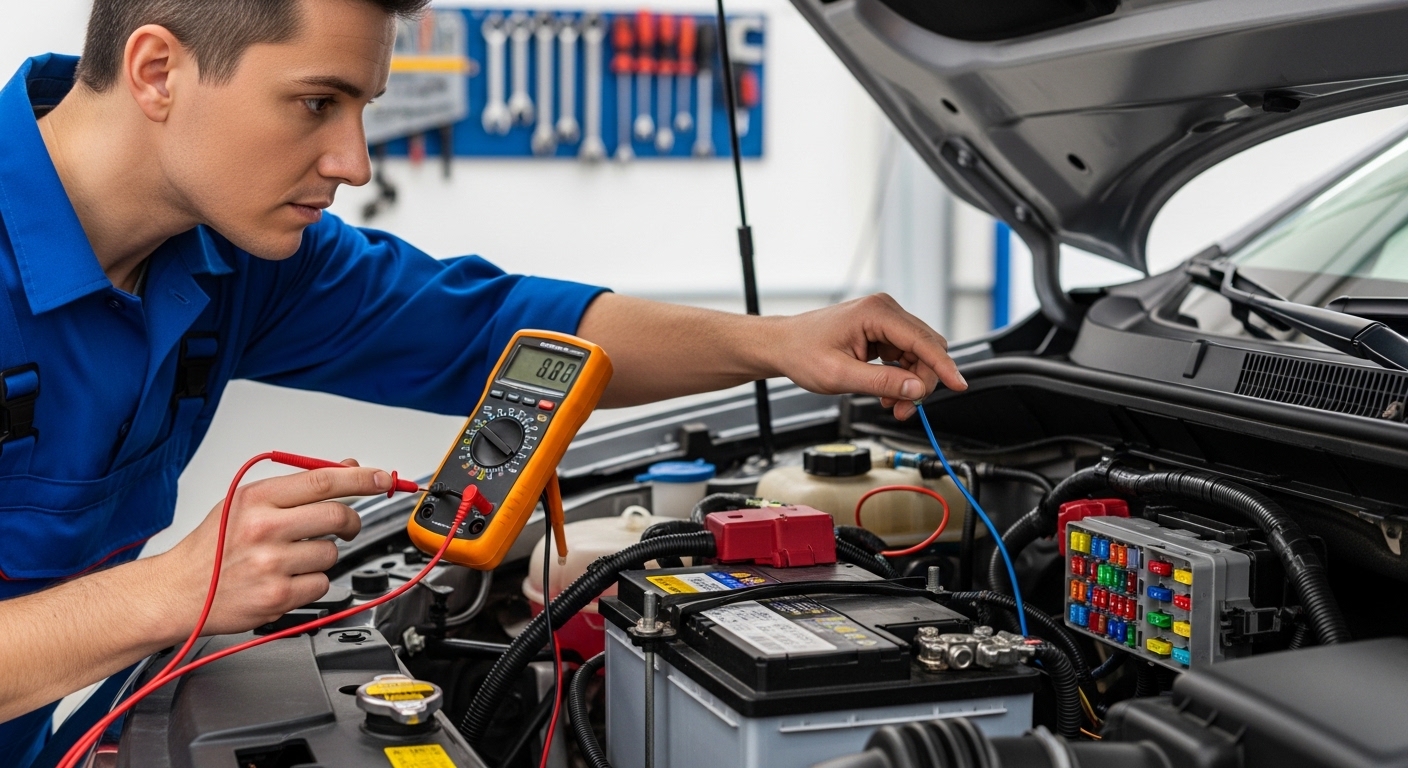 Mechanic checks a vehicle battery and fuse box with a multimeter during service.
The Aqua has two battery systems that buyers should keep separate. The small 12-volt battery supports vehicle electronics and start-up functions. The high-voltage hybrid battery stores energy for the hybrid drive system. A weak 12-volt battery does not automatically mean the high-voltage battery has failed.
Possible warning signs include rapid state-of-charge changes, reduced electric assistance, hybrid warning lights, unusual cooling-fan noise and fuel use that has changed noticeably. These signs need testing. They do not prove a battery replacement is required.
The battery cooling intake and fan deserve attention. Dust or blocked ventilation can increase heat stress. A technician should inspect the intake, check the fan and record the result. This is a simple ownership habit that can reassure the next buyer.
Keep the following records:
- Battery health report.
- Scan-tool report.
- Cooling-fan inspection or cleaning record.
- 12-volt battery test.
- Replacement battery invoice.
- Details of whether a component was new, reconditioned or used.
A replacement battery should also be disclosed when selling. Hiding a repair creates the same uncertainty that makes buyers nervous about imported hybrids.
Citation capsule: Toyota’s Prius c catalogue confirms that hybrid battery components are supported parts, but it does not establish a fixed lifespan or Ugandan replacement cost. For a Toyota Aqua, battery condition should be tested through scan data, cooling-system inspection and repair records, rather than guessed from the vehicle’s age (Toyota Parts, “2015 Toyota Prius C Parts and Accessories”, 2015).
What makes a Toyota Aqua easier or harder to resell?
A documented Aqua is easier to explain to a future buyer. Uganda does not permit vehicles 15 years old or older to be imported for registration, so the genuine manufacture year is especially important. URA’s 2023 warning also shows why altered year information creates serious risk (Uganda Revenue Authority, “URA Meets Car Importers Over Impounded Vehicles”, 2023).
Resale-supporting factors include:
- Genuine manufacture year.
- Complete import and inspection documents.
- Auction sheet.
- Service invoices.
- Hybrid diagnostic report.
- No unresolved dashboard warning lights.
- Straight body and matching panels.
- Clean interior.
- Correct NHP10 and part identification.
- Battery-cooling maintenance records.
- Standard, practical repairs.
Resale-damaging factors include:
- Unclear manufacture year.
- Odometer concerns.
- Missing service history.
- Unknown battery replacement.
- Warning lights.
- Blocked cooling fan.
- Poorly repaired accident damage.
- Mismatched panels.
- Incorrect parts.
- Unexplained cosmetic modifications.
UNBS’s 2024 notice stated that imported used vehicles need a Certificate of Road Worthiness from the country of origin or export under its PVoC programme (UNBS, “Notice to All Exporters, Importers and Dealers of Used Motor Vehicles”, 2024). Because the notice is dated, confirm the current UNBS PVoC requirement before relying on it. That document belongs in the vehicle file, alongside auction and service records.
Service records can reduce the information gap between you and the next buyer. A folder containing invoices, scan results, inspection documents and parts references may support confidence more effectively than expensive cosmetic accessories.
| Resale factor |
Why buyers care |
| Battery report |
Reduces hybrid-specific uncertainty |
| Service invoices |
Shows how the car was maintained |
| Auction sheet |
Helps verify original condition |
| Manufacture year |
Affects eligibility and future demand |
| Tyres and suspension |
Shows readiness for Ugandan roads |
| Correct parts history |
Helps future maintenance |
| Clean dashboard |
Reduces fear of hidden faults |
Citation capsule: A Toyota Aqua’s resale confidence depends on more than fuel economy. The 15-year manufacture-year rule, UNBS roadworthiness documentation and a clear hybrid service history all help the next buyer assess risk. A clean dashboard and complete records can matter more than a low asking price or cosmetic upgrades (UNBS, “Notice to All Exporters, Importers and Dealers of Used Motor Vehicles”, 2024).
Check the Uganda vehicle import rules and documentation before relying on any eligibility information.
What does the 2019 Toyota Aqua example show about choosing a year?
The Toyota Aqua example reviewed for this article is a 2019 hybrid with 104,000 kilometres, auction grade 4, a 1,500cc 1NZ-FXE engine and five seats (2019 Toyota Aqua vehicle page, 2026). It offers a useful newer NHP10 reference, but age alone does not decide value.
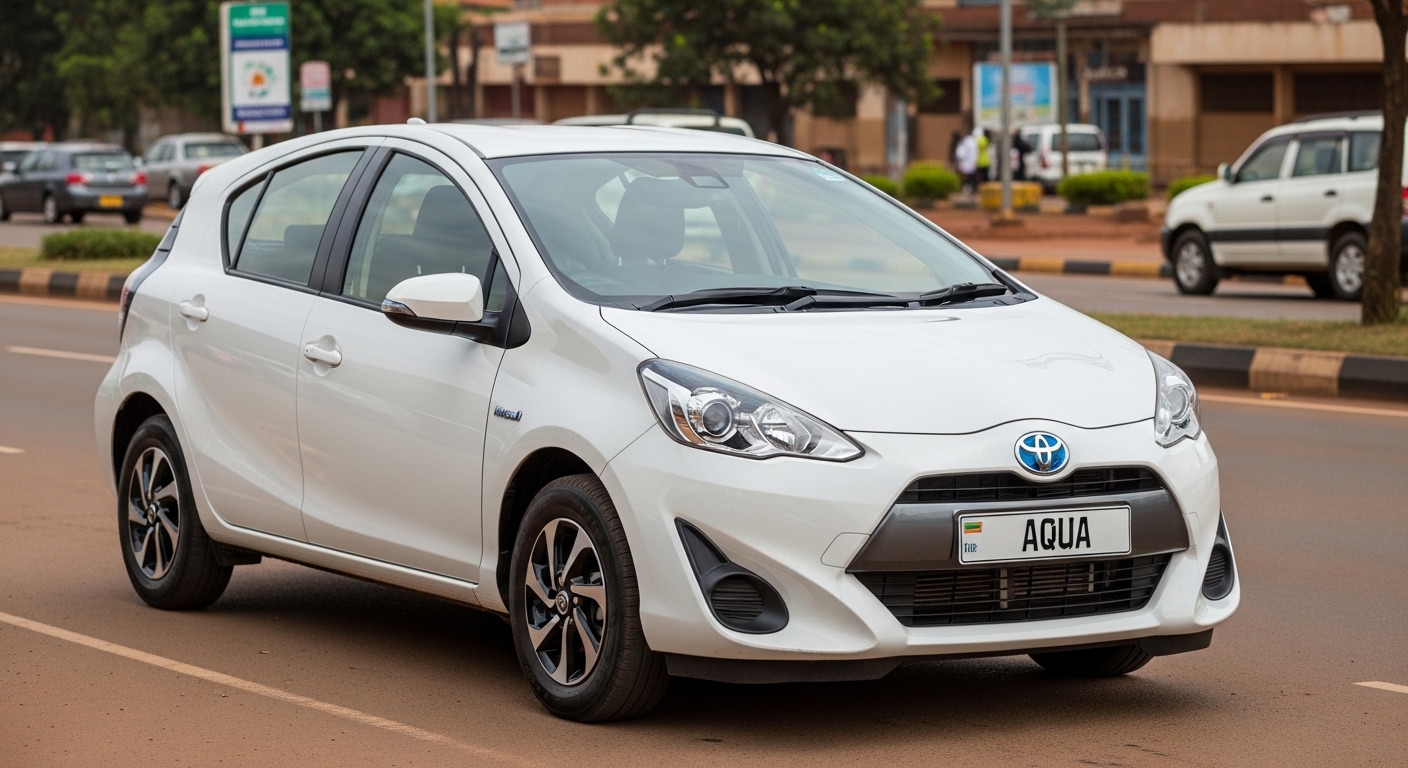 2019 Toyota Aqua
Toyota Global lists the early NHP10 engine at 74 PS and 1,496cc, while the vehicle page records its engine code as 1NZ-FXE and engine size as 1,500cc. Toyota’s first Aqua also used a five-door hatchback body, and Toyota Japan identifies the model as having five seats (Toyota Japan, “Aqua vehicle information”). Official economy figures vary by year and grade, so do not attach one figure to every Aqua.
The 2019 page records minor rear-bumper imperfections. That detail matters because auction grade alone does not describe every defect. A future buyer will want to see the auction sheet, inspection notes and any repair evidence.
An older eligible Aqua may sit in a lower UGX budget bracket, but it needs careful battery, suspension and body checks. It also has less remaining age headroom. Strong records can make an older example sensible, but a low initial bracket should not be the only reason to choose it.
A mid-generation Aqua can balance purchase bracket, age and buyer appeal. The exact manufacture year, condition and battery report still matter more than a broad generation label.
A newer Aqua may occupy a higher purchase and landed-cost bracket. It may offer more time before the age limit becomes a concern, but it is not automatically the better purchase. The 2022 example reviewed in the same research snapshot carried auction grade 3.5, while the 2019 example carried grade 4.
Citation capsule: The 2019 Toyota Aqua example has 104,000 kilometres, auction grade 4, a 1,500cc 1NZ-FXE engine and a minor rear-bumper note. These details show why buyers should assess year, mileage, grade, defects and inspection records together, rather than treating a newer model year or auction grade as a complete resale assessment (2019 Toyota Aqua vehicle page, 2026).
For a broader comparison, review the Toyota Aqua model range and current vehicle examples.
What should you ask before buying a Toyota Aqua in Uganda?
Ask for evidence that identifies the vehicle, proves its condition and shows that its hybrid system has been checked. UNBS stated in its 28 March 2024 notice that used vehicles need a Certificate of Road Worthiness from the origin or export country under PVoC (UNBS, “Notice to All Exporters, Importers and Dealers of Used Motor Vehicles”, 2024).
Questions for a seller or importer
- What is the exact manufacture year?
- What is the chassis code?
- What is the auction grade?
- Can I see the auction sheet?
- Is there a separate inspection report?
- Has the hybrid system been scanned?
- Has the battery cooling fan been checked?
- Are there any dashboard warning lights?
- Which parts have been replaced?
- Are service records available?
- What does the quoted vehicle amount include?
- Which costs remain for clearance, taxes and registration?
Questions for a workshop
- Do you have a hybrid-capable scan tool?
- Can you read battery block data?
- Can you inspect the inverter and brake actuator?
- Can you identify parts using the chassis code and VIN?
- Do you provide a written diagnostic report?
- Can you safely fit and test a replacement battery?
The answers should be written down. Verbal reassurance is difficult to pass to the next buyer. Written evidence travels with the car and makes future service decisions simpler.
Do not clear a warning light before understanding why it appeared. A clean dashboard without a scan report may not tell the full story. The same applies to a replacement battery with no invoice or test result.
Citation capsule: UNBS requires a Certificate of Road Worthiness for imported used vehicles under PVoC, while a buyer also needs vehicle-specific evidence such as the auction sheet, inspection report and hybrid scan. Together, these documents create a clearer ownership record and reduce uncertainty when the Aqua is eventually sold (UNBS, “Notice to All Exporters, Importers and Dealers of Used Motor Vehicles”, 2024).
For eligibility guidance, see the Toyota Aqua model page and import rules.
How can the import process support your resale records?
A vehicle-specific import process can provide two inspection reports before payment, an export inspection certificate and shipping documents. It can also show the manufacture year, mileage, auction grade and defect notes before the vehicle leaves Japan.
Buyers should compare those details with the vehicle page and keep copies of the proforma invoice, auction sheet, inspection report, certificate, bill of lading and final clearance documents. The page’s Estimated landed cost panel is the correct place to review a vehicle-specific estimate.
The listed vehicle amount covers the vehicle, shipping and inspection. Import duty, VAT, port clearance and registration remain separate costs. The linked Uganda import rules and documentation page should not be treated as the sole current authority because its steering and tax guidance is internally inconsistent. Confirm the latest requirements with URA and UNBS before committing.
The journey runs from Japan to Mombasa or Dar es Salaam, followed by road transport to Uganda. Allow roughly six to ten weeks as an end-to-end estimate, but confirm the current timing because clearance and handover can add time; the cited buying guide mainly supports shorter transit estimates.
With Carbarn, buyers can review Japanese vehicles listed through the service, the official Japanese auction sheet and Carbarn inspection report before payment, see EAA pre-shipment certification where shown, compare year, mileage, grade and condition, use the vehicle page’s Estimated landed cost panel, receive a proforma invoice, follow RoRo shipping to Mombasa or Dar es Salaam and road delivery to Uganda, and use the self-service dashboard for invoices, inspection reports, bill of lading, certificates and live vessel tracking. Sales and support run through Japan by email and WhatsApp; confirm the current support arrangement and facilities before relying on it.
Citation capsule: The buying process provides a practical record of a vehicle’s identity and condition. Two inspection reports, export certification, shipping documents and dashboard access can help the next owner understand what was purchased. The records do not remove ownership costs, but they make the Aqua easier to assess and explain (How to Buy a Japanese Car, 2026).
The resale verdict
The Toyota Aqua remains a sensible option for a Kampala-focused buyer who values compact size, Toyota familiarity and hybrid efficiency. Toyota Global recorded 35.4 km/L on the JC08 cycle for the first Aqua, but real resale confidence comes from records, diagnosis and condition (Toyota Global, “Vehicle Lineage: Aqua”, 2011).
Routine parts are not the main concern. The bigger risks are incorrect parts identification, unsuitable diagnosis, unknown battery condition and missing paperwork. Search with Aqua, Prius c, NHP10 and the exact part number, then confirm the reference with a supplier.
Choose the newest well-documented eligible car that fits your UGX budget bracket. Do not choose solely by the lowest initial cost. Think twice if you have no access to hybrid-capable diagnosis, need more family space or cannot keep service records.
Browse Toyota Aqua vehicles by model and year when comparing eligible examples.
Sources and verification notes
- Toyota Global, “Vehicle Lineage: Aqua”, retrieved 2026-08-13, https://www.toyota-global.com/company/history_of_toyota/75years/vehicle_lineage/car/id60017505/index.html
- Toyota Japan, “Aqua vehicle information”, retrieved 2026-08-13, https://toyota.jp/ucar/catalog/brand-TOYOTA/car-AQUA/
- Toyota Japan, “Aqua fuel economy catalogue”, retrieved 2026-08-13, https://toyota.jp/ucar/catalog/brand-TOYOTA/car-AQUA/nenpi/
- Toyota Parts, “2015 Toyota Prius C Parts and Accessories”, retrieved 2026-08-13, https://autoparts.toyota.com/models/prius-c/2015
- Toyota Parts and Service, “Air Filters 2024”, retrieved 2026-08-13, https://www.toyotapartsandservice.com/wp-content/uploads/2024/10/02_AirFilters2024_hi-1.pdf
- Toyota Uganda, “Frequently Asked Questions”, retrieved 2026-08-13, https://www.toyota.co.ug/en/faq
- Uganda Revenue Authority, “URA Meets Car Importers Over Impounded Vehicles”, retrieved 2026-08-13, https://ura.go.ug/en/ura-meets-car-importers-over-impounded-vehicles/
- Uganda National Bureau of Standards, “Notice to All Exporters, Importers and Dealers of Used Motor Vehicles”, retrieved 2026-08-13, https://www.unbs.go.ug/news-highlights.php?news=276&read=
- 2019 Toyota Aqua vehicle page, retrieved 2026-08-13, https://www.carbarn.ug/vehicles/2019-toyota-aqua-10599
- How to Buy a Japanese Car, retrieved 2026-08-13, https://www.carbarn.ug/how-to-buy


