A Toyota C-HR can look like the answer for a Kampala driver who wants SUV styling without a large fuel bill. Its compact body is easier to place in busy streets, while the hybrid system suits stop-start traffic.
The catch is space. The rear cabin feels tighter than a conventional family wagon, and most Japanese-market hybrid examples use 2WD. This guide explains the Toyota C-HR price in Uganda, official fuel economy, key features, model codes and the checks to complete before importing one from Japan.
Quick Answer
- Japanese-market Toyota C-HR examples include five-seat 1.8-litre hybrids with automatic electric CVT and 2WD, alongside 1.2-litre turbo petrol versions, including some 4WD models.
- Toyota’s official 2017 figure is 30.2 km/L on the JC08 cycle for the hybrid, compared with 15.4 km/L JC08 for the 1.2-litre turbo petrol version (Toyota C-HR specification PDF, 2017).
- Rounded vehicle prices generally sit around UGX 35M–55M, while estimated landed costs may fall around UGX 75M–85M, depending on the vehicle and final charges.
- The C-HR suits Kampala commuters and small families more than large families or regular rough-road travellers.
- Check the manufacture year, auction sheet, hybrid condition, inspection documents and estimated landed cost before paying.
Toyota C-HR pricing in Uganda
In 2026, the Toyota C-HR model and listing page recorded 23 Japanese-market listings from 2016 to 2019, with odometers from 42,000 to 128,000 km (Toyota C-HR Price in Uganda | Japan Stock, 2026). That spread explains why one C-HR can cost noticeably more than another.
Older or higher-mileage Japan-stock examples usually sit around the UGX 35M–45M vehicle-price bracket. Cleaner 2017–2019 Japan-stock examples commonly sit around UGX 40M–55M. These are editorial UGX budget estimates based on the listing records reviewed in August 2026, not a live conversion quote, fixed price or the price of a registered car in Uganda.
The vehicle amount is not the complete Ugandan on-road cost. It covers the vehicle, shipping and inspection, but import duty, VAT, port clearance and registration remain separate costs.
URA explains in its Import and Export FAQs, 2026, that customs valuation can include the price, insurance and freight up to the port of importation. Used vehicles can also be valued through the Used Motor Vehicle Valuation Database rather than relying only on the seller’s invoice.
| Cost concept |
Rounded Uganda budget band |
What it means |
| Vehicle price |
UGX 35M–55M |
The Japanese vehicle, depending on year, grade, mileage and variant |
| Estimated landed cost |
UGX 75M–85M |
An August 2026 vehicle-level estimate only; it changes with valuation and final charges |
[UNIQUE INSIGHT] The most useful question is not “What does the C-HR cost?” Ask instead, “Which part of the cost am I looking at?” Review the individual vehicle page’s Estimated landed cost panel, then read the Uganda vehicle import rules before setting your final budget.
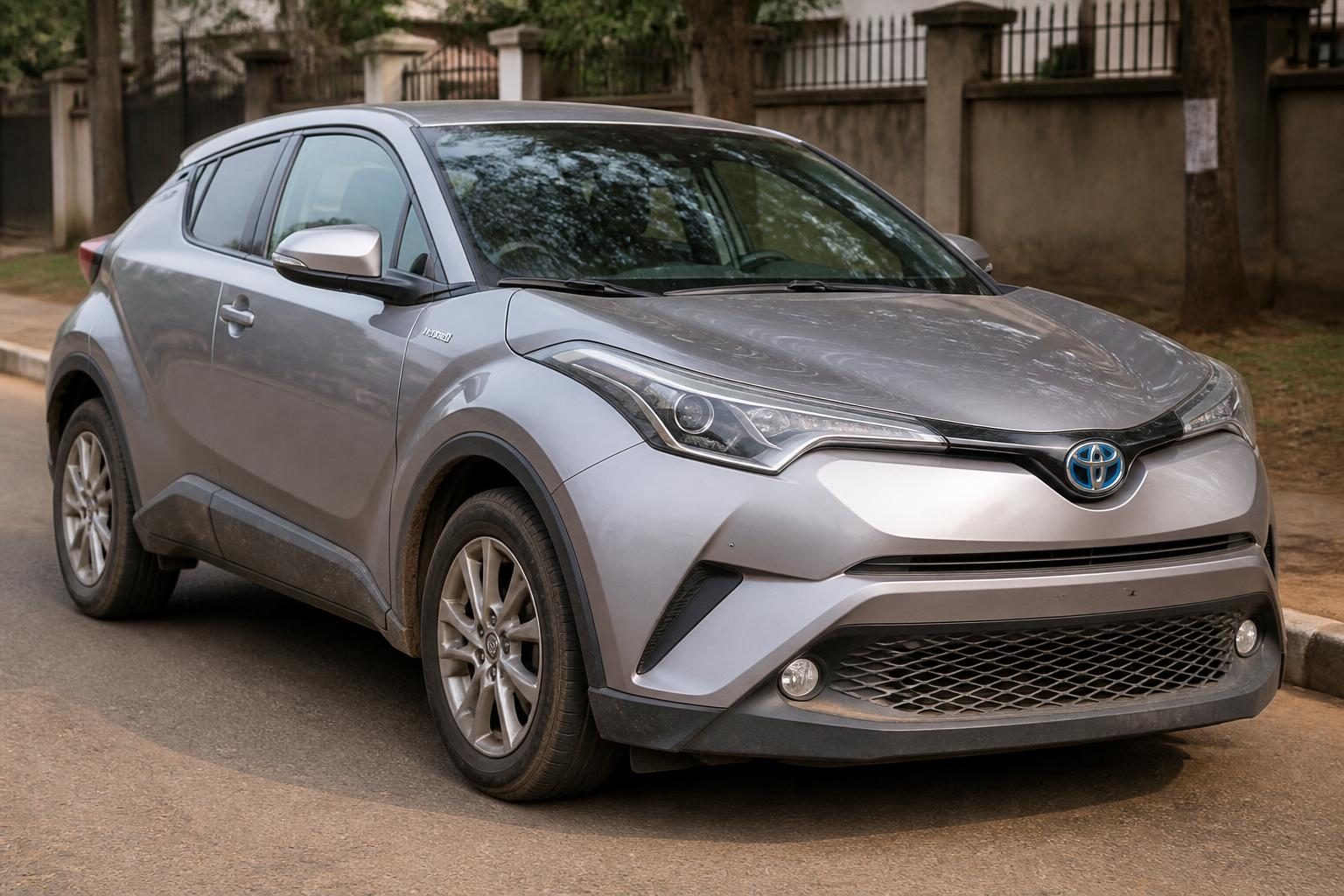
The 2019 Toyota C-HR G hybrid example
In 2026, a matching 2019 example appeared in the C-HR results with 42,000 km and auction grade 4.5. Treat it as a benchmark only: call it a late-2019 ZYX11, the facelifted model code, only if its manufacture month confirms production from October 2019. The mileage and grade still need documentary and mechanical verification.
 2019 Toyota C-HR
This example uses a 1.8-litre hybrid engine, automatic electric CVT transmission, 2WD and five seats. Its model code is ZYX11, and its G grade points to a higher equipment level than the S grade, although the exact features still depend on the vehicle record.
A grade 4.5 and low odometer reading are encouraging starting points. They do not replace the auction sheet, inspection report or hybrid-system information. The manufacture date also matters because Uganda’s import-age rule is based on the year of manufacture, not simply the registration year.
Is the Toyota C-HR fuel efficient in Kampala?
Toyota’s 2017 C-HR specification lists 30.2 km/L JC08 for the 1.8-litre hybrid and 15.4 km/L JC08 for the 1.2-litre turbo petrol model (Toyota C-HR specification PDF, 2017). The hybrid is therefore the stronger choice for buyers who place fuel economy ahead of turbo-petrol performance.
JC08 is a controlled Japanese test cycle. It helps compare versions, but it does not promise the same result on Kampala roads. Heavy congestion, long idling, air-conditioning, hills, tyre pressure, passengers and luggage can all reduce actual economy.
Hybrid systems can suit stop-start driving because regenerative braking sends some energy back into the battery and can reduce engine idling, as explained by the U.S. Department of Energy Hybrid Electric Vehicle Basics. The source does not establish a 2026 publication date.
What about conflicting online figures? Treat any unexplained fuel field as unresolved. Do not silently convert it, especially when it conflicts with Toyota’s official JC08 result. Confirm the fuel type, model code and source before comparing one listing with another.
The C-HR hybrid will not use the same amount of fuel in every part of Uganda. It makes the most sense when your routine includes Kampala traffic, frequent braking and regular urban driving.
What features and specifications matter most?
Toyota’s official 2017 C-HR specification document lists a 1,797 cc engine, 98 PS or 72 kW, a 43-litre tank and five seats (Toyota C-HR specification PDF, 2017). Those figures describe the early Japanese hybrid configuration and should not be applied blindly to every grade or model year.
The common hybrid layout includes front-wheel drive, an electric CVT and five doors. Toyota’s 2017 Japanese specification gives the early ZYX10 hybrid body dimensions as approximately 4,360 mm long, 1,795 mm wide and 1,550 mm high. The 2019 ZYX11 catalogue lists a 4,385 mm body length, so do not apply the early figure to later cars. The 2017 source lists peak engine torque of 142 Nm.
Typical safety equipment includes driver, passenger and side airbags, ABS, traction control, Brake Assist, EBD, seatbelt pretensioners and side-impact protection. Toyota’s Japanese launch material also identified Toyota Safety Sense P, but equipment must be checked against each vehicle.
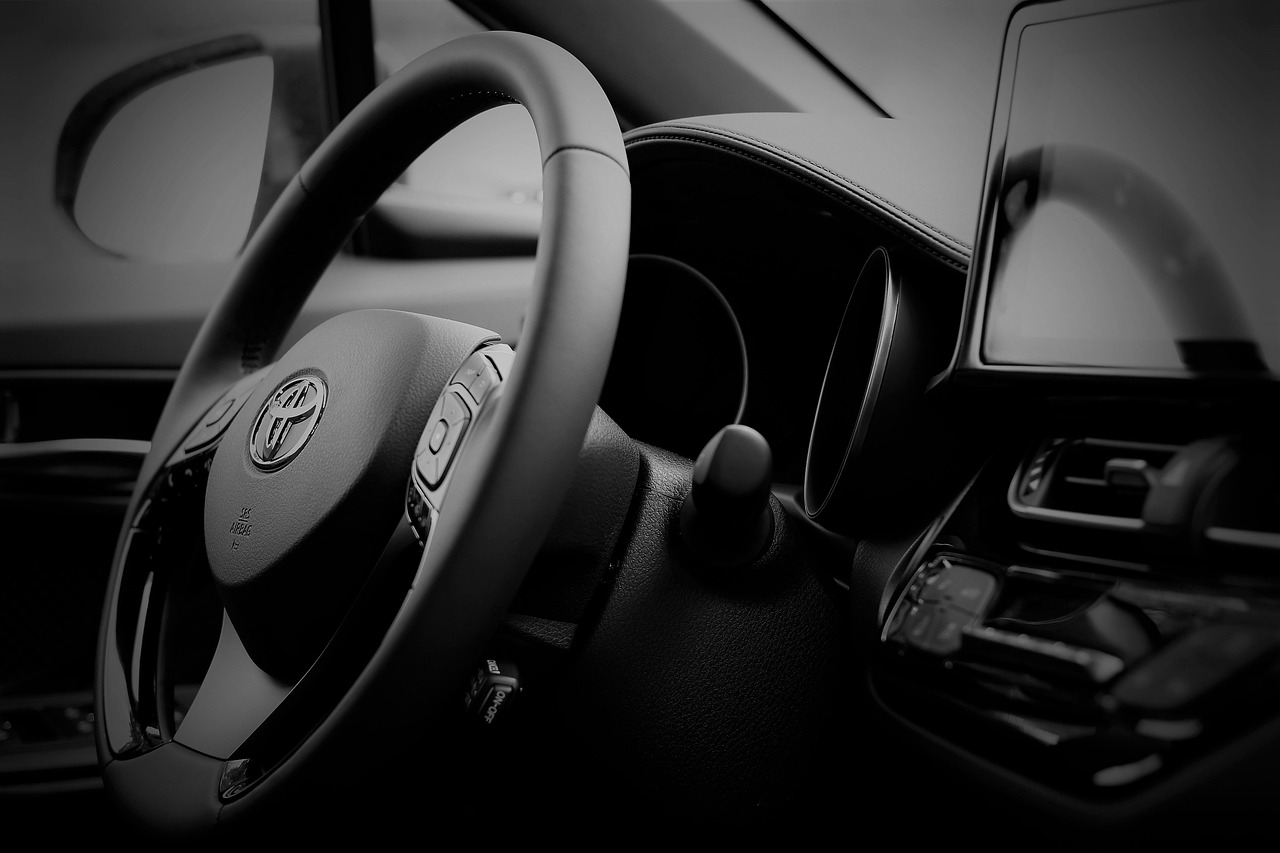
Comfort items can include full automatic air-conditioning, power windows, cruise control, an adjustable steering column, a leather steering wheel, folding rear seats, UV-filter glass and tinted glass.
 Toyota front cabin dashboard and driver controls in a dark interior
Which Toyota C-HR variant should you choose?
In 2026, the C-HR model page referenced the ZYX10 and ZYX11 model codes alongside grades and special editions such as S, G and G MODE NERO. ZYX10 and ZYX11 identify model codes; S and G are grades, while G MODE NERO is a special edition. The right choice depends more on condition and documentation than on the trim badge.
| Grade, special edition or model code |
What it offers |
Best suited to |
Watch-outs |
| ZYX10 hybrid |
Early 1.8-litre hybrid, CVT and 2WD |
Value-focused urban buyers |
Confirm manufacture date and age eligibility |
| ZYX11 model code |
Facelifted 1.8-litre hybrid from October 2019 onward |
Buyers wanting a newer example |
Confirm manufacture month and equipment |
| S grade |
Core hybrid package with practical equipment |
Buyers prioritising value |
May have fewer comfort or appearance upgrades |
| G grade |
Higher trim with additional equipment |
Buyers wanting a richer specification |
Higher grade does not prove better condition |
| G MODE NERO |
Appearance-focused special edition |
Buyers who value styling |
Compare condition, not only body-kit details |
The S grade can make a lot of sense when the auction history is clear and the vehicle is clean. A well-documented S may be a better purchase than a poorly documented G with unclear repairs or mileage.
The ZYX10 and ZYX11 codes identify different production configurations. Use the Toyota C-HR specification details to understand the listed equipment, but confirm the exact vehicle record before paying.
Is the Toyota C-HR practical for Kampala and upcountry driving?
Toyota’s official 2017 C-HR specification document lists a 4,360 mm body length, a 2,640 mm wheelbase and five seats (Toyota C-HR specification PDF, 2017). Those dimensions make the C-HR manageable in town, but they do not make it a large family SUV.
The compact body helps with Kampala parking, narrow streets and daily commuting. Five seats work well for a couple, a small family or a first-time hybrid buyer.
The sloping roofline and rear design can make the cabin feel more enclosed from the back seat. That is a driving impression, not a measured comparison. If you regularly carry five adults, bulky luggage or business loads, sit in the rear and check the boot before choosing the C-HR.
Its 2WD layout suits normal urban and highway use. I would not choose it for regular off-road work. If your route includes rough upcountry roads, inspect the suspension, underbody, tyres and ground clearance carefully, and judge the route rather than treating this as a formal off-road rating.
| Buyer type |
Verdict |
| Kampala commuter |
Strong fit, especially with the 1.8-litre hybrid |
| Couple or small family |
Worth considering if rear space is sufficient |
| First-time hybrid buyer |
Good option when inspection evidence is clear |
| Large family |
Consider a roomier body style |
| Heavy-load user |
The C-HR may feel too limited |
| Frequent rough-road traveller |
Compare a vehicle with more suitable clearance and drivetrain |
What should you check before importing a Toyota C-HR?
As of July 2026, Uganda Revenue Authority guidance states that passenger vehicles 15 years or older cannot be imported for registration (Ask URA Commissioner General 27, 2026). Confirm the manufacture year before payment, because an otherwise attractive vehicle can still fail the age requirement.
Eligibility and paperwork
Start with the chassis number and manufacture year. Then compare the auction inspection document with the vehicle description and the in-house inspection report.
Check these items:
- Auction grade and interior grade
- Odometer reading
- Accident notes and repair symbols
- Chassis number
- Vehicle variant and model code
- Proforma invoice
- Export documents
- Bill of lading
- Inspection records
A Japanese auction sheet is an auction inspection document. It can show condition marks, repairs and mileage information, but it is not automatically conclusive proof of condition or mileage. Understand the symbols and compare it with the other inspection report.
Hybrid and mechanical checks
Ask for available hybrid battery, warning-light and diagnostic information. No document can promise future battery life, so focus on the vehicle’s present condition and evidence.
Inspect the tyres, brakes, suspension and underbody. These parts affect safety and can create immediate costs after the vehicle arrives.
The usual route is Japan to Mombasa or Dar es Salaam, followed by road transport to Uganda. Allow about 6 to 10 weeks from purchase confirmation to delivery. This is an estimated end-to-end timeframe, not a fixed promise.
How can you compare Toyota C-HR options through the Uganda import service?
In 2026, the C-HR listing page showed 23 examples spanning model years 2016 to 2019, with odometers from 42,000 to 128,000 km. A vehicle-level listing makes it easier to compare year, grade, mileage, model code and estimated landed cost.
Through Carbarn Uganda, listed vehicles are supplied with the Japanese auction sheet plus an in-house inspection report before payment. Current Uganda information refers to EAA inspection or certification, not a blanket JEVIC certification claim. Weekly RoRo sailings may use Mombasa or Dar es Salaam, followed by road transport to Uganda. Payment is arranged through the stated Carbarn process, while the self-service dashboard provides invoices, inspection sheets, certificates, bill of lading documents and live vessel tracking. The quoted amount covers the vehicle, shipping and inspection, not Uganda duty, VAT, clearance or registration.
Who should buy a Toyota C-HR in Uganda?
Toyota’s official 2017 C-HR specification document lists five seats and front-wheel drive for the early hybrid C-HR (Toyota C-HR specification PDF, 2017). That combination makes it a strong urban crossover, but not an all-purpose family or off-road vehicle.
The C-HR is probably the best fit for a Kampala driver who values hybrid economy, compact dimensions and modern styling. It is less suitable if you regularly carry heavy loads, need generous rear-seat room or travel rough roads.
Condition, documents and route suitability matter more than choosing the highest grade. A clean S with clear records can be a smarter purchase than a tired G with uncertain history.
Final verdict on the Toyota C-HR in Uganda
Toyota’s official 2017 figure of 30.2 km/L JC08 gives the 1.8-litre hybrid a clear efficiency advantage over the 15.4 km/L JC08 turbo petrol version (Toyota C-HR specification PDF, 2017). For urban buyers, the hybrid is the version that makes the most sense.
The trade-offs are just as clear. The rear cabin and luggage area may feel tight, based on the vehicle’s shape and seating position, while 2WD makes it a weaker fit for demanding routes. Check those points in person where possible and match the car to your usual use.
Budget using the estimated landed cost, not only the vehicle price. Then verify the manufacture year, auction sheet, inspection evidence, hybrid condition and exact variant before committing. You can review Toyota C-HR options for Uganda and read how the Japan-to-Uganda buying process works.


