Many Ugandan buyers want hybrid fuel economy without giving up useful luggage space. A Toyota Aqua is easy around town, but its cabin and boot may feel limited for family work. An SUV gives more clearance, yet often brings a larger purchase and running-cost commitment. The Toyota Corolla Fielder Hybrid sits between those choices. It is a compact wagon for Kampala commuting, family travel and ordinary upcountry routes. The real question is whether its practical shape and Toyota familiarity can also support resale later.
Quick Answer
- The Fielder Hybrid is a five-seat wagon with a 1.5-litre petrol-electric system.
- Toyota lists 27.8 km/L combined under WLTC for the 2024–2025 Hybrid EX. Its city figure is 24.6 km/L, although Ugandan driving conditions will change actual consumption.
- Its wagon body offers useful cargo flexibility, but the direct Aqua comparison depends on the specific load and use.
- Resale appeal is plausible, not proven, and depends on age, condition, documents and hybrid health.
- Check the 15-year rule and full landed cost before importing.
What kind of car is the Toyota Corolla Fielder Hybrid?
The Toyota Corolla Fielder Hybrid is a five-seat Japanese-market wagon with a 1.5-litre hybrid system, front-wheel drive and a practical rear cargo area. Toyota’s 2024–2025 Hybrid EX measures 4,400 mm long, 1,695 mm wide and 1,475 mm high (Toyota Japan, Corolla Fielder specifications, 2024). Older examples differ, so check the year-specific specification.
A specific 2013 Toyota Corolla example
The 2013 Toyota Corolla Fielder Hybrid, NKE165G is a useful example of how one vehicle should be assessed. In 2026, its vehicle page identifies a 2013 manufacture year, hybrid drivetrain, wagon body, front-wheel drive, 111,000 km and a grade 4 auction rating (Carbarn, 2013 Toyota Corolla vehicle page, 2026).
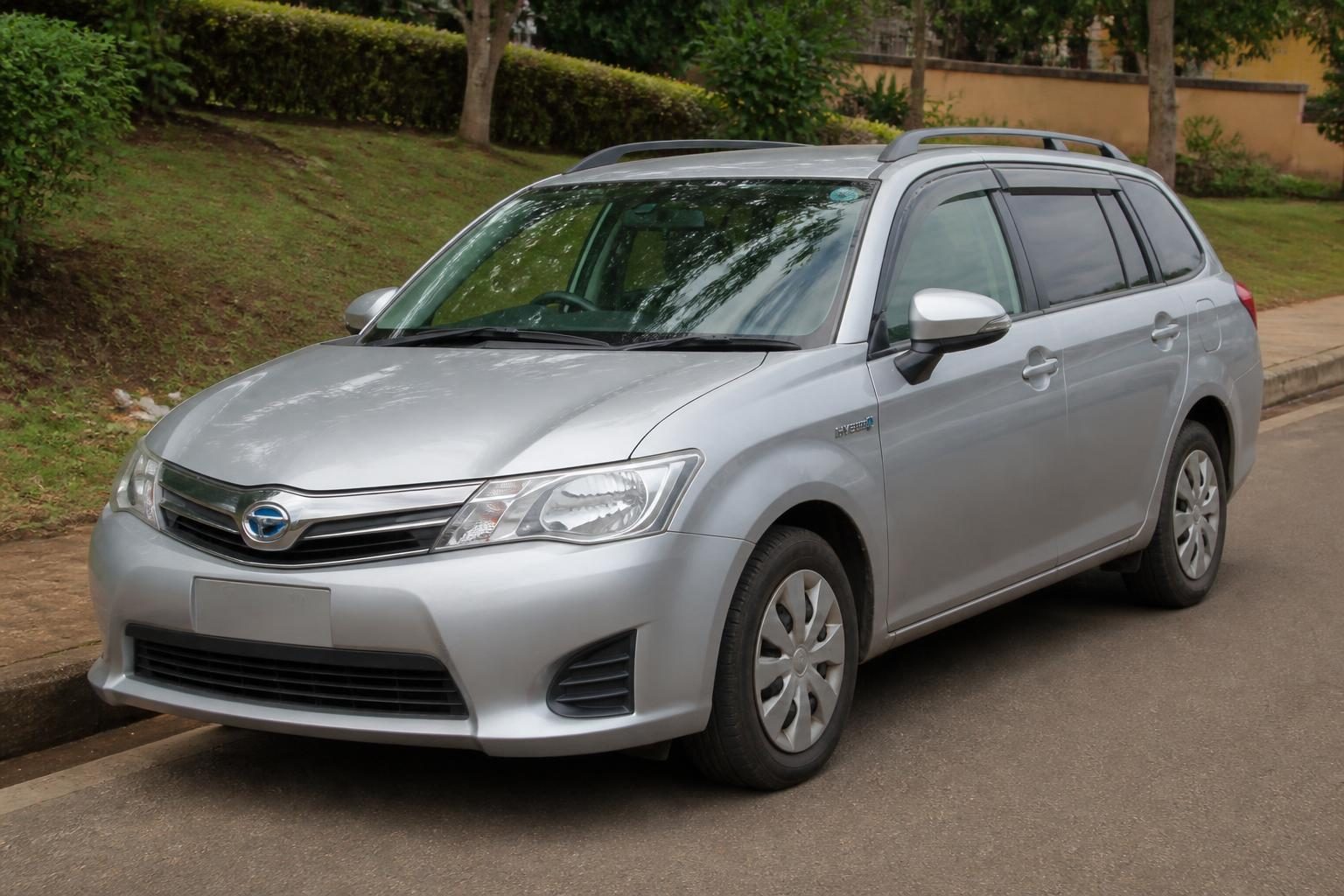 2013 TOYOTA Corolla Fielder
Those details describe that example only. Toyota’s 2013 catalogue lists the NKE165G at 33.0 km/L under the JC08 cycle, with no WLTC figure shown for that model year (Toyota Japan, 2013 Corolla Fielder vehicle information, 2013). They don’t confirm the specification, condition or availability of every Fielder. The model code, auction sheet and individual inspection report should always be checked before comparing one vehicle with another.
An auction grade is the auction house’s broad condition assessment for a specific vehicle. It isn’t a guarantee of mechanical condition or hybrid battery health, so the grade should be read alongside the auction sheet and inspection report.
Toyota Corolla Fielder Hybrid specification
The Fielder’s wagon body gives you a longer roof and a flexible rear area for shopping, school bags, luggage and work equipment. For the 2013 NKE165G, Toyota lists the 1NZ-FXE engine, 1,496 cc displacement, 74 PS, five seats and an electrically controlled continuously variable transmission. Toyota lists those figures under the 2013 model data, not the later 2024–2025 specification (Toyota Japan, 2013 Corolla Fielder vehicle information, 2013).
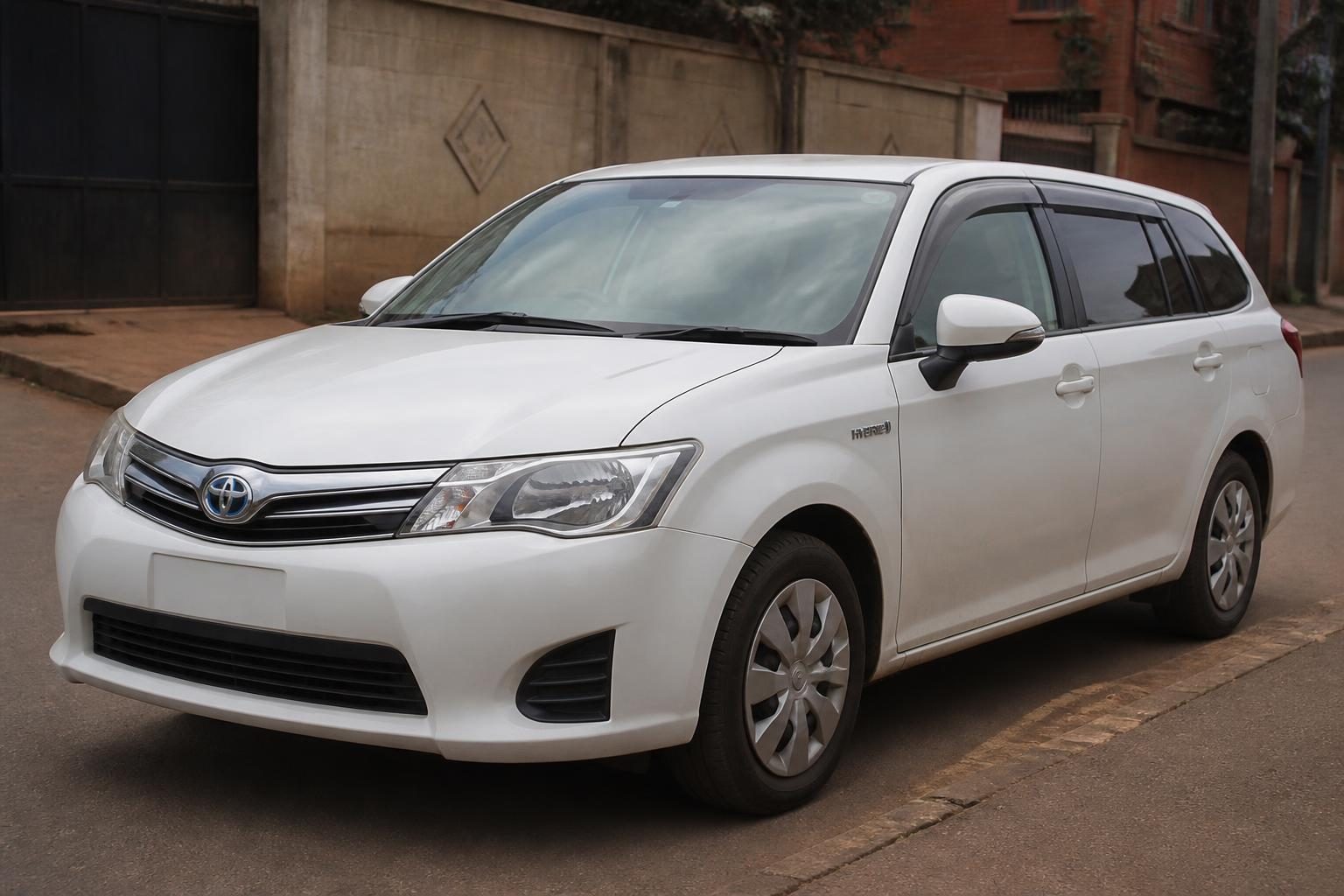 2013 TOYOTA Corolla Fielder
The relatively narrow 1,695 mm width can make urban parking less stressful than a larger SUV. However, the listed 155 mm minimum ground clearance is a reminder that this remains a low wagon. It can handle normal roads, but deep ruts, steep entrances and rough tracks need more care.
For wider model-code information, compare the Toyota specification references before relying on a general Corolla description.
Is the Fielder Hybrid economical enough for Kampala driving?
Toyota lists 27.8 km/L combined under the WLTC test cycle for the 2024–2025 Corolla Fielder Hybrid EX. WLTC is Japan’s newer laboratory fuel-economy test cycle. Its subfigures are 24.6 km/L city, 30.8 km/L suburban and 27.6 km/L highway. These are controlled manufacturer comparison figures, not a promise of Ugandan fuel consumption (Toyota Japan, Corolla Fielder specifications, 2024).
WLTC combines different driving conditions into one test result. It helps compare vehicles, but your fuel use will change with Kampala congestion, air-conditioning, tyre pressure, road quality, luggage, passengers and driving style. A tired hybrid system can also behave differently from a carefully maintained example.
Toyota lists the hybrid’s 27.8 km/L and the comparable petrol CVT’s 19.8 km/L as combined WLTC figures. The hybrid’s WLTC subfigures are 24.6 km/L city, 30.8 km/L suburban and 27.6 km/L highway. The petrol CVT’s subfigures are 15.0 km/L city, 20.9 km/L suburban and 22.1 km/L highway.
| Version |
Test cycle |
Official figure |
| Fielder Hybrid |
Combined WLTC |
27.8 km/L |
| Fielder Hybrid |
WLTC city / suburban / highway |
24.6 / 30.8 / 27.6 km/L |
| Fielder petrol CVT |
Combined WLTC |
19.8 km/L |
| Fielder petrol CVT |
WLTC city / suburban / highway |
15.0 / 20.9 / 22.1 km/L |
Source: Toyota Japan, 2024–2025 Corolla Fielder specifications. Manufacturer test data; actual consumption in Uganda will vary.
Why might a hybrid suit stop-start driving? The electric motor can assist during low-speed movement, while the petrol engine does not need to work in exactly the same way as a conventional car. That advantage is useful, but it isn’t a fixed monthly saving.
Is the Fielder practical for Ugandan families and businesses?
The Fielder is a strong fit for buyers who need five seats and a useful boot, but not seven seats or serious off-road ability. Toyota’s 2024–2025 Hybrid EX specification lists five seats and 155 mm of minimum clearance (Toyota Japan, Corolla Fielder specifications, 2024).
The long roof and rear opening provide a practical loading shape for shopping, luggage, school items or light work equipment. That can be more useful than a small hatchback for some households, although the exact advantage over an Aqua depends on the load. The lower body may help with step-in height, but its low seating position can make sitting down or standing up harder for some older passengers.
The compromise is clear. Five seats limit family growth, and the low body offers less confidence on damaged roads than a crossover. If your regular route includes deep mud, severe ruts or heavy loads, a higher-riding vehicle probably makes more sense.
Good fit if you:
- Mostly drive in Kampala and on ordinary paved roads.
- Want a compact family car with useful cargo space.
- Care about fuel economy.
- Prefer Toyota familiarity when buying and reselling.
Look elsewhere if you:
- Need seven seats.
- Regularly drive difficult rural tracks.
- Want a high seating position.
- Carry heavy loads every day.
Does the Toyota Fielder Hybrid have resale appeal in Uganda?
The Fielder’s resale appeal is plausible because Ugandan buyers recognise Toyota and the model has visible marketplace presence. When checked on 2 September 2026, Cari’s Uganda search page displayed 190 Corolla Fielder results. That number shows listing visibility only, not completed sales, average resale performance or resale value. It may include different years, variants and repeated listings (Cari Uganda, Corolla Fielder search results, 2026).
That visibility matters, but it isn’t proof of an average resale value. A marketplace asking price is not the same as a completed sale. AutoMag Uganda also identifies Toyota familiarity, condition, age, mileage and road suitability as important valuation factors (AutoMag Uganda, Setting the Right Price: Valuing Your Used Car in Uganda’s Market, 2026).
The Fielder’s wagon shape can help it stand out from a small hatchback. Families and small businesses may value its cargo flexibility. On the other hand, a narrower buyer group may prefer an Aqua, Axio, Premio or RAV4.
Resale appeal doesn’t come from the Toyota badge alone. It comes from the combination of Toyota recognition, useful body design, sensible fuel economy, acceptable age, clean documents, condition and buyer confidence in the hybrid system.
A sensibly aged Fielder with a clear auction history may be a better purchase than the cheapest example. What would a future buyer trust more, a low asking price or a well-documented car with no unpleasant surprises?
Checks before importing one
Check the manufacturing year, auction documents, hybrid condition and full landed cost before comparing one Fielder with another. Uganda’s vehicle-import eligibility rules apply a 15-year age limit measured from the year of manufacture. Because notices and enforcement guidance can change, confirm the current position through the Uganda Revenue Authority import and export FAQs, Uganda’s current vehicle import rules and the vehicle’s eligibility documents before ordering.
Landed cost means the estimated cost of getting the vehicle to Uganda before separately confirmed charges such as import taxes, clearance and registration. The import rule is based on the year of manufacture, not the registration year. As of 2026, a 2013 example is within the 15-year window, subject to confirming the official manufacturing documents and current requirements.
Read the auction sheet and inspection report. The auction grade gives a broad condition assessment. It isn’t a complete battery-health report. Check the grade, odometer evidence, repair marks, underbody condition, interior damage, warning lights and signs of flood or accident repairs.
Check the hybrid system. Look for warning lights and diagnostic evidence. Inspect the battery cooling intake near the rear-seat area, and make sure luggage or seat covers won’t block it. No fixed battery lifespan or replacement cost should be assumed without examining the specific vehicle.
Plan the full landed cost. The vehicle price is not the complete cost of putting the car on Ugandan roads. Import taxes, port clearance and registration are separate. Uganda Revenue Authority explains that customs value includes the goods, freight and insurance for sea imports (URA, Import and Export FAQs, 2026).
Before shipment, check the applicable export-country roadworthiness and pre-export inspection requirements with the Uganda National Bureau of Standards. Requirements can depend on the shipment and current guidance. Review the Uganda vehicle import requirements and use the individual vehicle page’s Estimated landed cost panel for a model-specific estimate.
Fielder Hybrid vs Aqua, Axio and Corolla Cross Hybrid
The Fielder sits between a compact city hatchback and a higher-riding crossover. Toyota’s catalogue confirms five seats for the Fielder Hybrid, so the decision mainly depends on cargo needs, road conditions, driving position and budget (Toyota Japan, Corolla Fielder vehicle information, 2024).
| Model |
Main strength |
Main compromise |
Best fit |
| Toyota Corolla Fielder Hybrid |
Wagon practicality and hybrid efficiency |
Low body and five seats |
Families needing cargo space without an SUV |
| Toyota Aqua |
Compact size and city manoeuvrability |
Its smaller body may limit cabin and cargo flexibility for some loads |
Kampala commuters and first-time hybrid buyers |
| Toyota Corolla Axio Hybrid |
Familiar saloon shape |
Less flexible rear cargo area |
Buyers who prefer a traditional saloon |
| Toyota Corolla Cross Hybrid |
Higher seating position and greater clearance |
Larger footprint and budget |
Buyers wanting crossover practicality |
Which buyer should choose the Fielder?
Choose the Fielder when boot space matters more than SUV styling. It makes sense for paved roads, ordinary upcountry travel and buyers who want a compact five-seat Toyota. Choose an Aqua when tight-city manoeuvrability matters most. A Corolla Cross is the better direction when ground clearance and a higher driving position come first.
The verdict
The Toyota Corolla Fielder Hybrid is worth considering, but only as a fit-led purchase. Its strongest case combines a useful wagon body, official hybrid efficiency, Toyota familiarity and transparent vehicle documentation. Its weakest point is the low clearance, especially for buyers travelling rough rural routes.
A sensible inspection conversation should begin with the year, auction sheet and hybrid evidence, not the advertised price. That order often reveals whether a cheap-looking Fielder is genuinely good value or simply old, poorly documented or difficult to assess.
How a managed Japan-to-Uganda purchase works
A managed import should provide the vehicle’s model details, auction sheet, inspection findings, export documentation, shipping route and estimated landed cost through the buying process. The journey is from Japan to Mombasa, or by a route-dependent sailing to Dar es Salaam, then onward by road to Uganda. The journey typically takes about 6 to 10 weeks from purchase to delivery, subject to shipping, customs clearance and handover. You can compare published sailing information on the shipping schedule.
Carbarn’s Japan-to-Uganda import process lists Japan-stock vehicles and handles the export process from Japan. Buyers receive an official Japanese auction sheet and an in-house inspection report before payment. Current Uganda process information identifies EAA roadworthiness certification where required; confirm the applicable provider for the shipment. The vehicle price covers the car, shipping and inspection, while import duty, VAT and registration remain separate costs to confirm. Full payment is made through an official proforma invoice, with no instalments or manufacturer warranty offered. Sales and support run through Japan, with dashboard access for invoices, inspection reports, bills of lading, certificates and vessel tracking. Compare Toyota Corolla stock available for Uganda and review how the buying process works, while confirming any Fielder listing through a fresh vehicle-page check.


