UBOS reports annual inflation for the purchase of vehicles at 4.4% in October 2026, up from 3.6% in September. The figure comes from the Uganda Bureau of Statistics (UBOS) Consumer Price Index publication for October 2026, checked on 23 November 2026. This post explains what it measures and what it leaves out.
Quick Answer
- Annual vehicle purchase inflation in Uganda was 4.4% in October 2026, up from 3.6% in September, according to the UBOS CPI October 2026 publication.
- It's an index of what households pay for vehicles in general, not the price of any one car.
- The rise shows the index moving up. It doesn't say why, and it doesn't forecast next month.
- Treat it as background. Compare real, current listings when you decide.
What does the 4.4% figure say?
The figure says that, on average, urban households in Uganda (UBOS surveys ten urban centres, per its October 2026 CPI publication) paid more for vehicles in October 2026 than in October 2025, and the gap was 4.4%. A month earlier, the same line stood at 3.6%. So the pace of increase picked up between September and October.
The move from 3.6% to 4.4% is a rise of 0.8 percentage points. "Percentage points" is the plain difference between two percentages. It's not the same as saying the index rose 0.8%.
For context, the UBOS release page puts headline annual inflation at 5.8% for the 12 months to October 2026, up from 4.6% in September. That headline figure covers the whole basket of goods and services.
| Measure |
September 2026 |
October 2026 |
What it covers |
| Purchase of vehicles, annual inflation |
3.6% |
4.4% |
One vehicle component of the CPI |
| Headline annual inflation |
4.6% |
5.8% |
The whole basket of goods and services |
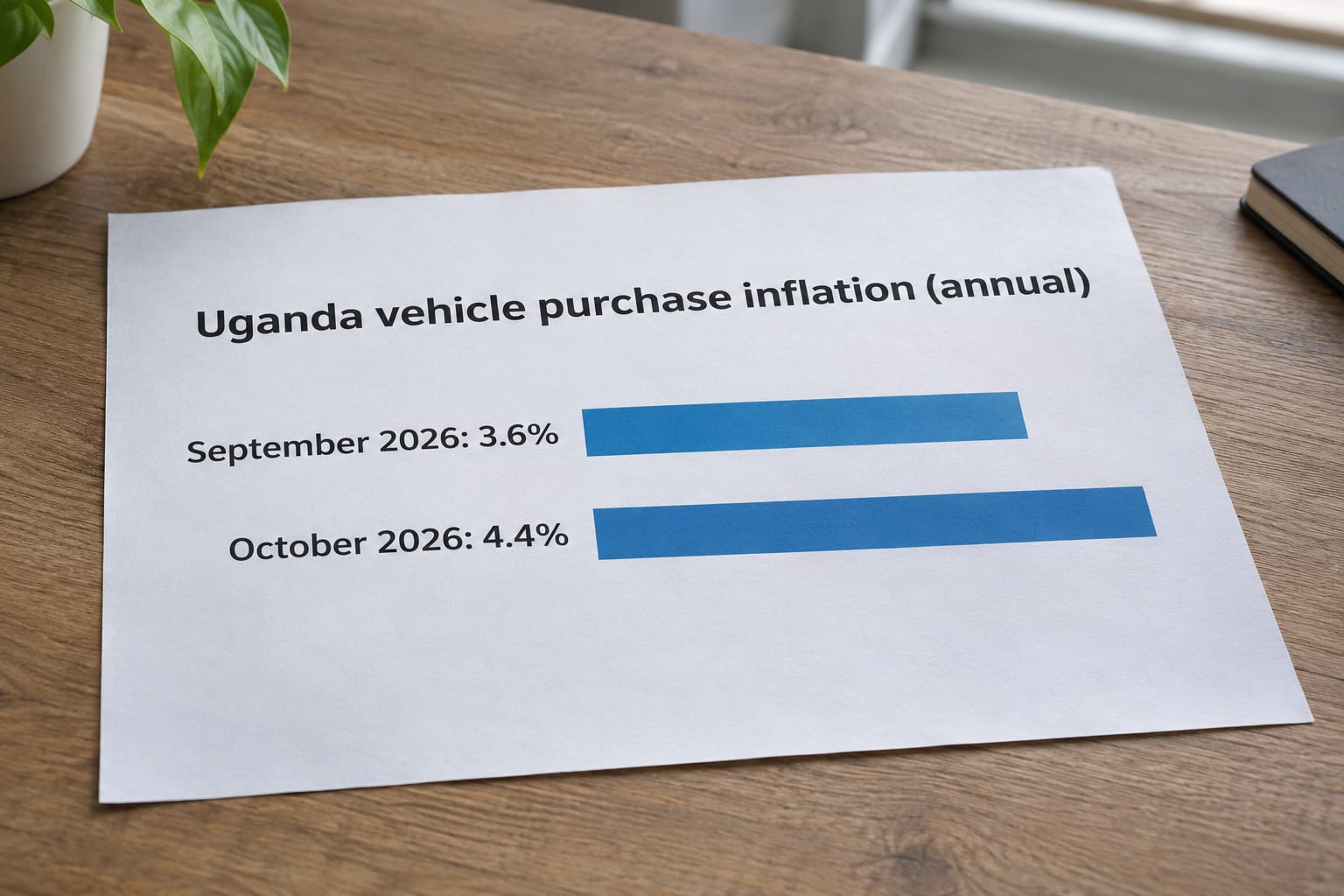 Annual vehicle purchase inflation moved up 0.8 percentage points in a month.
What does "purchase of vehicles" measure?
"Purchase of vehicles" is one component of Uganda's Consumer Price Index. UBOS tracks a basket of goods and services that urban households typically buy, from food to transport. It records what those items cost each month and compares the result with earlier periods. Vehicles sit inside that basket as their own line.
"Annual" means compared with the same month a year earlier. So the October 2026 figure measures October 2026 against October 2025. The September figure measures September 2026 against September 2025.
What doesn't the index tell you?
The index doesn't tell you what any particular car costs. It isn't the price of a Toyota Aqua, a Harrier, or any other model. It isn't a price for a Japanese import, and it isn't a price for a car sold from a local bond. A bond is a yard where imported cars are sold in Uganda, and the how-to-buy guide explains how importing differently works. It's a measure across all vehicle purchases captured by the UBOS survey, blended into one number.
It also doesn't explain itself. The published annual rate shows that the index rose. It doesn't break down what pushed it up.
And it isn't a forecast. The 4.4% describes the 12 months to October 2026. It says nothing about November, next quarter or next year. A rising rate in one month can level off or reverse in the next.
How should you use a figure like this?
Use it as a direction of travel, not a quote. The index tells you that, in general, vehicle purchases cost more in October 2026 than a year earlier, and that the gap widened compared with September. That's useful background when you set a budget. It's not a number you can plug into a purchase decision.
Compare real, current listings instead. A live listing shows what a specific car, in a specific year and condition, is offered for today. That beats any index for deciding what you can afford.
Build some room into your budget. Prices on individual cars move for their own reasons, and an index only shows the broad pattern. Leaving a margin keeps a small change from derailing your plan.
Browsing reconditioned Japanese vehicles with Carbarn
Carbarn Uganda sells reconditioned Japanese vehicles to Ugandan buyers. Each car is owned by Carbarn, shown with its official Japanese auction sheet and an in-house inspection report, and shipped to Mombasa, then by road to Uganda. The quoted price covers the vehicle, shipping and inspection, not import duty, VAT, clearance or registration. The import rules and regulations page explains eligibility, and the how-to-buy guide walks through the process. If you want to see what's on offer, you can browse the full range of cars for Uganda and compare current listings for yourself.