A used electric car can look affordable until its remaining range no longer matches your daily route. That concern is reasonable, especially when the vehicle will travel through Kampala traffic, hot weather and occasional upcountry journeys.
Battery failure and battery ageing are different problems. In 2024, the U.S. Department of Energy reported that replacement batteries caused by failure appeared in 1.5% of about 15,000 plug-in vehicles from model years 2011 to 2023, excluding recalls (U.S. Department of Energy, “FOTW #1339”, 2024). That figure does not mean every older battery remains strong. It means you must inspect capacity loss rather than assume a replacement pack is needed.
This guide explains how to read State of Health, or SOH, battery-capacity bars, usable range, cell balance and charging behaviour. It also shows how model year should influence your decision without becoming the decision itself.
Quick Answer
- Model year is a clue about battery generation, not a battery-health report.
- SOH shows the percentage of original battery capacity that remains.
- A 90% SOH reading means different things in 40 kWh and 62 kWh packs.
- Check SOH, capacity bars, range, cell balance and charging together.
- For Uganda, confirm where you will charge before choosing an EV.
What Does Battery Health Mean on a Used Electric Car?
Nissan’s battery-health certificate explanation defines SOH as the remaining capacity percentage compared with a new battery at 100% (Nissan Japan, “Nissan Battery Health Certificate”, 2026). Nissan says this certificate began as a limited ZE1 Leaf trial with three Chiba dealer groups on 27 February 2026, so a Japan-sourced auction vehicle may not include one. SOH is different from the charge shown on the dashboard: a full-looking battery can still have reduced long-term capacity.
SOH and SOC are not the same thing
State of Charge, or SOC, tells you how full the battery is now. It works like the fuel gauge in a petrol car. A reading of 90% SOC means the battery currently holds a high charge, but it says little about how much energy the pack could hold when new.
State of Health, or SOH, measures the battery’s remaining capacity against its original condition. A vehicle might show 90% SOC while having only 80% of its original capacity. That is why the two readings should never be treated as interchangeable.
The most useful question is not, “How full is the battery?” It is, “How much energy can this battery still store and deliver reliably?”
Usable capacity matters more than the headline number
Published battery-capacity figures may not equal the energy available to the driver, because a vehicle can keep a buffer for battery protection. Nissan’s 2026 explanation says its certificate estimates remaining capacity by multiplying original battery capacity by SOH (Nissan Japan, “Nissan Battery Health Certificate”, 2026).
That calculation is useful for comparison, but it does not create a guaranteed driving range. Traffic, speed, hills, passengers, air conditioning and tyre pressure all change energy use. A range estimate is a prediction based on recent driving conditions.
Illustrative calculation: A 40 kWh pack at 90% SOH equals about 36 kWh of gross retained capacity. A 62 kWh pack at 75% SOH equals about 46.5 kWh. These figures exclude usable buffers and do not promise a particular distance.
| Term |
Meaning |
Why it matters |
| SOC |
Current charge level |
Shows how full the battery is now |
| SOH |
Remaining capacity compared with new |
Helps assess battery ageing |
| Usable capacity |
Energy the car allows you to access |
More useful than gross capacity |
| Estimated range |
Predicted distance under current conditions |
Changes with traffic, speed and terrain |
| Cell balance |
Difference in cell behaviour or voltage |
Helps identify uneven pack performance |
A used EV buyer should therefore read the battery report beside the vehicle’s exact pack size. See Nissan’s battery specifications for the model details to confirm.
The important comparison is capacity multiplied by health. A larger pack with lower SOH can still retain more energy than a smaller pack with a higher SOH. This is why simple “good SOH by year” tables often mislead buyers.
Nissan Leaf Battery Sizes by Model Year
Nissan’s ZE1 battery specification FAQ lists 40 kWh, 60 kWh and 62 kWh entries, all with approximately 350 V total voltage (Nissan Japan, “Leaf ZE1 Lithium-Ion Battery Capacity and Specifications”, 2024). Japanese vehicle descriptions commonly present the Leaf as a 40 kWh or 62 kWh model, so the separate 60 kWh specification entry should not be treated as an uncomplicated model-year vehicle configuration. Confirm the exact battery size from the vehicle specification, because the year alone does not identify every pack.
Nissan also lists pack weights of approximately 303 kg for the 40 kWh pack, 436 kg for the 60 kWh pack and 439 kg for the 62 kWh pack (Nissan Japan, “Leaf ZE1 Lithium-Ion Battery Capacity and Specifications”, 2024). These differences show why larger packs should not be judged against smaller ones using the same range expectation.
Use model-year bands, not fixed battery assumptions
| Production period |
What may vary |
What you must confirm |
| Through September 2017 (ZE0) |
24 kWh or 30 kWh packs, depending on production period |
Manufacture date, exact kWh, SOH and charging condition |
| From October 2017 (ZE1) |
Japanese descriptions commonly identify 40 kWh and 62 kWh versions; Nissan also lists a separate 60 kWh specification entry |
Chassis or model code, exact pack, SOH and charging performance |
| Any production period |
Mileage, storage and repair history can vary widely |
Vehicle-specific inspection and battery evidence |
Nissan’s official specification also lists 24 modules and 192 cells for the 40 kWh configuration. The 60 kWh and 62 kWh configurations use 16 modules and 288 cells (Nissan Japan, “Leaf ZE1 Lithium-Ion Battery Capacity and Specifications”, 2024). These are manufacturer specifications, not evidence that one pack has better current health than another.
Japanese trim names can also confuse buyers. A badge or grade may identify equipment, but it does not prove SOH. Ask for the exact model code, battery capacity and diagnostic report before comparing two vehicles.
Manufacture year matters for another reason. Carbarn’s Uganda vehicle import-rules explainer describes the 15-year age limit from the date of manufacture as a practical eligibility check. It is a commercial explainer, not the primary legal authority. Confirm the current position with the relevant Ugandan government guidance before payment, because a parliamentary proposal to reduce the threshold to 13 years was withdrawn on 21 April 2026. Do not assume that battery health makes an older vehicle eligible.
Nissan’s ZE1 Leaf specifications include 40 kWh, 60 kWh and 62 kWh battery packs. Because pack size varies by configuration, a buyer should confirm the exact model code before interpreting SOH, capacity bars or estimated range.
How Do You Read Nissan Leaf Battery Bars?
In 2026, Nissan’s official battery-health explanation linked SOH with estimated remaining capacity and estimated range, but it did not define dashboard capacity bars as a complete battery certificate (Nissan Japan, “Nissan Battery Health Certificate”, 2026). Leaf capacity bars are therefore a useful first screen, not a final buying decision.
Separate the dashboard readings
A Leaf dashboard can show several different pieces of information:
- Current charge level
- Battery-capacity bars
- Estimated driving range
- Charging indicators
- Warning lights
Current charge bars tell you how much energy is available at that moment. Capacity bars provide a longer-term indication of how much battery capacity the car believes remains. Estimated range is a prediction based on recent consumption.
These readings answer different questions. Confusing them is one of the easiest ways to overestimate a used EV’s condition.
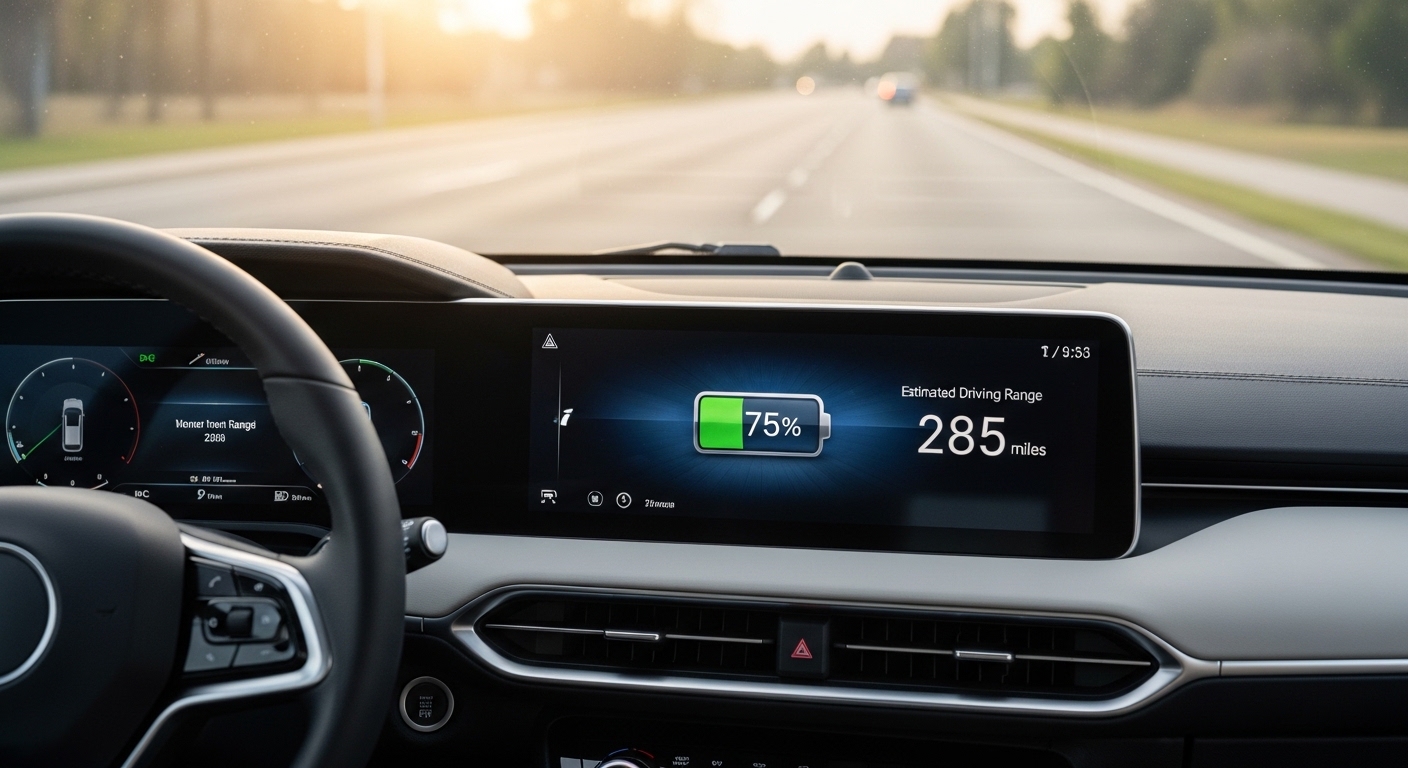 Digital car dashboard displays battery charge and estimated range. The image is illustrative and is not evidence for a particular vehicle, test cycle or battery size.
What capacity bars can and cannot tell you
Capacity bars are not a precise, linear SOH scale. Losing one bar does not necessarily represent the same percentage loss as losing another. The display is a software-calculated indication of capacity, while estimated range can change with recent consumption and driving conditions; keep those readings separate.
A full-looking display does not prove that the cells are balanced. It also does not prove that the vehicle accepts AC or DC charging correctly. Photograph the dashboard with the vehicle switched on, then match that image to the diagnostic report and test date.
Be cautious when a seller provides only a dashboard photograph. Ask whether the vehicle’s battery-management system has been checked and whether the reading belongs to the exact vehicle. A reset or unexplained reading deserves further questions.
Nissan Leaf capacity bars are a screening clue rather than a complete battery certificate. They should be checked beside SOH, usable range, cell behaviour and charging performance. A full display cannot prove that the battery will deliver the range your Kampala commute or upcountry route requires.
Which Battery Tests Should You Request Before Payment?
In 2026, an unreviewed arXiv preprint examined 1,114 EVs across five manufacturers over 375 days and reported real capacity differences of 12% to 25% within each model (Park et al., “Battery Health Reporting Fails Independent Validation Across Manufacturers”, 2026). This is emerging research, not peer-reviewed or a Nissan-specific verdict, but it supports cross-checking a software reading with practical tests.
Request a dated SOH reading
Ask for the following information:
- SOH percentage
- Available capacity or amp-hour figure, if reported
- Battery temperature during the test
- Test date
- Vehicle mileage at the test
- Vehicle identification or chassis reference
- Name of the tool or inspection process used
The report should clearly identify the exact vehicle. An undated screenshot is less useful than a dated report connected to the auction sheet and inspection documents.
Nissan’s battery-health certificate explanation also shows how a manufacturer may connect SOH, estimated remaining capacity and estimated WLTC range (Nissan Japan, “Nissan Battery Health Certificate”, 2026). Treat that estimate as a structured comparison, not as a promise of Ugandan range.
Check cell-voltage balance
An EV battery contains many cells or modules that must work together. Uneven behaviour between cells can reduce confidence in the pack, especially when the battery is under load.
A noticeable voltage difference may justify more testing. Interpret cell-voltage information using the exact model, temperature, state of charge, test method and load conditions rather than applying a universal pass-or-fail number.
The report should state whether the cell information was taken at rest, during charging or under load. Those conditions are not interchangeable.
Carry out a range and charging check
Ask for evidence that:
- The displayed range was recorded at a known charge level.
- The range reading was not recently reset.
- The vehicle had not just travelled downhill or at unusually low speed.
- The car accepts an AC charge.
- DC quick charging works if fitted.
- The charge port is clean and undamaged.
- No high-voltage, isolation or charging warning appears.
- The range does not fall unusually quickly under load.
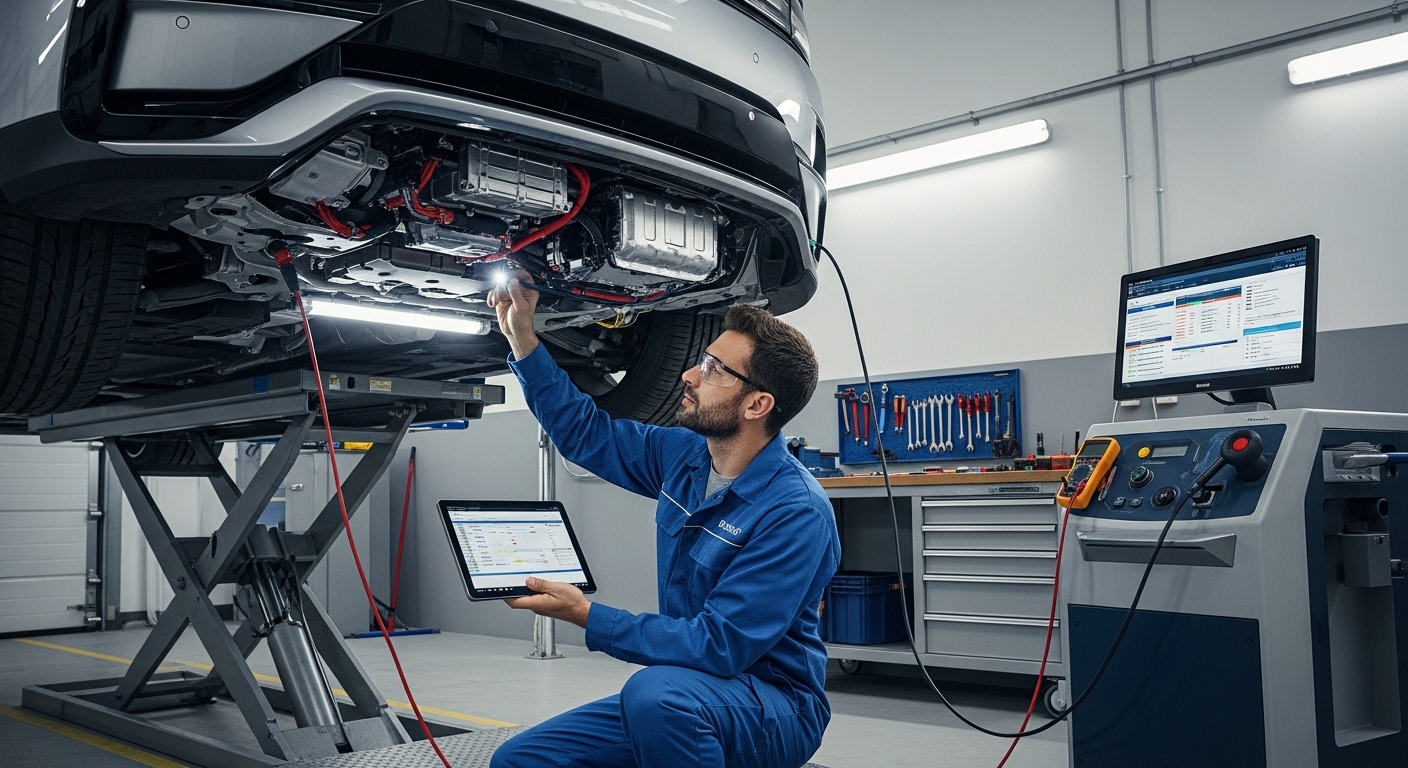 A technician examines an electric vehicle on a lift using diagnostic tools.
Ask about battery history
Ask whether the pack has been replaced or repaired. Request supporting documents for any module replacement, battery repair, recall work or flood-damage inspection.
A seller-supplied report can still be useful. You need to understand what was tested, when it was tested and which vehicle it describes. If those details are missing, treat the report as incomplete evidence.
A used-EV battery check should combine SOH, cell behaviour, range evidence and charging performance. A 2026 preprint found that reported SOH did not consistently track independently measured capacity across manufacturers, so a dashboard or app reading should not stand alone.
How Should Uganda’s Driving Pattern Shape Your Battery Choice?
On 12 March 2025, Uganda Broadcasting Corporation reported the launch of the country’s first public EV charging station at Amber House through a Ministry initiative, with a plan to pilot ten stations in Kampala Metropolitan (Uganda Broadcasting Corporation, “Uganda Launches First Public Electric Vehicle Charging Station”, 2025). Charging access is developing, so treat your home and work charging plan as a key part of the decision.
Kampala and nearby trips
Stop-start Kampala traffic may suit an EV’s quiet, low-speed driving. However, congestion, hills, air conditioning, passengers, detours and tyre pressure all affect practical energy use.
A smaller battery can suit predictable daily driving when overnight charging is reliable. The same vehicle may become stressful if you regularly travel farther than planned or return home without enough charge for the next day.
Build a buffer into your routine. Arriving with an almost empty battery every evening leaves little room for traffic, road diversions or a power interruption.
Upcountry travel
Regular long-distance travel needs more planning than a Kampala commute. Check the charging options along the exact route rather than relying on general claims that a town has an EV charger.
Nissan’s Japanese Leaf product information states that 40 kWh and 62 kWh models can display both WLTC and JC08 figures. It also warns that actual range changes with weather, congestion, driving style, air conditioning and tyre pressure (Nissan Japan, “Leaf Product Information”, 2021). Never compare a WLTC figure with a JC08 figure without labelling the test cycle.
Ask yourself:
- Where will the car charge overnight?
- Can the home or workplace supply support charging?
- How often will you travel beyond Kampala?
- Where can the car charge on that route?
- What arrival charge level gives you confidence?
Uganda’s National E-Mobility Strategy identifies home and institutional Level 2 charging as important for passenger EV use (Uganda National E-Mobility Strategy, 2024). That makes charging location part of the buying decision, not an afterthought.
| Driving pattern |
Battery priority |
Charging priority |
| Kampala commute with home charging |
SOH and usable range |
Reliable overnight charging |
| Kampala plus Entebbe trips |
SOH and range buffer |
Home charging and route planning |
| Frequent upcountry travel |
Larger pack, SOH and charging performance |
Confirm route-level charging |
| No reliable home or workplace charging |
Charging compatibility |
Compare whether a hybrid fits better |
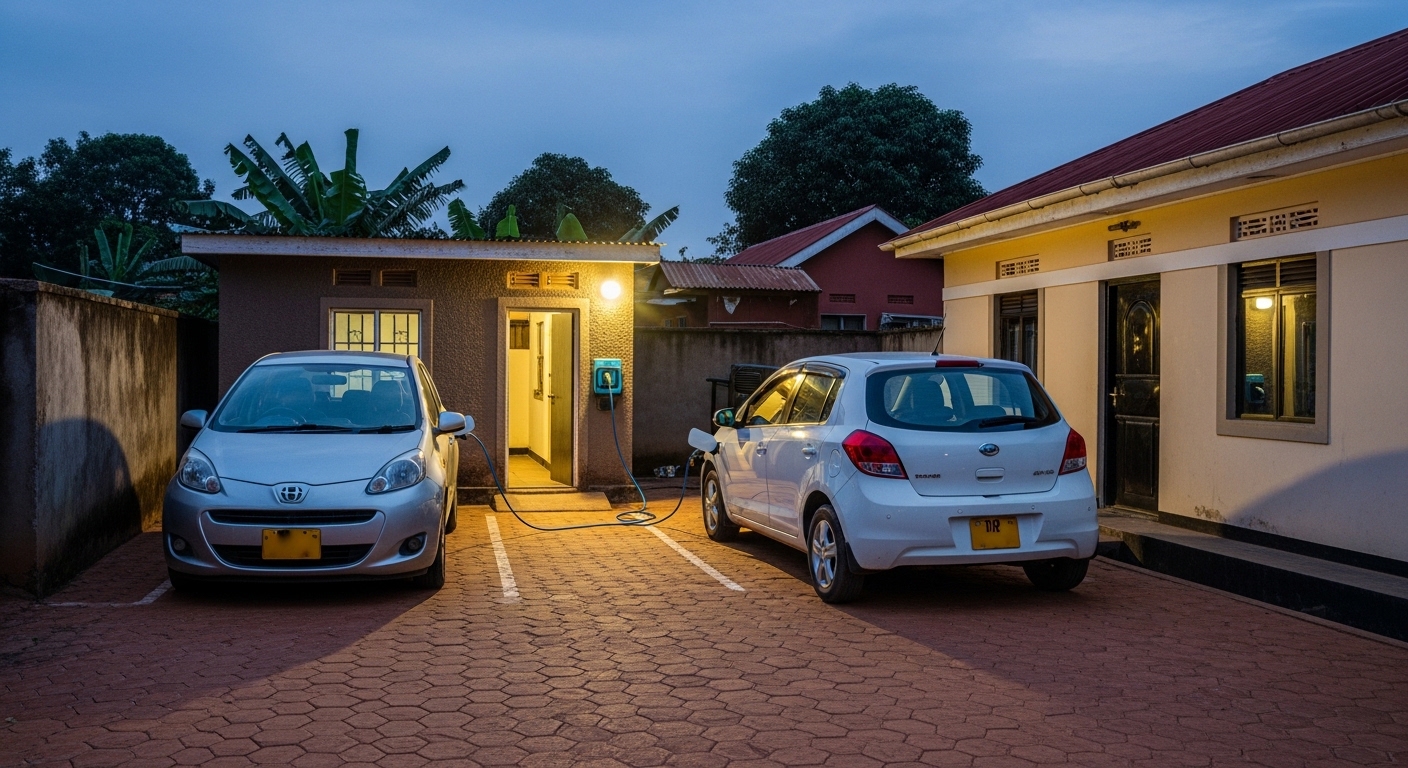 A compact hatchback charges in a modest residential compound at dusk.
Uganda’s EV decision is partly an infrastructure decision. A healthy battery may still be unsuitable without reliable home or workplace charging. The National E-Mobility Strategy identifies home and institutional charging as important parts of passenger-EV adoption.
For a wider comparison, see this guide to hybrid versus electric cars in Uganda.
Is a Newer Nissan Leaf Always a Better Buy?
In 2024, the U.S. Department of Energy reported that battery replacements caused by failure occurred in 1.5% of about 15,000 plug-in vehicles, excluding recalls (U.S. Department of Energy, “FOTW #1339”, 2024). A newer vehicle can reduce age-related concern, but it still needs vehicle-specific battery evidence.
Use SOH bands as screening guidance
The following bands are provisional Carbarn editorial decision heuristics, not Nissan limits or a battery-life guarantee. Use them only as prompts for further checks, because reported SOH may not always track independently measured capacity.
| SOH reading |
Practical interpretation |
| 90% and above |
Strong result, especially for a newer used vehicle; verify range and diagnostics |
| 80% to 89% |
Often workable when pack size, route and charging access fit |
| 70% to 79% |
Needs a clear reason to buy and a predictable short-trip use case |
| Below 70% |
High caution; require documented repair or replacement evidence |
A 90% SOH reading in a smaller pack may provide less practical energy than a 75% reading in a much larger pack. Price, route and charging access must therefore be considered alongside the percentage.
What mileage can and cannot tell you
High mileage does not automatically mean poor battery health, and low mileage does not prove the battery is healthy. Treat storage, charging history, heat exposure and repairs as questions for the inspection, not as conclusions that the odometer can answer.
A vehicle that spent long periods fully charged may deserve more questions than one with higher mileage and a clear inspection history. You cannot determine that difference from the odometer alone.
A replaced battery may also change the buying decision. Ask for the pack number, installation date, repair invoice and supporting diagnostic evidence. Do not accept “new battery” as a description without documentation.
Check import eligibility separately
Battery condition and import eligibility are separate checks. Uganda’s URA import guidance explains that customs valuation and vehicle import processes depend on official rules and documentation (Uganda Revenue Authority, “Import and Export FAQs”, 2026).
Confirm the exact manufacture year before payment. Recheck the current 15-year position before publication and before importing, because policy discussions can change. A healthy battery does not make an ineligible vehicle acceptable.
The right question is not “Which model year is safest?” It is “Which exact vehicle has the strongest evidence for my route?” That shift prevents buyers from paying more for age alone.
When Is a Used EV a Poor Fit in Uganda?
Nissan’s 2021 Leaf product information warned that actual range changes with weather, congestion, driving style, air conditioning and tyre pressure (Nissan Japan, “Leaf Product Information”, 2021). A used EV may therefore be a poor fit when the buyer has no charging plan or very little tolerance for changing conditions.
Warning signs before purchase
Take extra care when:
- You cannot charge reliably at home or work.
- You regularly travel long upcountry routes.
- The SOH report is missing, undated or unrelated to the exact vehicle.
- Warning lights appear during charging or driving.
- The displayed range falls unusually quickly.
- The seller cannot explain battery repairs or replacement history.
- No qualified EV technician can review the vehicle.
- The car is close to Uganda’s import-age limit.
- Your budget does not allow for clearance, registration or electrical work.
A low purchase price does not solve a charging problem. Nor does a high SOH reading help if the vehicle cannot complete your normal route with a reasonable buffer.
Buyer-fit summary
| Buyer situation |
Editorial direction |
| Mostly Kampala driving, home charging and verified SOH |
Strong potential fit |
| Kampala driving but uncertain charging access |
Needs more planning |
| Frequent upcountry travel with limited charging options |
Higher-risk use case |
| Older Leaf with complete battery evidence and short trips |
Possible value case |
| Older Leaf with no SOH report |
Not ready to buy |
| Predictable refuelling matters more than charging planning |
Compare a hybrid |
How Can You Compare Japan-Sourced Nissan Leafs Before Importing?
A 2026 snapshot of the Nissan Leaf category showed Japanese-market Leaf pages spanning 2014 to 2022 model years, but the pages did not consistently display battery capacity, SOH or cell-voltage data (Carbarn Uganda, “Nissan Leaf Price in Uganda”, 2026). That makes individual document review more important than browsing by year alone.
What should you compare on each vehicle page?
Start with the exact vehicle’s:
- Manufacture year
- Model and trim
- Model code
- Auction sheet
- Carbarn inspection report
- Battery-health evidence, if provided
- SOH percentage and test date
- Capacity-bar photograph
- Charging check
- Odometer reading
- Accident or flood history
- Battery repair or replacement history
- Estimated landed cost
An auction grade describes general vehicle condition. It does not replace a high-voltage battery diagnostic. A clean body and strong auction grade cannot prove the battery will deliver the range you need.
You can browse Nissan Leaf options for Uganda, then open an individual vehicle page such as a 2022 Nissan Leaf vehicle page or a 2017 Nissan Leaf vehicle page. Treat each page as a separate vehicle record, not as proof that every Leaf from that year has the same battery condition.
What does the quoted vehicle price cover?
The quoted price on the vehicle pages covers the vehicle, shipping and inspection. It does not cover Uganda import duty, VAT, port clearance or registration.
Use the individual vehicle page’s Estimated landed cost panel for the next step. That estimate is vehicle-specific and should be confirmed through the official proforma invoice. For more detail, read how the Carbarn import process works and Uganda’s vehicle import rules.
Carbarn-listed vehicles are sourced in Japan rather than sitting in a Ugandan showroom. They are shipped to Mombasa or Dar es Salaam, then transported by road to Uganda. Allow about 6 to 10 weeks from purchase to delivery, including shipping, clearance and inland transport. The total time is an estimate and can vary.
The self-service dashboard can provide documents such as the invoice, inspection sheets, bill of lading, certificates and vessel tracking. You can also review Carbarn’s shipping schedule before making a decision.
The useful comparison is battery evidence first, then model year, then total landed cost. A cheaper older Leaf with no SOH report may be a weaker decision than a newer vehicle with clear evidence and a workable charging plan.
A Japan-sourced Nissan Leaf should be judged through its exact model code, inspection documents, battery evidence and estimated landed cost. Model year and a general auction grade cannot establish current battery health.
Final Used EV Buying Checklist
In 2026, emerging research on 1,114 EVs found that reported SOH did not consistently track independently measured capacity across manufacturers (Park et al., “Battery Health Reporting Fails Independent Validation Across Manufacturers”, 2026). Before payment, combine the report with the pack size, charging test, route plan and import documents.
Use this final checklist:
- Confirm the year of manufacture.
- Confirm the exact model, trim and battery capacity.
- Request a dated SOH reading.
- Check available capacity or amp-hour data, if reported.
- Photograph the capacity bars and estimated range.
- Ask how the range reading was obtained.
- Request cell-voltage information where available.
- Confirm AC charging works.
- Confirm DC charging works if fitted.
- Check the charge port for damage.
- Ask about flood damage, repairs and pack replacement.
- Review the auction sheet and inspection report.
- Confirm Uganda import eligibility.
- Review the vehicle page’s Estimated landed cost.
- Confirm where the car will charge after arrival.
- Compare the practical route, not only the dashboard range.
The safest buying decision is not based on a single number. It combines several pieces of evidence that tell the same story.
Read the used EV buying guide for the import and payment process.
Sources and retrieval notes
- U.S. Department of Energy, “FOTW #1339, April 22, 2024: Plug-in Electric Vehicle Battery Replacements Due to Failure Have Been Very Rare Since Model Year 2015,” retrieved 2026-08-14, https://www.energy.gov/cmei/vehicles/articles/fotw-1339-april-22-2024-plug-electric-vehicle-battery-replacements-due
- Nissan Japan, “Nissan Battery Health Certificate,” retrieved 2026-08-14, https://faq2.nissan.co.jp/faq/show/81177
- Nissan Japan, “Leaf ZE1 Lithium-Ion Battery Capacity and Specifications,” retrieved 2026-08-14, https://faq2.nissan.co.jp/faq/show/4673
- Nissan Japan, “Leaf Product Information,” retrieved 2026-08-14, https://www2.nissan.co.jp/SP/LEAF/VLP/
- Park, Jeongju et al., “Battery Health Reporting Fails Independent Validation Across Manufacturers,” arXiv preprint, retrieved 2026-08-14, https://arxiv.org/abs/2603.21592
- Uganda National E-Mobility Strategy, retrieved 2026-08-14, https://sti.go.ug/wp-content/uploads/2024/07/National-E-Mobility-Strategy.pdf
- Uganda Broadcasting Corporation, “Uganda Launches First Public Electric Vehicle Charging Station,” retrieved 2026-08-14, https://ubc.go.ug/2025/03/12/uganda-launches-first-public-electric-vehicle-charging-station-paving-the-way-for-sustainable-transport/
- Uganda Revenue Authority, “Import and Export FAQs,” retrieved 2026-08-14, https://ura.go.ug/en/import-export-faqs/
- Carbarn Uganda, “Nissan Leaf Price in Uganda,” retrieved 2026-08-14, https://www.carbarn.ug/cars/nissan/leaf
- Carbarn Uganda, “Hybrid vs. Electric Cars in Uganda,” retrieved 2026-08-14, https://www.carbarn.ug/blog/hybrid-vs-electric-cars-in-uganda-cost-efficiency-guide-2025


