Uganda added 12,540 newly registered cars to its roads between January and March 2026, according to the Uganda Bureau of Statistics (UBOS). The figure is below the previous quarter but above the same months a year earlier, so it gets read two ways. This article reads it plainly and explains what, if anything, you should do with it.
Quick Answer
- UBOS counted 12,540 newly registered private cars in Uganda in Jan–Mar 2026, per its ICT and Transport Report Q3 2025/26.
- That is down 14.8% from 14,721 cars in Oct–Dec 2025.
- It is up about 18.9% from 10,546 cars in Jan–Mar 2025.
- Cars only. Motorcycles, tricycles and government vehicles are excluded.
- The figure counts registrations, not prices and not which models sold.
What did UBOS count, and what did it leave out?
UBOS counted 12,540 newly registered private cars in Uganda for January to March 2026. "Newly registered" means a car was registered in Uganda for the first time during that quarter. It does not mean the car left the factory this year, and it says nothing about where the car came from.
The figure doesn't tell you how many of the 12,540 were factory-fresh and how many were used imports.
The quarter label can also confuse. UBOS reports on Uganda's financial year, which runs from July to June. "Q3 of 2025/26" is therefore the third quarter of that year, which falls in January to March 2026 on the calendar. It is not July to September.
You can open the full report as a PDF or start from the UBOS release page for that publication.
Motorcycles, tricycles and government vehicles are left out, so the figure is private cars only.
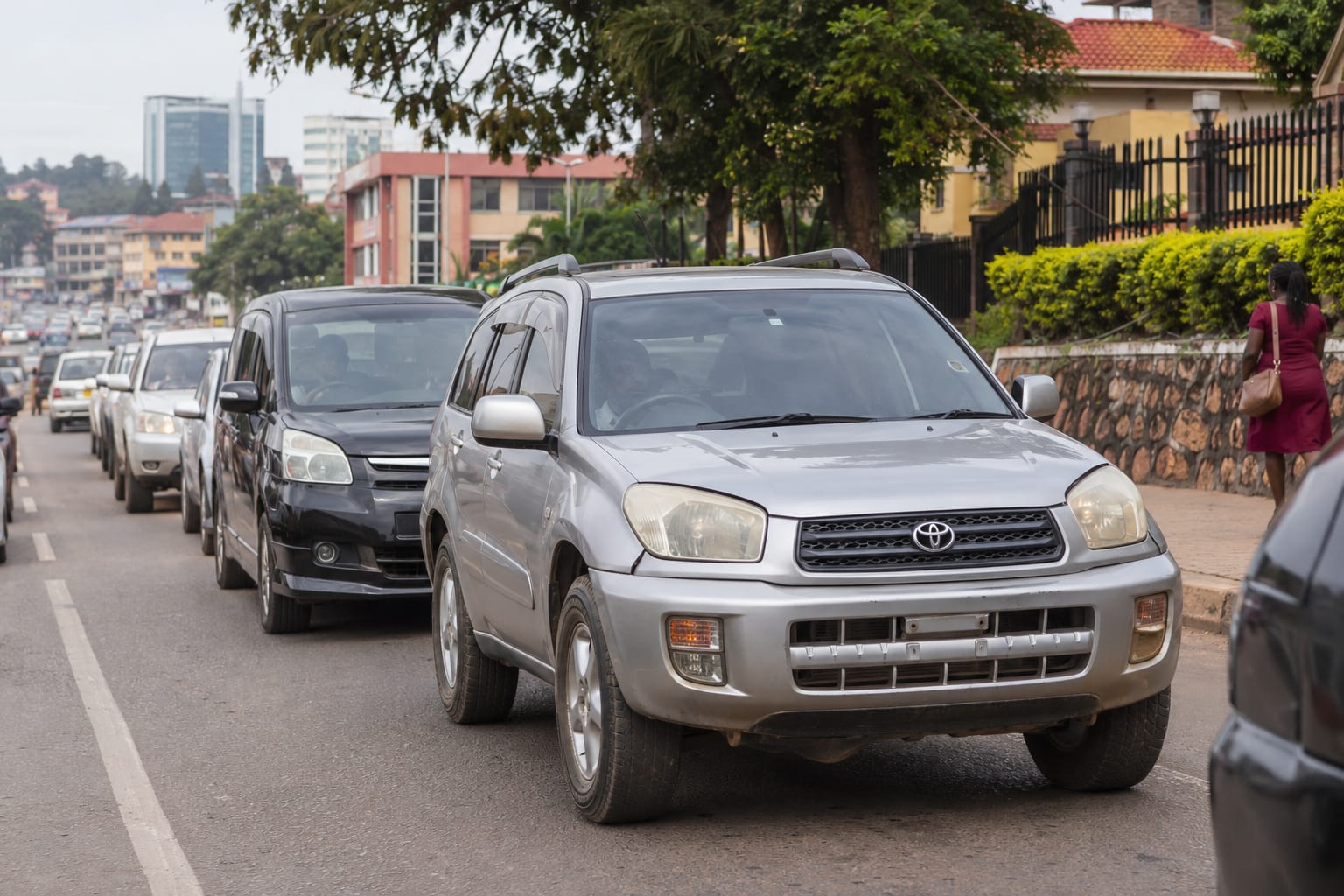 Illustration: A silver Toyota RAV4 at the front of a line of urban traffic.
How do the three quarters compare?
The Jan–Mar 2026 count sits between the two quarters people compare it with. It is lower than the 14,721 cars registered in Oct–Dec 2025, but higher than the 10,546 registered in Jan–Mar 2025. The same single figure therefore looks like a fall or a rise depending on which quarter you set it against.
| Period |
Newly registered private cars |
Change |
| Jan–Mar 2025 (Q3 2024/25) |
10,546 |
Base for the year-on-year comparison |
| Oct–Dec 2025 (Q2 2025/26) |
14,721 |
Base for the quarter-on-quarter comparison |
| Jan–Mar 2026 (Q3 2025/26) |
12,540 |
−14.8% on the previous quarter; about +18.9% on a year earlier |
The quarter-on-quarter change of −14.8% comes from the UBOS report itself. The year-on-year figure is a simple calculation: 12,540 ÷ 10,546 ≈ 1.189, so about 18.9% higher. Treat that one as approximate, because it is derived rather than quoted.
How should you read a dip inside a year-on-year rise?
Read it as exactly what it is: one quarter that came in below the quarter before it, and above the same quarter a year earlier. The UBOS report gives the counts and the percentage change. It does not explain why the number moved, and this article won't guess on its behalf.
Prices, exchange rates and shipping are easy to blame, but none of that appears in the data. The other trap is extrapolation: one quarter is one datapoint. Note the figure, remember that quarterly counts move up and down, and wait for the next release before forming a view.
For the Japan side of the trade, see used cars that left Japan for Uganda between January and September, which uses export records and shouldn't be compared directly.
What does this mean if you're buying a car?
Not much on its own. It is useful background, but it shouldn't change your shortlist or budget.
Registrations aren't a price signal. A busier or quieter quarter says nothing about what a specific car costs this month. Check the car against live listings.
Browse the stock itself. You can browse the full range of Japanese used cars for Uganda, or go straight to a brand you already trust, such as Toyota, Nissan or Honda.
Buying through Carbarn
Carbarn sells Japanese used cars directly to Ugandan buyers. Every car is in Japan. Before you pay, you see two reports on the car: the official Japanese auction sheet and an in-house Carbarn inspection report.
Once bought, the car ships by RoRo vessel to Mombasa and then travels by road to Uganda.
The listed price covers the vehicle, shipping and inspection only. Whatever you pay in Uganda to clear and register the car is separate. You can see the cars available for Uganda or read how importing to Uganda works.
What this does not show
The 12,540 figure counts first-time registrations and nothing more. It doesn't show prices, models, brands or origin, and it leaves out motorcycles, tricycles and government vehicles. UBOS gives no reason for the fall from Oct–Dec 2025, and one quarter can't support an annual projection.
Method and sources
- Headline count, quarterly comparison and the −14.8% change: Uganda Bureau of Statistics, ICT and Transport Report, Q3 2025/26 (PDF), released 4 August 2026 via the UBOS release page. Checked 21 November 2026.
- Year-on-year change (about +18.9%): our own calculation from the UBOS counts, 12,540 ÷ 10,546 ≈ 1.189. Treat it as approximate.
- Japan-side export context: Carbarn's post on used cars that left Japan for Uganda, Jan–Sep, based on Japanese export records. Checked 21 November 2026. It measures a different thing and is not combined with the UBOS count.